
Advantages
- Demonstrated ultra-high current density reaching 1012A/m2 in theoretical calculations
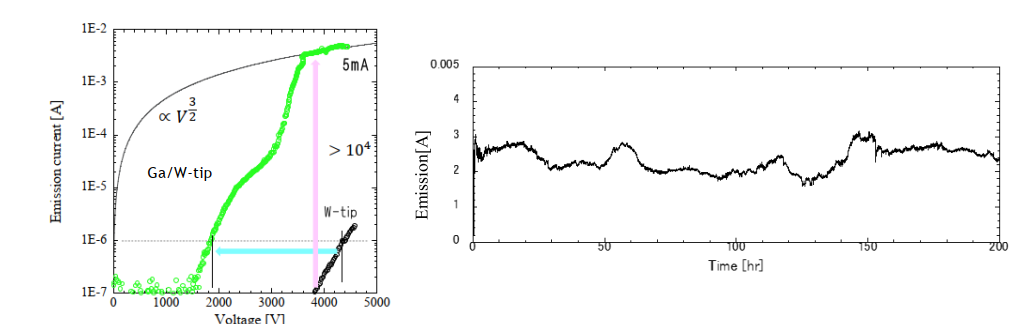
- Stable discharge of large currents ranging from 5mA to a maximum of 20mA while maintaining the electric field radiation area
- Proven continuous operation for long periods (over 200 hours)
Current Stage and Key Data
Radiation current and voltage characteristics and long-term current discharge demonstration using this electrode Ga/W-FE
Left: Compared to conventional electrodes (W-FE), this electrode has been shown to significantly lower the threshold voltage and significantly increase the radiant current. It was also proven that it was possible to reach the space charge limit.
Partnaring Model
At this stage: This technology has already been proven through rigorous numerical calculations and particle-in-cell simulations.
Next stage: Application development phase to translate into specific devices. We are seeking the following development and evaluation partners for this purpose.
1. Power Development for Tabletop Compact Accelerators and Free-Electron Lasers: The injector section in free-electron laser and quantum science research accelerator systems, which previously required large facilities, Prototype development for higher brightness and miniaturization.
2. Joint demonstration of next-generation multibeam and high-resolution X-ray equipment: Joint design and evaluation testing of cathode units optimized to meet requirements for multibeam light sources that improve throughput in semiconductor visual inspection equipment, as well as medical X-ray sources requiring high-brightness and point light sources.
3. Joint development of gallium-free drive systems: Joint development of fully gallium-free next-generation heads, such as the "light irradiation (laser excitation) type" that prevents metal contamination disliked in semiconductor manufacturing lines.
We are seeking companies interested in utilizing this technology and developing equipment, as well as partner companies interested in joint research and development. We would appreciate it if you could start with a detailed explanation of the technology and a discussion.
Background and Technology
In next generation multibeam visual inspection devices, increasing the emission current (brightness) to compensate for brightness loss caused by beam splitting has become an urgent task. However, until now, the physical limitation of electrodes rapidly exceeding their melting point and self-destructing due to Joule heat (resistance heating) associated with high currents has not been resolved.
This technology is based on the discovery of the operating principle of electron sources that overcome this thermal breakdown feedback. They have succeeded in introducing a mechanism that intentionally draws out cooling effects (self-compensation of heat) during high-current discharge. In experiments, it was easily reached up to the Spatial Charge Limitation (SCLC) range, demonstrating continuous operation for over 200 hours while maintaining performance. Additionally, the mechanism for controlling and reproducing the "limit emission state with cooling" has been elucidated, and as a methodology, various drive methods have been provided to support the realization of high-intensity electric field emission. As a result, the current emission limit, which was limited to several tens of μA in conventional electric field-emitting cathodes, becomes possible with milliampere-level current emission by the present invention. By generating high current and increasing brightness, it is possible to maintain brightness and increase the number of divisions (multibeam). Additionally, high-frequency devices such as terahertz oscillation, realized by electric field emission operating under space charge limitation, are also possible.
Principal Investigator
Yoichiro Neo, Professor
Institute of Electronic Engineering, Shizuoka University, National University Corporation
Patents and Publications
Information on related literature is included in the materials. Please click the “Iinterested in this technology? [Download Materials]” button below to download and view the materials.