サイトロゴ

A candidate compound for promoting bone formation

Bone volume was increased through the enhanced bone formation in vivo, and the mechanism of action involving inhibition of a target protein has been identified.

Advantage and Core Benefit

- It promoted bone formation through the induction of osteoblast-specific expression of Runx2 but showed no effect on cartilage.
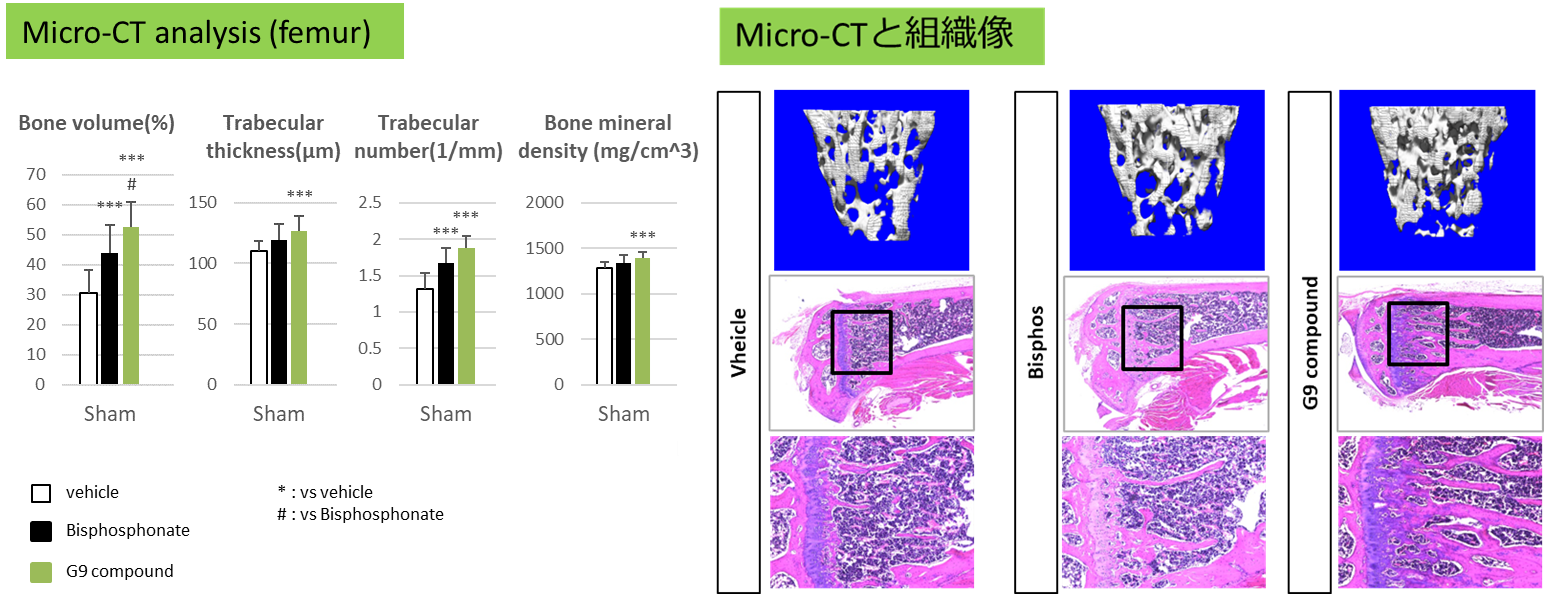
- In vivo experiments showed a significant increase in bone volume and other parameters compared to Bisphosphonate. Bone histomorphometry confirmed the promoted osteogenesis.
- The mechanism of action, inducing bone formation by inhibiting the function of a specific target protein, has been demonstrated.
- Multiple derivative compounds exhibiting equivalent ALP activity (including those with different basic skeletons) have been identified.
- The researcher has extensive knowledge of the mechanisms of bone and cartilage formation and the search for therapeutic agents.

Background and Technology

The number of osteoporosis patients is increasing in an aging society. However, the inhibitors of bone resorption such as bisphosphonates have problems like osteonecrosis of the jaw, poor bone quality, and suppression of bone formation, while the use of injectable parathyroid hormone and anti-sclerostin antibody, which promote bone formation, is limited to 1-2 years due to the risks of osteosarcoma and cardiovascular diseases, respectively. An oral bone-forming agent is highly anticipated.
The researcher has for many years worked on the transcription factor Runx2, which is essential for the differentiation of osteoblasts and chondrocytes, to understand the mechanisms of bone and cartilage formation and to develop therapeutic agents, and has discovered a novel bone-formation-promoting compound “G9” and several derivative compounds. While Runx2 promotes osteogenesis but induces chondrocyte maturation and destroys cartilage, G9 is osteoblast-specific and has no effect on cartilage.
In vivo experiments showed a significant increase in bone volume and other parameters in the femoral trabecular bone of the sham group, compared to Bisphosphonate. In addition, bone histomorphometry in ovariectomized mice confirmed promoted bone formation.
Furthermore, it has been demonstrated that G9 specifically binds to a specific target protein (Protein A) and induces bone formation by inhibiting its function.

Patent

- Status: Patent Pending
- Application Number: PCT/JP2025/022563

Researcher

Toshihisa KOMORI (Nagasaki University Graduate School of Biomedical Sciences, Professor)

Expectations

We are looking for a company to develop a novel osteogenesis-promoting drug based on this candidate compound.
Project No: HK-04315

Project No:hk-04315b