Advantages
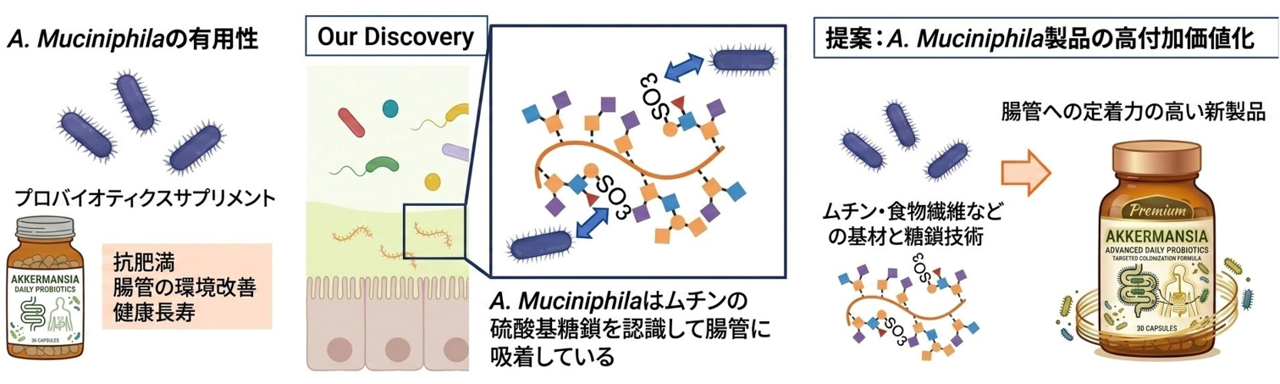
Product Differentiation: Rather than simply ingesting Akkermansia muciniphila, pairing the bacteria with a "scaffold" for gut colonization is expected to yield higher efficacy than conventional products.
Value-add to Existing Products: Short-term product design is possible by adding "colonization support ingredients" to existing Akkermansia products or dietary fiber supplements.
Clear Scientific Evidence: Based on the elucidation of the gut colonization mechanism, convincing marketing is possible.
Current Stage and Key Data
[Current Stage]
Creation of sulfate-deficient (SmD) mice
In vitro and in vivo demonstration of the sulfated glycan-dependent attachment/colonization mechanism of Akkermansia bacteria
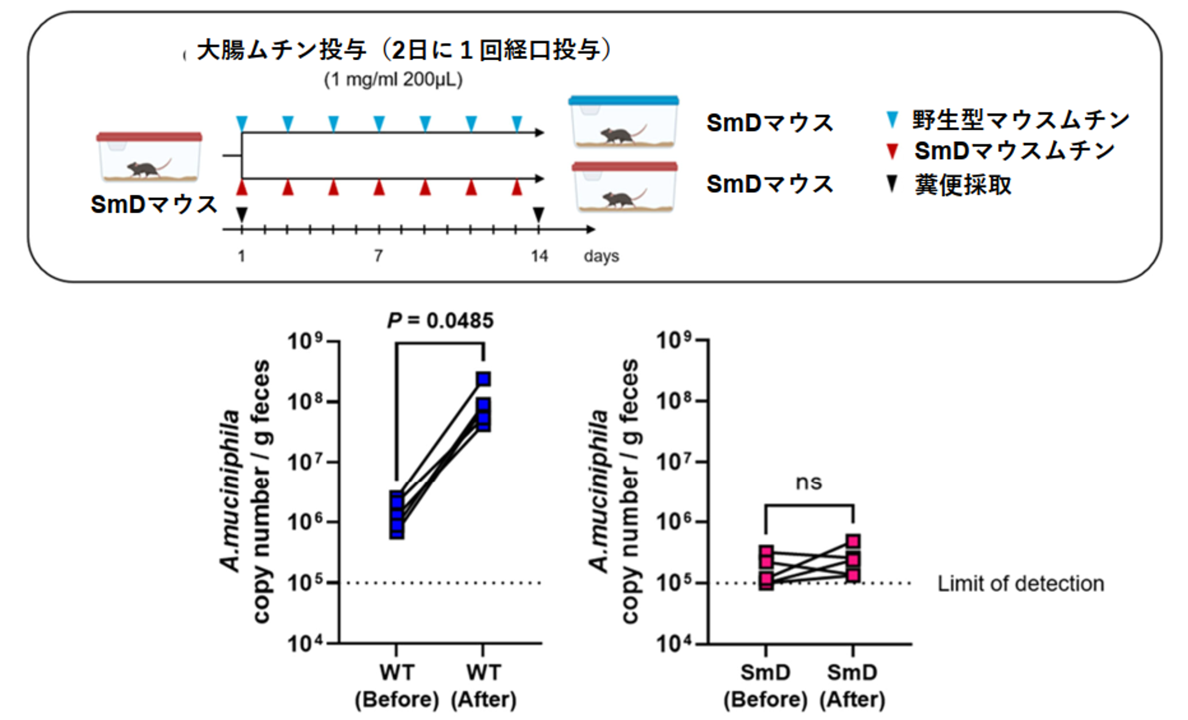
Confirmation of colonization recovery via oral administration of wild-type mouse mucin
[Key Data]
When wild-type mucin was added to cultured Akkermansia bacteria, their attachment was confirmed. However, when sulfate-deficient mucin was added, attachment did not occur, indicating that sulfated glycans are the attachment targets of Akkermansia bacteria.
When SmD mice lacking sulfated mucin and wild-type mice were housed in the same cage, the SmD mice maintained Akkermansia bacteria through the consumption of wild-type mouse feces (coprophagy). However, when they were moved to separate cages, the Akkermansia bacteria decreased. Furthermore, oral administration of wild-type mouse colonic mucin to SmD mice restored the colonization and population of Akkermansia bacteria.
Partnaring Model
Osaka University is looking for corporate partners to jointly develop supplements using this technology. We look forward to collaborating with microbiome and probiotics development companies that have an interest or expertise in glycans, mucins, and dietary fibers.
Osaka University has an evaluation system using disease model mice lacking mucin sulfation, as well as deep expertise in Akkermansia colonization. If you are interested in this technology, please feel free to contact us.
Background and Technology
Background: Akkermansia muciniphila, attracting attention as a next-generation probiotic, is known as a gut bacterium with health benefits such as improving obesity, type 2 diabetes, and intestinal inflammation. However, it has been reported that this bacterium is decreased in the guts of patients with diseases such as inflammatory bowel disease (IBD). A challenge has been that even if the bacteria are orally ingested when the gut environment is degraded, they easily pass through and are excreted without colonizing the gut.
Technology: A research team at Osaka University has revealed the mechanism by which Akkermansia bacteria attach and colonize using specific "sulfated glycans" contained in intestinal mucus (mucin) as a scaffold. They demonstrated that while the bacteria decrease drastically in mice lacking the mucin sulfation enzyme (SmD mice), colonization can be restored by the oral administration of sulfated mucin from wild-type mice.
Principal Investigator
Prof. Kiyoshi Takeda (University of Osaka)
Patents and Publications
Pending(Unpublished)