サイトロゴ

Non-invasive Fully Automated Forrester Classifier

Simultaneously measures extracellular water fraction and left ventricular contraction time using a single device to perform a non-invasive, automated pseudo-Forrester classification of heart failure

Advantages

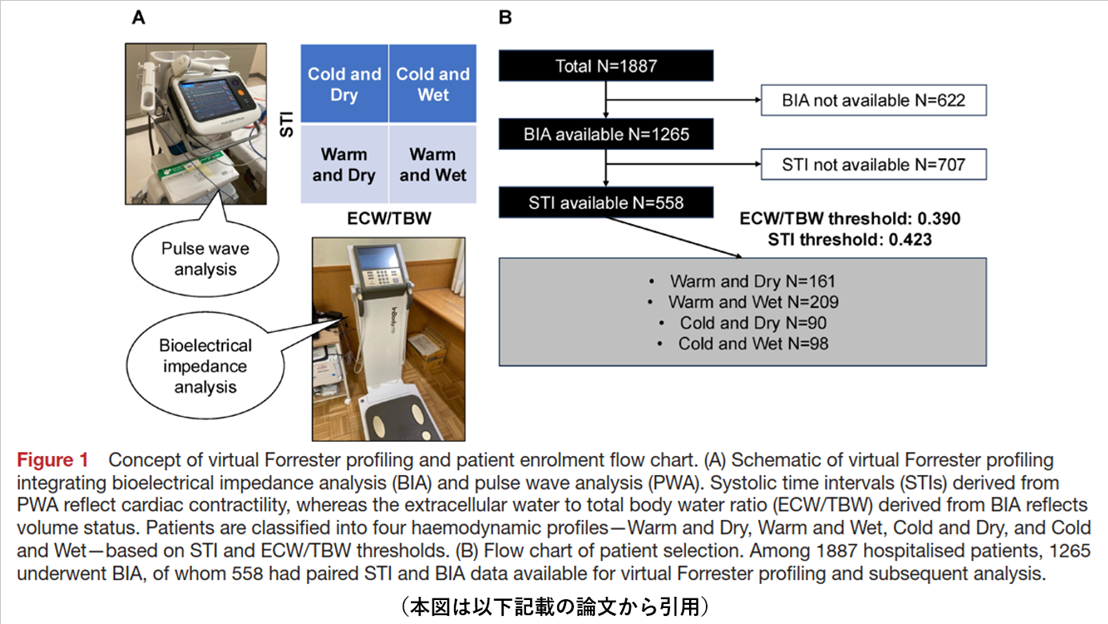
- Immediately presents the complex pathology of heart failure in a four-quadrant format using two indicators (pulmonary congestion and cardiac contractility) derived from bioelectrical impedance analysis (BIA) and blood pressure pulse wave analysis.
- Enables objective and quantitative classification according to the Forrester classification without the need for catheter procedures or echocardiography, which requires considerable expertise.
- Simplifies frequent outpatient monitoring and preoperative risk assessment.

Background and Technology

In evaluating the pathological condition of heart failure and determining treatment strategies, the Forrester classification—which assesses cardiac output (perfusion) and the degree of pulmonary congestion—is widely used as the gold standard. However, this classification requires invasive measurement of hemodynamics through right heart catheterization, making it unsuitable for frequent monitoring of outpatients. As alternative approaches, several methods have been proposed so far, such as echocardiography and the Nohria-Stevenson classification based on physical findings. However, echocardiography heavily relies on the examiner's skill and faces cost and time constraints, while physical findings are subjective and lack objectivity. Therefore, there is a need for a new method that can provide an objective evaluation regardless of the examination procedure or level of proficiency. Additionally, there remains the challenge of ensuring simplicity to accommodate frequent monitoring during outpatient visits.

The technology of the present invention is a device that simultaneously performs bioelectrical impedance analysis (BIA) and blood pressure pulse wave velocity testing using a single unit, automatically executing a pseudo-Forrester classification through a proprietary algorithm. Specifically, it adopts the extracellular water ratio (ECW/TBW) obtained from BIA as the indicator for pulmonary congestion, and the systolic time intervals (STI) obtained from the pulse wave as the indicator for cardiac contractility (low perfusion). By running these two indicators through an integrated analysis program, the device quantitatively classifies the patient's pathological condition into four subsets: Warm (no peripheral circulatory failure), Cold (with low perfusion and peripheral circulatory failure), Dry (no pulmonary congestion), and Wet (with pulmonary congestion). This enables an accurate understanding of hemodynamics without causing invasiveness. It is expected to be utilized for regular outpatient follow-ups of chronic heart failure patients, as well as for cardiovascular risk assessment prior to non-cardiac surgeries.

Data

- When 386 patients with heart disease were classified using this algorithm, the group classified as ‘Cold and Wet’ (low perfusion, with pulmonary congestion) had significantly higher BNP levels, a biomarker of heart failure, than the group classified as ‘Warm and Dry’ (normal) (p < 0.001), and also had a higher incidence of subsequent adverse cardiovascular events.
- For further details of the verification and the associated analysis data, please refer to the paper cited below.

Expectations

Tech Manage, commissioned by Ehime University, is seeking medical device manufacturers to jointly develop this invention's Forrester classifier toward commercialization and practical application. We also welcome companies that are currently planning to obtain medical device manufacturing licenses and permits in the future. Furthermore, it is possible to disclose undisclosed data by signing a non-disclosure agreement with Ehime University, as well as to hold direct meetings with the researchers. Please feel free to contact us.

Principal Investigator

Akinori HIGAKI, MD, PhD, Assistant Professor
Dept. of Cardiology, Pulmonology, Hypertension & Nephrology
Ehime University Graduate School of Medicine (Japan)

Patents and Publications

Patent:
- Filed in JP (not yet published), PCT application pending.

Publication:
- Nishikawa T, Higaki A, Kurokawa K, Abe A, Horie R, Miyabe R, et al. "Complementary cardiac functional assessment using systolic time intervals and bioelectrical impedance analysis." Open Heart (2026) 13:e004041.

Project No:jt-05454