
Advantages
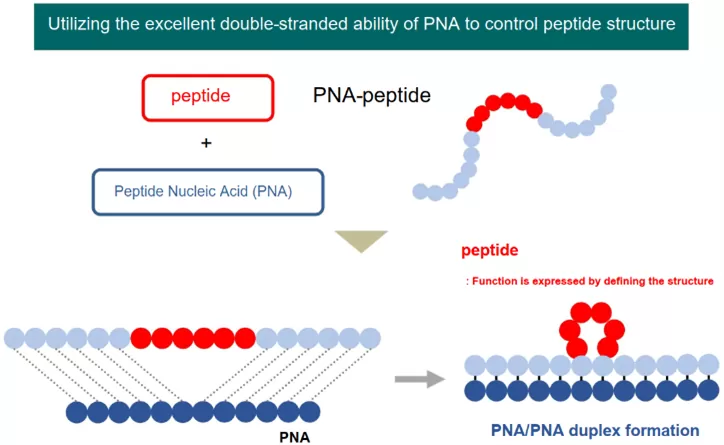
・Sequence-independent cyclization: Applicable to a wide range of peptide sequences.
・Simplicity: Facilitates the rapid generation of cyclic peptide.
・Structural control: Hybridization-induced cyclization allows for tunable ring geometry.
Current Stage and Key Data
Confirmed functional reproduction of known peptides
- Cyclic peptides constructed using this method, based on the known membrane-permeable cyclic peptide sequence, exhibited membrane permeability. Furthermore, membrane permeability was controlled by modulating the peptide structure between its linear and cyclic forms via sequence-specific duplex formation..
Partnering Model
Licensing and tech transfer, or joint research (library construction and screening)
- Potential partners include biotechnology, pharmaceutical , food, cosmetics, and agrichemical companies that develop peptide-based functional molecules, therapeutics, supplements, cosmetics, and pesticides, etc.
Background
Cyclic peptides are peptides in which the peptide chain is closed in a ring shape within the molecule. Cyclization has been reported to enhance stability (protease resistance), improve affinity and/or specificity for target molecules such as proteins, and impart functions such as membrane permeability. As a result, they are actively being explored for applications in pharmaceuticals, supplements, cosmetics, pesticides, etc.
Peptide nucleic acid (PNA) is an artificial nucleic acid that forms exceptionally stable duplexes with complementary DNA. PNA/DNA duplexes are known to be more stable than corresponding DNA/DNA duplexes, and PNA/PNA duplexes are even more stable. In addition, PNA is linked by peptide bonds, making it easy to incorporated into peptide sequence.
Principal Investigator
Yuichiro Aiba, Ph.D. (Graduate School of Science, Nagoya University, Tokai National Higher Education and Research System).
Patents and Publications
Patent: Pending
Presented at academic conferences.