
Advantages
‐ Makes it easy to identify causal muscles, which was previously a major challenge.
- Enables targeted therapy for causal muscles only, ensuring treatment without affecting surrounding muscles.
Current Stage and Key Data
Clinical Research Phase
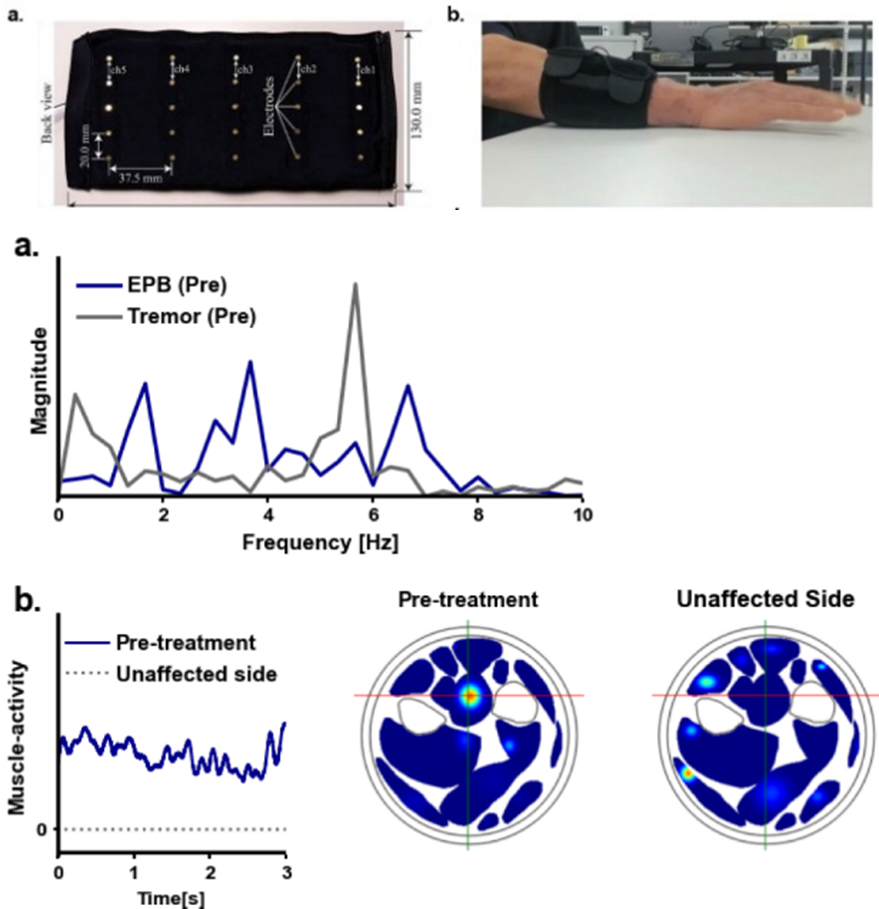
- Using this device to measure forearm muscle activity in patients with upper limb dystonia symptoms (tremors, Pre-treatment), it was confirmed that only a specific muscle, the Extensor Pollicis Brevis (EPB), exhibited hyperexcitability compared to the unaffected side. Therapeutic efficacy was confirmed by pharmacological blocking the action potential of the EPB as the identified causal muscle.
- In a study involving 7 patients with Focal Hand Dystonia (FHD) and 20 healthy subjects, the device successfully pinpointed abnormal muscle activity in each patient. Subsequent targeted blocking of these muscles consistently resulted in confirmed therapeutic effects.
Partnaring Model
- We are actively seeking partner companies for the evaluation, licensing, and product development of this device as a diagnostic tool for upper limb dystonia. We are also open to exploring additional applications and indications.
- Potential partners: EMG device manufacturers, pharmaceutical or medical device companies specializing in dystonia treatment, and general medical equipment manufacturers.
Background
Upper limb dystonia is a neurological disorder characterized by involuntary, sustained muscle contractions, including conditions such as writer’s cramp and musician’s focal dystonia. While Botulinum Toxin (BoNT) and Muscle Afferent Nerve Blocks (MAB) are well-established and effective treatments when administered correctly, their success depends entirely on the accurate selection of the Target Muscle for Injection (TMI). Although BoNT can suppress contractions by relaxing the muscle for several months, identifying the precise TMI remains a significant challenge. Inadvertently targeting non-causal muscles carries the risk of side effects, such as localized motor paralysis. In the case of upper limb dystonia, the forearm is a frequent TMI site; however, it comprises 17 complex, functionally redundant muscles, many of which are situated deep within the limb. Therefore, a definitive method for accurately isolating the causal muscle from these intricate structures is needed.
Principal Investigator
Shingo SHIMODA (Graduate School of Medicine, Nagoya University, Tokai National Higher Education and Research System)
Patents and References
- Reference Paper: Okajima et al., Anat Rec. (2023) 306:741–763.
- Intellectual Property: JP No. 7393003 and Additional PCT Patent Application pending