
Advantages
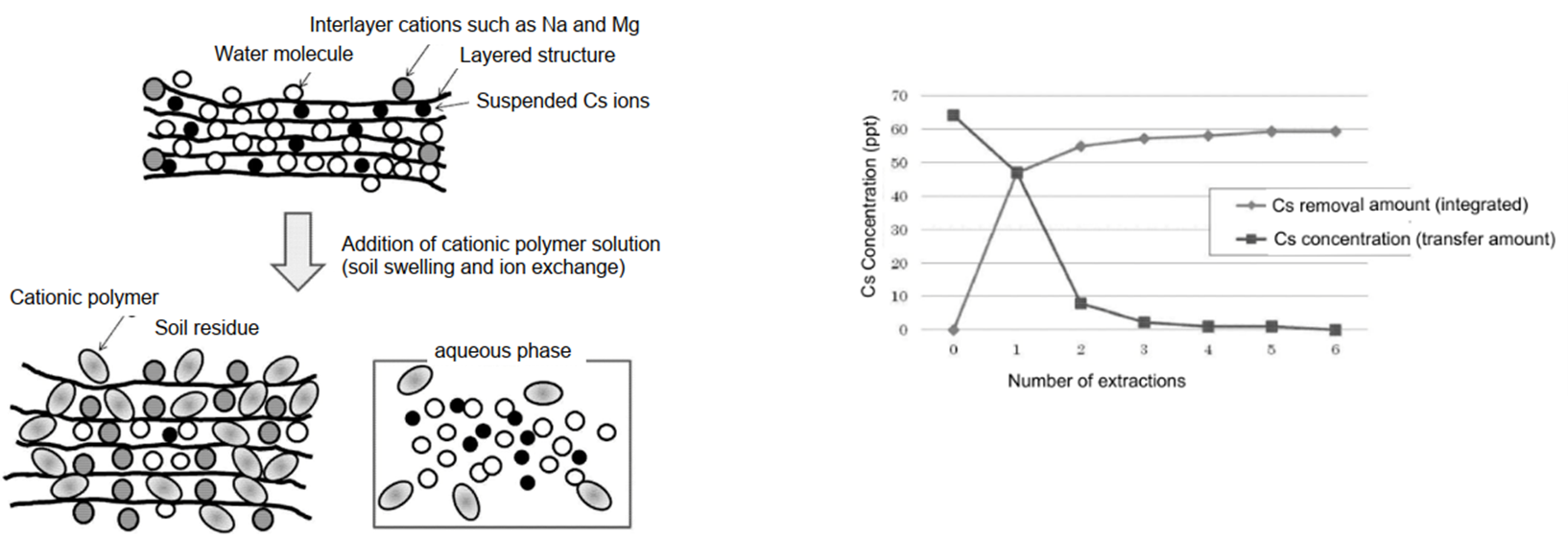
- It is possible to remove suspended cesium from clay particles that have absorbed cesium, which was previously difficult to separate and remove from radioactively contaminated soil.
- This technology makes it easier to reduce the volume of the contaminated soil and reuse it.
Current Stage and Key Data
Cesium was suspended in a montmorillonite sample used to represent soil, creating 2g of suspended cesium. 10ml of 2% polyethyleneimine solution was added, and the mixture was left for 8 hours, after which it was stirred in pure water for 12 hours. This process was repeated six times, until cesium was no longer detectable in the supernatant.
Partnaring Model
We hope to collaborate with companies that are working on developing technology to reduce the volume of removed soil.
- Potential partners: major general contractors, environmental companies, etc.
Background
Following the explosion at Tokyo Electric Power Company's Fukushima Daiichi Nuclear Power Plant, cesium has been detected in soil and other materials over a wide area, mainly in Fukushima Prefecture. Because cesium has the property of remaining in the environment for a long time, waste materials containing cesium cannot be disposed of as is, and radioactive cesium must be separated and recovered. Various methods have been proposed to separate and recover cesium, including water washing, acid treatment under heat, topsoil stripping, high-pressure washing, and high-temperature treatment in the presence of calcium salts.
At the time of the accident, it was thought that cesium was adsorbed to the surface of the soil, etc., but in recent years it has been discovered that cesium is not only adsorbed to the surface of the soil, etc., but also remains in a strongly adsorbed state (suspended state) deep within clay minerals and at adsorption sites containing aluminum, iron, etc. due to weathering caused by rainfall (watering), etc. The fact that suspended cesium remains has raised the issue that it is difficult to remove suspended cesium from deep within clay minerals and at adsorption sites containing aluminum, iron, etc. using conventional technology.
Principal Investigator
Tamihito NISHIDA (Graduate School of Environmental Studies, Nagoya University, Tokai National Higher Education and Research System)
Patents and References
- JP Patent No. 6607485