
Advantages
- Technology 1) High-Precision Even-Function TMR Sensor: Shattering the limitations of conventional TMR technology, this sensor delivers an exceptional magnetoresistance ratio several times higher than the industry standard. Designed for high-precision applications like encoders, it instantly boosts position and rotational sensing resolution by a factor of two or more.
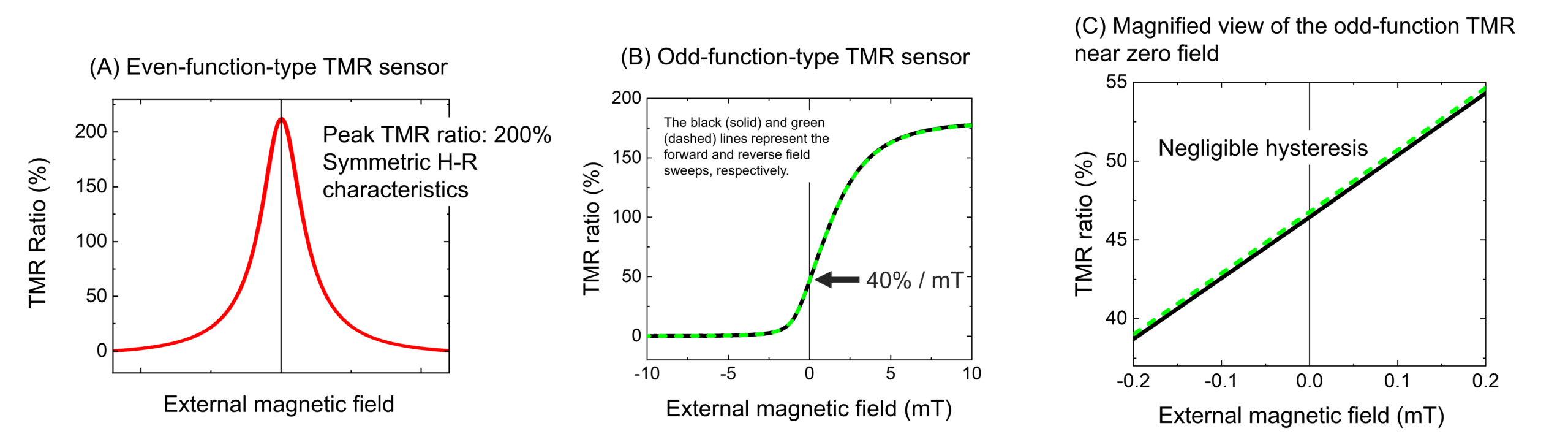
- Technology 2) High-Sensitivity, High-Reliability Odd-Function TMR Sensors: These sensors demonstrate outstanding external magnetic field vs. magnetoresistance characteristics. Key specifications include negligible hysteresis, superior linearity, and a TMR ratio of over 200%. These ideal properties satisfy the most stringent requirements for precision and reliability in advanced applications.
Current Stage and Key Data
- A high-performance Even-function TMR sensor with a dual soft-pin free-layer structure was fabricated. Measurement of its resistance change in response to an external magnetic field revealed a high response with a TMR ratio exceeding 200%, yielding an R-H curve exhibiting extremely high symmetry for both polarities of the external magnetic field (Graph (A)).
- A high-performance odd-function TMR sensor utilizing non-collinear interlayer exchange coupling was fabricated. Measurement of its R-H characteristics in the low magnetic field region yielded a highly linear R-H curve with virtually zero magnetic hysteresis, even when measured over a full loop (Graphs (B,C)).
Partnaring Model
The National Institute for Materials Science (NIMS) strongly desires collaboration with companies interested in commercializing and applying this high-performance even-function TMR and odd-function TMR technology. Through technology licensing agreements, we actively consider opportunities to enhance your product lineup, develop new products, and conduct joint research tailored to specific applications.
We can provide detailed technical information through direct meetings with researchers and disclose unpublished data upon signing a non-disclosure agreement. We also welcome inquiries regarding paid evaluations using samples (with options such as Material Transfer Agreements (MTAs) and preferential negotiation rights).
Background and Technology
Sensors utilizing the magnetoresistance effect are widely employed across diverse industrial fields such as position detection and magnetic field measurement. Among these, tunnel magnetoresistance (TMR) sensors are expected to enable highly sensitive sensing due to their magnetoresistance ratio being several times larger than that of existing GMR sensors. However, conventional TMR sensors faced the following challenges: (1) Even-function TMR sensors often exhibit low symmetry in their R-H curves with respect to the polarity of the external magnetic field, posing problems for high-precision position and rotation detection. Furthermore, (2) odd-function sensors were prone to magnetic hysteresis, which caused measurement errors.
The researchers overcame these challenges and developed high-performance TMR sensors specialized for each characteristic.
1. High-Performance Even-Function TMR Sensor: Adopts a “dual soft pin free layer structure.” This structure places soft pin free layers on both sides of the MgO barrier and sets their magnetization directions oppositely. This significantly suppresses asymmetry in the R-H curve even when the external magnetic field direction shifts. This achieves excellent symmetry while maintaining a high magnetoresistance ratio exceeding 200%, making it suitable for applications requiring high resolution, such as encoders.
2. High-Performance Odd-Function TMR Sensor: By introducing “non-collinear interlayer exchange coupling,” a linear R-H characteristic with almost no hysteresis is realized. This ensures a one-to-one correspondence between magnetic field strength and resistance value, enabling highly accurate and stable magnetic field measurement. Furthermore, the design optimally biases the free-layer magnetization, promising linear response across a wide dynamic range. This technology is suitable for high-sensitivity magnetic sensors in general, as well as applications requiring high-precision detection of continuous position/angle information, such as linear/rotary encoders.
These groundbreaking TMR sensor technologies are expected to open new possibilities for positional precision control in manufacturing, advanced motion control in robotics, next-generation mobility, and magnetic sensing in IoT devices.
Principal Investigator
Tomoya Nakatani, Ph.D. Research Center for Magnetic and Spintronic Materials, National Institute for Materials Science (NIMS)
Patents and Publications
Patents:
- Even-function TMR sensor: WO 2024034206 (Japanese Patent No. 7779587) / WO 2024135038
- Odd-function TMR sensor: Patent application filed (Unpublished)
Publications:
- Even-Function TMR Sensor: Nakatani, T. and Iwasaki, H., J. Appl. Phys. 132, 223904 (2022), DOI: https://doi.org/10.1063/5.0132173
- Odd-Function TMR Sensor: Kulkarni, P. D. and Nakatani, T., Appl. Phys. Lett. 125, 162405 (2024), DOI: https://doi.org/10.1063/5.0231451
Patents and Publications
Patents:
- Even-function TMR sensor: WO 2024034206 (Japanese Patent No. 7779587) / WO 2024135038
- Odd-function TMR sensor: Patent application filed (Unpublished)
Publications:
- Even-Function TMR Sensor: Nakatani, T. and Iwasaki, H., J. Appl. Phys. 132, 223904 (2022), DOI: https://doi.org/10.1063/5.0132173
- Odd-Function TMR Sensor: Kulkarni, P. D. and Nakatani, T., Appl. Phys. Lett. 125, 162405 (2024), DOI: https://doi.org/10.1063/5.0231451