
Advantages
Unlock absolute safety and competitive advantage with non-contact "Current Distribution Imaging."
- Non-destructive Visualization: Enables quality inspection without disassembly or internal probes, preserving battery integrity.
- Drastic Risk Reduction: Detects real-time anomalies during operation to identify accident precursors early.
Current Stage and Key Data
Current Stage:
- Experimental concept verified. Proof of Concept (PoC) completed.
Key Data:
- Demonstration with Polymer Electrolyte Membrane Fuel Cell (PEMFC): Successfully captured changes in current distribution under both normal and dry conditions via non-contact sensing. The results confirmed consistency with actual measured values.
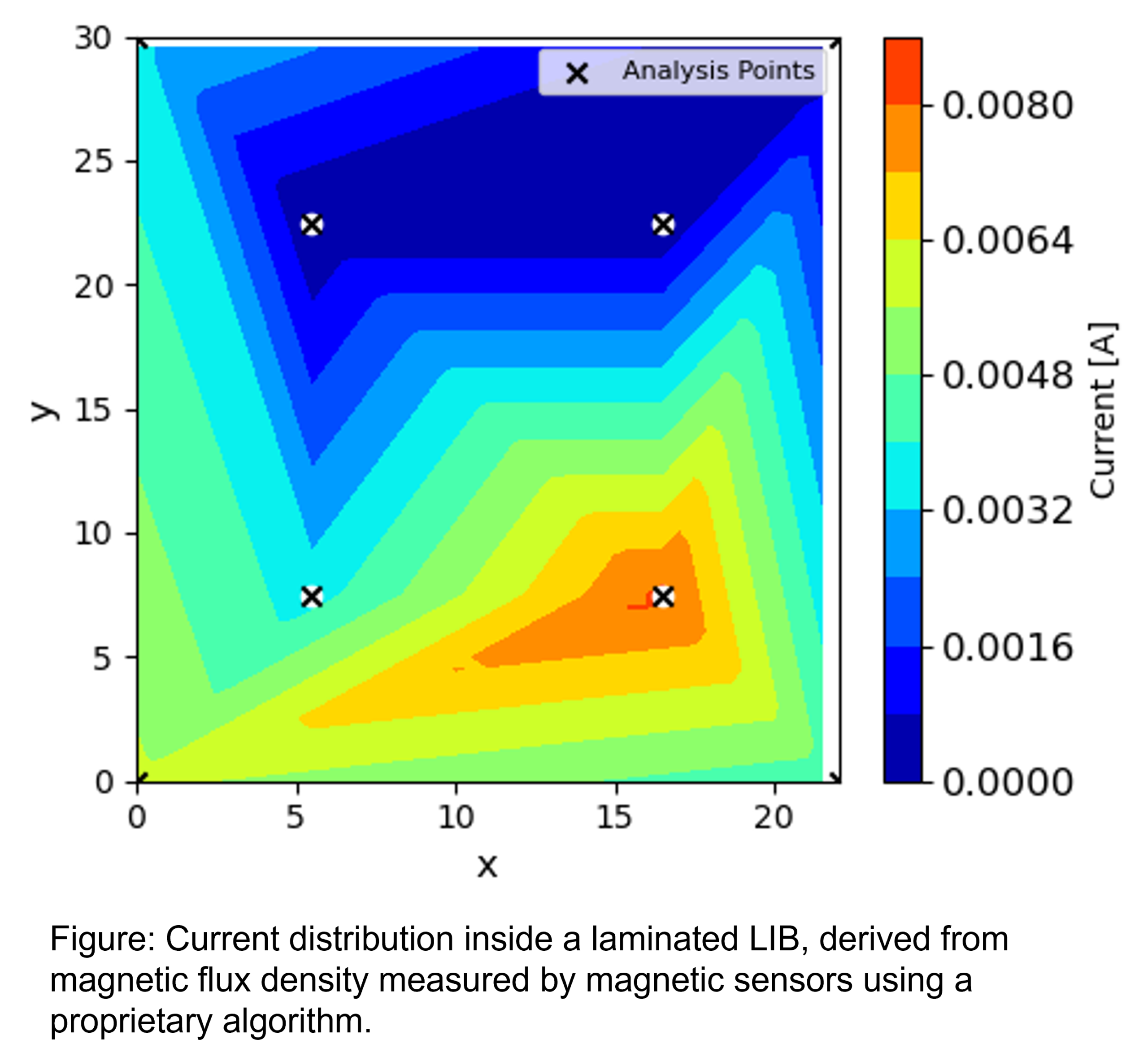
- Discharge Testing of Laminated LIB: Demonstrated the ability to visualize in-plane current distribution unevenness using only four magnetic sensors (see figure).
Partnaring Model
The University of Tsukuba is broadly seeking partners interested in this technology, including battery manufacturers, measurement equipment manufacturers, and corporate battery users.
Please contact us if you are interested in product development utilizing this technology or its implementation in quality control.
Upon signing a Non-Disclosure Agreement (NDA), we can disclose unpublished information, including detailed PoC data, and arrange direct consultations with the researchers. We are also open to discussing technical guidance for implementation and joint research opportunities.
Background and Technology
In the market for high-performance batteries such as fuel cells (FC) and lithium-ion batteries (LIB), the focus of competition has shifted from specifications to "manufacturing quality and absolute safety." No matter how high the performance, if fire risks caused by minute production defects cannot be eliminated, the product will be phased out of the market.
Conventional "destructive testing" and "invasive testing (sensor embedding)" suffer from structural flaws: the inefficiency of 100% inspection and the alteration of the product's natural behavior. Breaking through this barrier is the "Current Distribution Imaging Technology" established by the University of Tsukuba.
**Core Technology**: "Seeing Through" with Magnetic Sensors × Mathematical Models
This technology captures minute magnetic fields generated by internal currents using external sensors. By analyzing them with a proprietary algorithm, it visualizes internal current unevenness in a non-destructive and non-contact manner.
**Merit 1**: Achieving Quality Control Adapted to the New Competitive Landscape
Visualizing the internal state of fuel cells and mainstream batteries—including pouch and prismatic types. Seamlessly integrates into existing output and capacity testing lines. Offers a more accessible alternative to X-ray inspection, preventing defective products from reaching the market.
**Merit 2**: Realizing Predictive Maintenance with Diagnostics Akin to Medical Imaging
Diagnostics are possible not only during manufacturing but also in operating vehicles (EVs/FCVs) and energy storage systems. Just as a doctor identifies a lesion with an MRI, this technology identifies "current unevenness" in real-time to prevent accidents. This "predictive maintenance" capability provides your products with the competitive advantage of overwhelming reliability.
Principal Investigator
Assistant Professor Yutaro Akimoto (Institute of Systems and Information Engineering, University of Tsukuba)
Patents and Publications
Patent Pending (Unpublished)