
Advantages
Rapid, Centrifugation-Free Processing: Proteins are removed quickly through a simple flow-through process, eliminating the need for cumbersome precipitation and centrifugation.
High Recovery of Target Molecules: Selective adsorption captures proteins while ensuring high-efficiency recovery of polar compounds like amino acids.
Reusable and Scalable: The compact filter is reusable and easily integrated into automated systems for trace sample analysis.
Background and Technology
Metabolite analysis in saliva and other body fluids is essential for oral diagnostics and health monitoring. However, high protein concentrations often hinder accurate measurement. Traditional methods are labor-intensive and unsuitable for rapid clinical use.
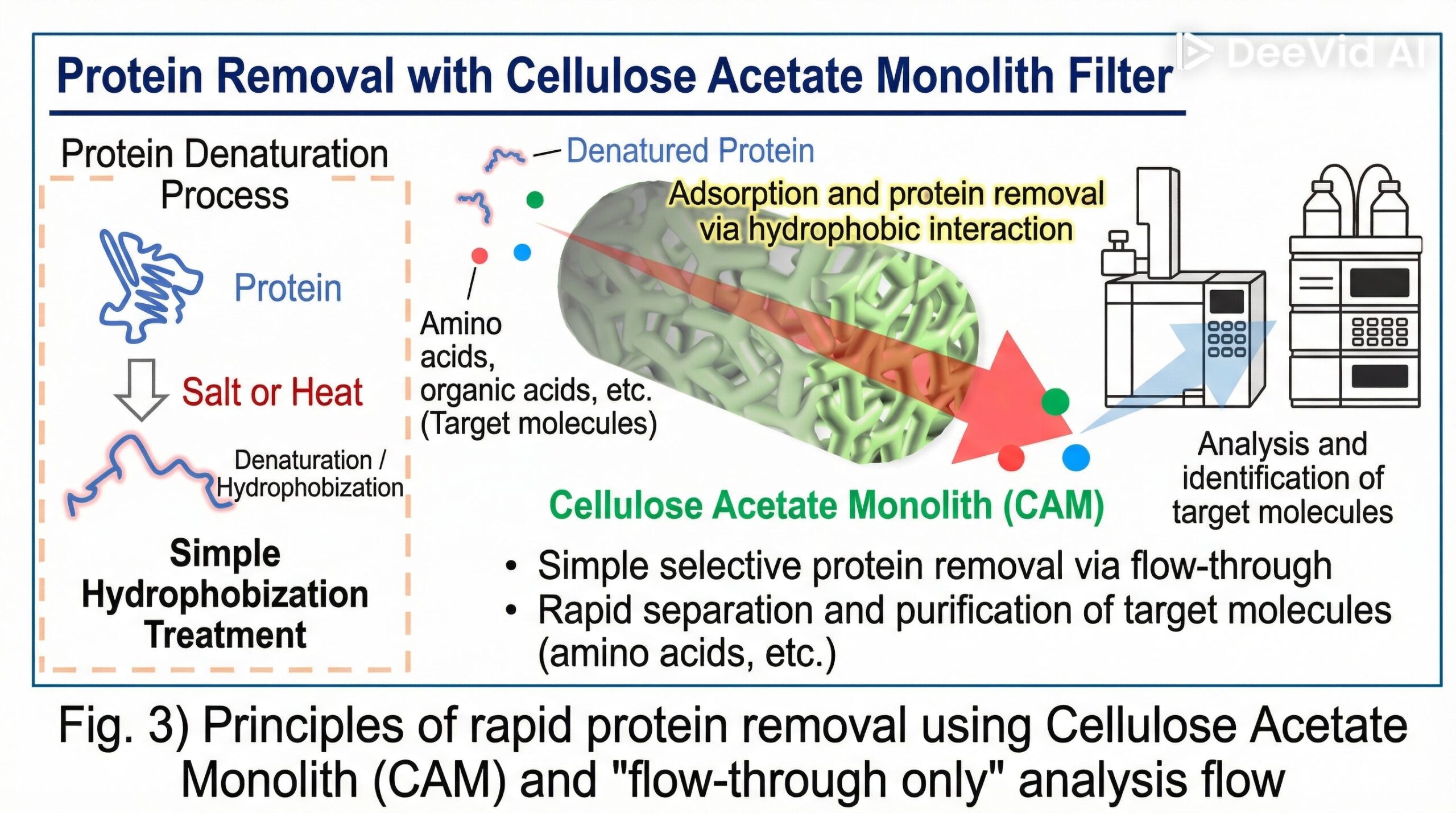
To address this, we developed a proprietary Cellulose Acetate Monolith (CAM) adsorbent. Featuring a 3D continuous pore structure (75–95% porosity), it captures denatured proteins via hydrophobic interactions with unprecedented efficiency.
Data
Principle: Rapid Protein Removal via CAM Flow-Through
Denaturation: Proteins are made hydrophobic using salt or heat.
Selective Adsorption: Denatured proteins are captured by the CAM filter.
Collection: Target molecules (amino acids, organic acids, etc.) pass through for immediate analysis.
Performance and Stability
・High Adsorption Capacity: Confirmed capacity of up to 25.9 mg/g with a single pass. It is particularly effective for trace samples, achieving approximately 78% adsorption at low concentrations.
・Controllable Adsorption: Sodium sulfate (≥1.0 mol/L) promotes protein adsorption, enabling stable removal at near-neutral pH (pH 7–8).
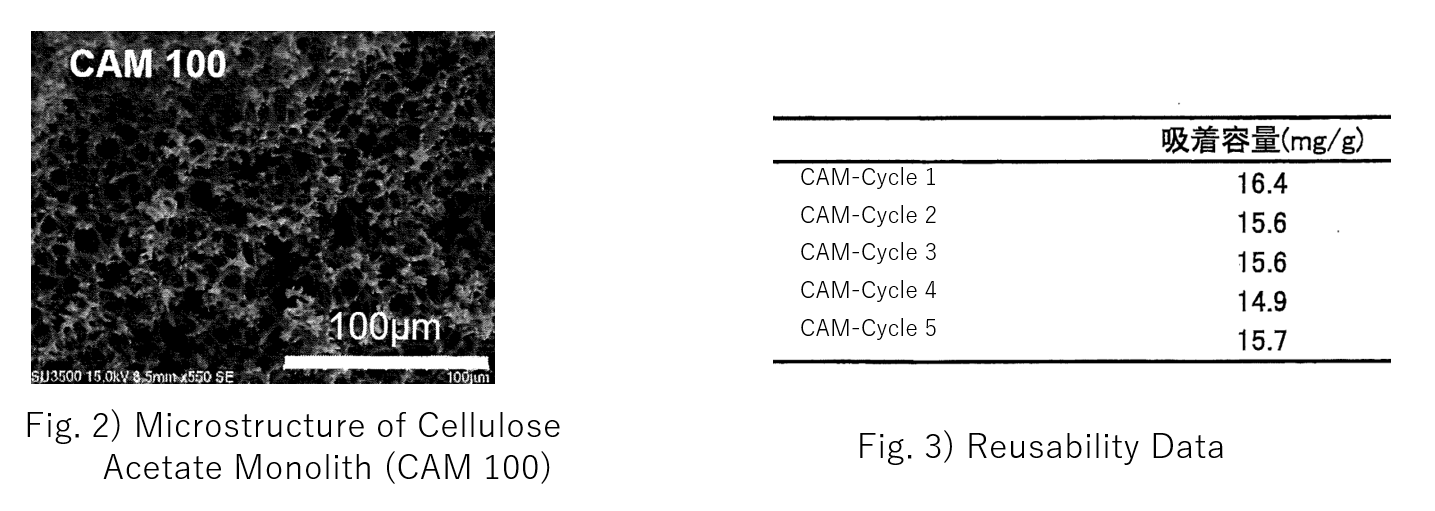
・Proven Reusability: Capacity remains stable over 5 cycles, demonstrating excellent durability through simple washing.
Expectations
We seek partners to commercialize this "flow-through, centrifuge-free" technology in the following areas:
●Diagnostics & IVD: Elimination of centrifugation in saliva-based risk testing and Point-of-Care Testing (POCT) kits.
●Analytical Instruments: Development of "pretreatment guard columns" for GC-MS/LC-MS or high-recovery syringe filters.
●Lab Automation: Integration into 96-well plates or in-line modules to increase throughput and simplify robotic workflows.
The university welcomes technical consultations and joint research toward commercialization, including evaluations using prototype devices and the optimization of monolith pore structures tailored to your specific target analytes.
Principal Investigator
Akihide Sugawara, Assistant Professor (Osaka University)
Patents and Publications
Patent Pending