
Advantages
Non-invasive, Stain-free In-situ Measurement: Enables visualization of time-lapse changes without detaching cells or stopping the culture process.
Eliminate Sampling Errors with Full-Field Scanning: Completely removes subjectivity and "individual bias" from confluency assessments through automated, comprehensive dish scanning.
Low-Cost, Space-Saving Design: Utilizes consumer scanner technology to eliminate the need for expensive, bulky dedicated equipment.
Background and Technology
In cell culture, there has long been a dilemma: obtaining accurate cell counts requires destructive testing (detachment and collection), while maintaining the culture forces researchers to rely on subjective visual estimation (confluency) under a microscope. This lack of quantitative, continuous data has been a persistent challenge for experimental precision and traceability.
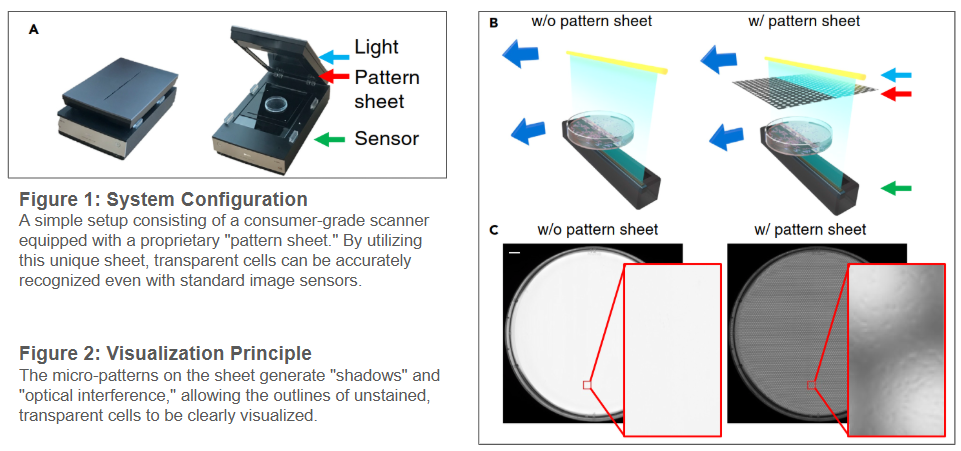
Our technology solves this problem by fusing a general-purpose scanner with an original "pattern sheet". By utilizing micro-shadows and light refraction created by the sheet, the system visualizes transparent cell outlines for AI analysis. This enables simple quantification and recording of cell counts and confluency for the entire dish without expensive specialized hardware, significantly improving culture process precision and ensuring full traceability.
Data
The fundamental technology is established and has completed principle verification and patenting. It is currently in the prototype evaluation stage for commercialization.
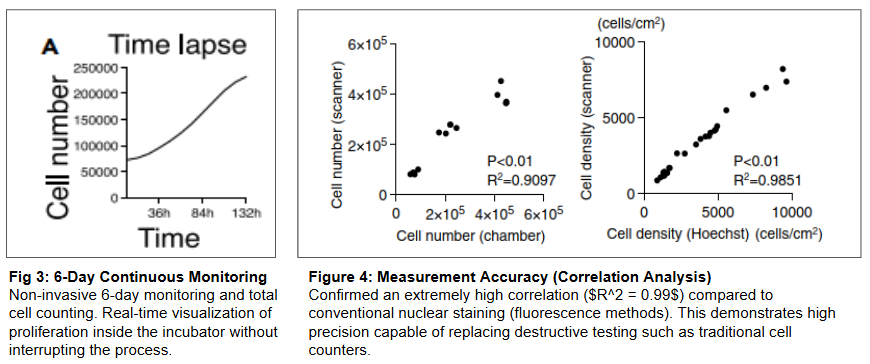
Proven High Accuracy: Demonstrated an extremely strong correlation (R²2 = 0.99) with conventional destructive tests and fluorescent staining methods, achieving an error rate within 5%.
Exceptional Throughput: Scans and quantifies the entire surface of a 10cm dish in under 10 minutes—a task difficult to achieve with manual microscopy.
Practical Application Range: Validated for adherent cells such as MSCs (Mesenchymal Stem Cells), with successful 6-day continuous monitoring inside an incubator.
Expectations
We are seeking device development and manufacturing partners to lead the commercialization of this technology. Our goal is to upgrade the current scanner-based prototype into a dedicated housing that meets the needs of research and production environments, while pursuing product development with a view toward future medical device approval. The core technology is already established and in use within our laboratory; we welcome potential partners to visit our facilities to observe the system's performance and current implementation. We look forward to establishing a concrete product development partnership for rapid social implementation.
Principal Investigator
Mitsuru Mizuno, Assistant Professor (Institute of Science Tokyo, Institute of General Research)