
Advantages
Enhanced signal detection sensitivity:
- Achieves signal intensity tens of times greater than conventional methods (based on comparative experimental results using the same sample)
Simplified measurement system through direct potential profiles:
- Approximate electric field profile can be determined simply by differentiating the measured signal
Background and Technology
In insulation reliability assessment, understanding the accumulation state of space charge within the insulator is essential. The PEA method (*1), widely used as a conventional technique for measuring space charge distribution, requires an amplifier due to the weak elastic waves (pressure waves) emitted from the space charge. Furthermore, it demands advanced signal processing skills from the operator to remove noise superimposed on the weak signal, attenuate high-frequency components, and correct waveform distortion. On the other hand, the SEA method (*2) is known as one approach to solve the waveform distortion problem. The SEA method involves measuring step-like pressure waves using a pressure wave detection system equipped with a differential circuit (high-pass filter) function. Recently, it has been demonstrated that this method allows the space charge distribution in power cable insulation layers to be directly observed on an oscilloscope screen without signal processing. Furthermore, it has recently been demonstrated that applying the SEA method allows direct observation of the electric field profile itself, rather than just the space charge distribution. However, in neither case has detection sensitivity been improved. Consequently, it has remained difficult to measure electric field profiles with high sensitivity within thick insulators exceeding several millimeters in thickness.
(*1) PEA method: Pulsed Electro Acoustic method
(*2) SEA method: Stepped Electro Acoustic method
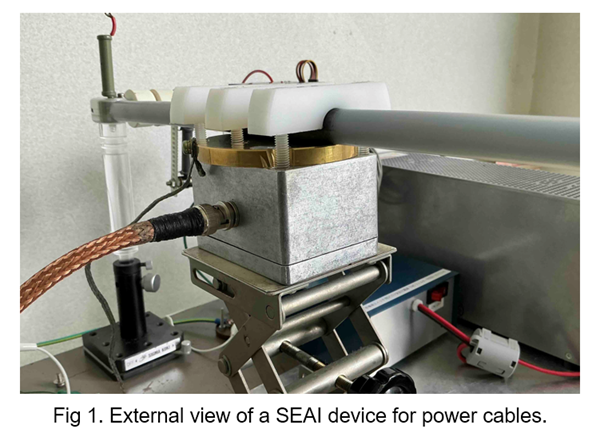
In contrast to these prior methods, the SEAI (Stepped Electro Acoustic Integration) method is based on the principle that step-function pressure waves from electric charges subjected to an excitation voltage penetrate a sufficiently thick piezoelectric element, and the resulting electromotive force is displayed directly without any filtering. The greatest feature of the SEAI method is that it can obtain signals orders of magnitude larger than those obtained by the PEA method. This is because the system, consisting of a piezoelectric element that is sufficiently thicker than the sample thickness and a voltage detection device with high input impedance, acts as a pressure wave integrator. The time-dependent change in the piezoelectric element's electromotive force, which increases linearly with the penetration depth of the step-like pressure wave into the piezoelectric element, corresponds to the potential profile in the insulator. Moreover, the longer the integration time, i.e., the thicker the insulator sample, the larger the output signal becomes. This represents a decisive difference from the PEA method, where sensitivity decreases as the sample thickens. Furthermore, while the PEA method measures the space charge distribution and then integrates it on a PC to obtain the electric field profile, the SEAI method follows the reverse process: it measures the potential profile and then differentiates it on a PC to obtain the electric field distribution. Both methods perform physical calculations based solely on Poisson's equation, so theoretically, the resulting electric field profiles should be identical. However, a clear difference exists between them in terms of measurement sensitivity.
Data
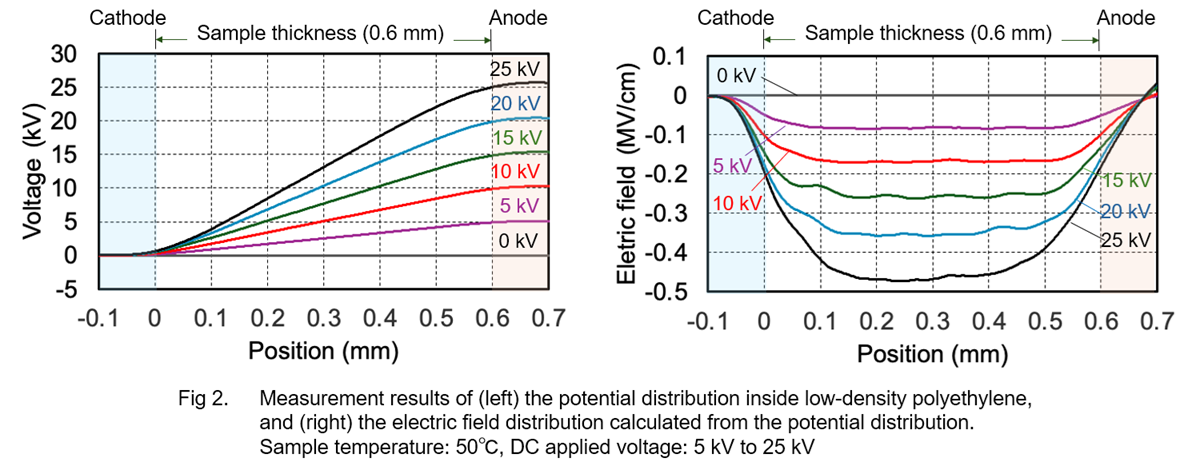
- The potential profile was measured using the SEAI method when a 25 kV DC high voltage was applied to a 0.6 mm thick low-density polyethylene sheet. Using a 2 mm thick lead zirconate titanate (PZT) plate as the piezoelectric element, a step-like pressure wave was generated with a 1 kV excitation voltage and an oscilloscope input impedance of 1 MΩ.
- This successfully displayed a clear potential profile signal with a peak-to-peak voltage of 25 mV or higher without an amplifier. Furthermore, this amplitude was tens of times larger than that measured using a conventional PEA device. It was also confirmed that the electric field profile could be obtained by differentiating the acquired signal.
Expectations
Ehime University welcomes collaboration with companies interested in this invention. Prof. Kadowaki and his team can disclose unpublished data under a confidentiality agreement and arrange direct meetings with them (including online meetings). Please feel free to contact us.
Principal Investigator
Kazunori Kadowaki, PhD (Professor, Ehime University, Japan)
Patents and Publications
Patents:
- A patent applied in Japan and not yet published.
Publications:
- Kadowaki K, et al., IEEE Trans. Dielectr. Electr. Insul. (2024) 31, 2252–2254.
- Kadowaki K, et al., IEEE Trans. Dielectr. Electr. Insul. (2025) 32, 3114–3116.
- Kadowaki K, et al., IEEE Trans. Dielectr. Electr. Insul. (2026) (Early Access)
Patents and Publications
Patents:
- A patent applied in Japan and not yet published.
Publications:
- Kadowaki K, et al., IEEE Trans. Dielectr. Electr. Insul. (2024) 31, 2252–2254.
- Kadowaki K, et al., IEEE Trans. Dielectr. Electr. Insul. (2025) 32, 3114–3116.
- Kadowaki K, et al., IEEE Trans. Dielectr. Electr. Insul. (2026) (Early Access)