
Advantages
Simple and Low-Cost:
- Can be prepared solely through a process of evaporating an aqueous solution of common raw materials
World-Class Optical Performance:
- Achieves a high asymmetry factor (0.023–0.026) derived from lanthanides and a PLQY (photoluminescence quantum yield) of 96%, which is close to the theoretical limit
Easy Quality Control and Sorting:
- Because the crystals are optically isotropic, chirality (dextrorotatory or levorotatory) can be easily determined using a standard polarizing microscope
Background and Technology
In the field of optical devices, there is a strong demand for highly efficient circularly polarized light-emitting materials capable of producing high-intensity, high-quality circularly polarized light. However, with conventional inorganic materials, controlling chirality is extremely difficult, making chiral transfer using expensive organic chiral molecules and complex ligand design indispensable.
The researchers focused on “chiral inorganic crystals” — in which chiral crystals are obtained from achiral building blocks — and have spent many years exploring conditions for spontaneous crystallization. Spontaneous crystallization is a phenomenon in which left- and right-handed crystals form spontaneously; while the probability of this occurring is generally low, at 10% or less, the research team has accumulated knowledge through past successes, such as the controlled crystallization of CsCuCl3, and has now discovered the conditions for the spontaneous crystallization of K3[Eu2(NO3)9], which exhibits ideal optical properties.
This innovative technology enables the spontaneous formation of chiral inorganic crystal structures through an extremely simple process involving only the evaporation of an aqueous solution of the raw materials. Because the crystals belong to the optically isotropic cubic crystal system, their chirality can be easily identified and sorted under a standard polarizing microscope without being affected by birefringence. This is the world’s first reported case of circularly polarized luminescence in a bulk crystal composed entirely of inorganic molecules, achieving a large asymmetry factor (0.023–0.026) derived from lanthanides and a quantum yield (96% PLQY) close to the theoretical limit.
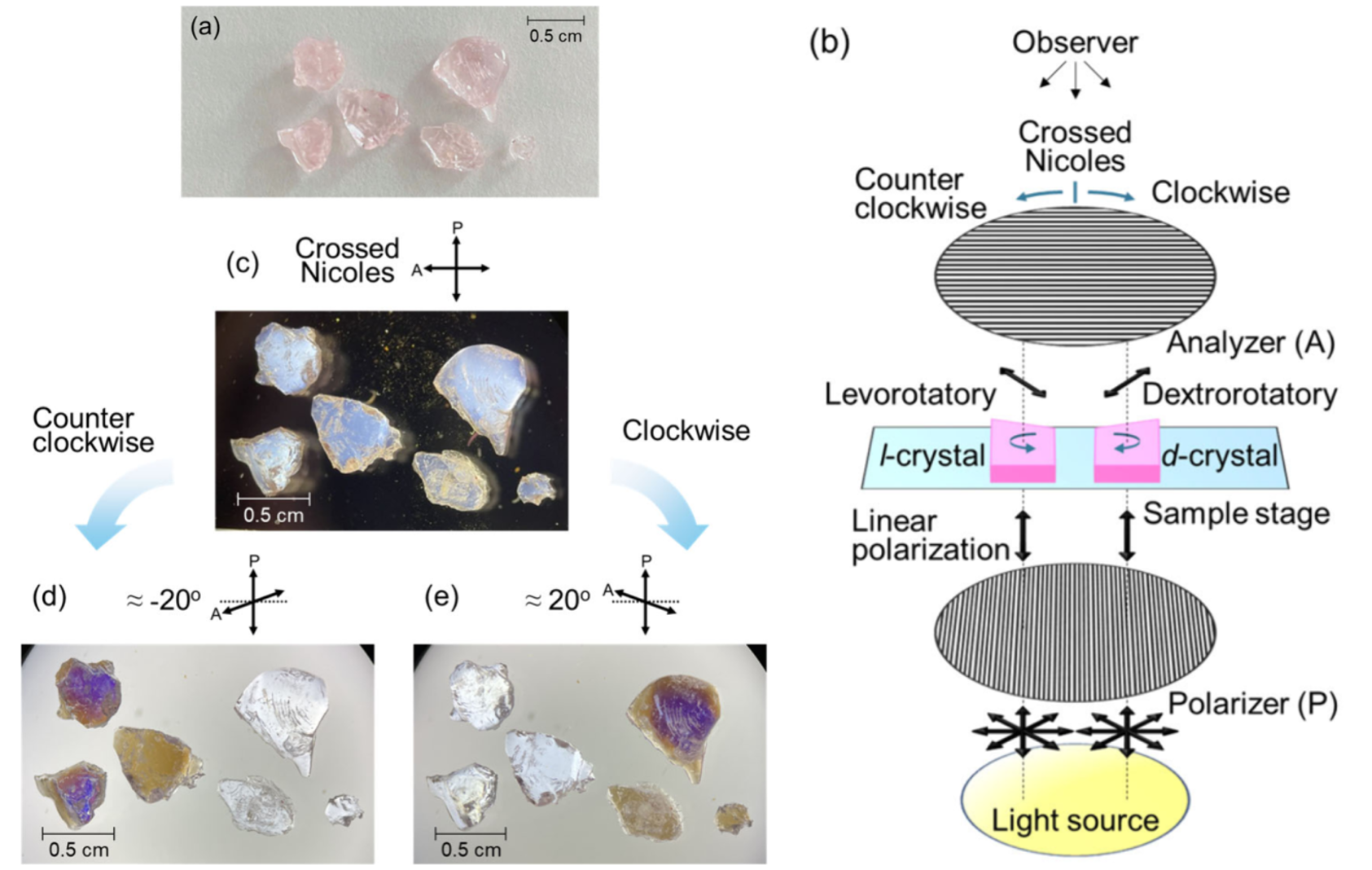
Key Data
- Circularly polarized luminescence (CPL) spectra were measured for a single-crystal powder of synthesized K3[Eu2(NO3)9] at room temperature under excitation at a wavelength of 400 nm. The results showed a high luminescence asymmetry coefficient with a maximum |glum| of 0.023–0.026 at a wavelength of 592 nm.
- Using an absolute PLQY spectrometer, the PLQY of K3[Eu2(NO3)9] was measured at an excitation wavelength of 400 nm and found to be 96%.
- As the next stage of development, work is underway to extend this approach to other lanthanides, such as terbium (green); furthermore, applications of inorganic chiral crystals other than luminescent materials are expected in the future by utilizing optical separation technology.
Expectations
As a highly efficient circularly polarized light-emitting material, the technology described in this invention is expected to find applications in areas such as optical data processing, 3D displays, and security printing.
Kumamoto University is seeking companies interested in commercializing this invention or engaging in joint development through a licensing agreement. Upon signing a confidentiality agreement with Kumamoto University, we can provide access to undisclosed data and arrange meetings with the inventors. Please feel free to contact us.
Principal Investigator
Yusuke Inomata, PhD
Assistant Professor, Graduate School of Advanced Science and Engineering
Kumamoto University (Japan)
Patents and Publications
Patent:
- PCT application filed (not yet published)
Publications:
1. Inomata Y. et al., "Solvent and Achiral Crystalline Phase-Induced Chiral Resolution of CsCuCl3." Cryst. Growth Des. (2026) 26, 401–407.
2. Inomata Y. and Kida T., "Circularly Polarized Luminescence in Chiral Potassium Europium Nitrate." JACS (2026) 148, 33−38.