
Advantages
- With simple operation without "genome modification," target molecules such as proteins, compounds, and nucleic acids can be inserted into viruses
- Widely applicable to envelope viruses
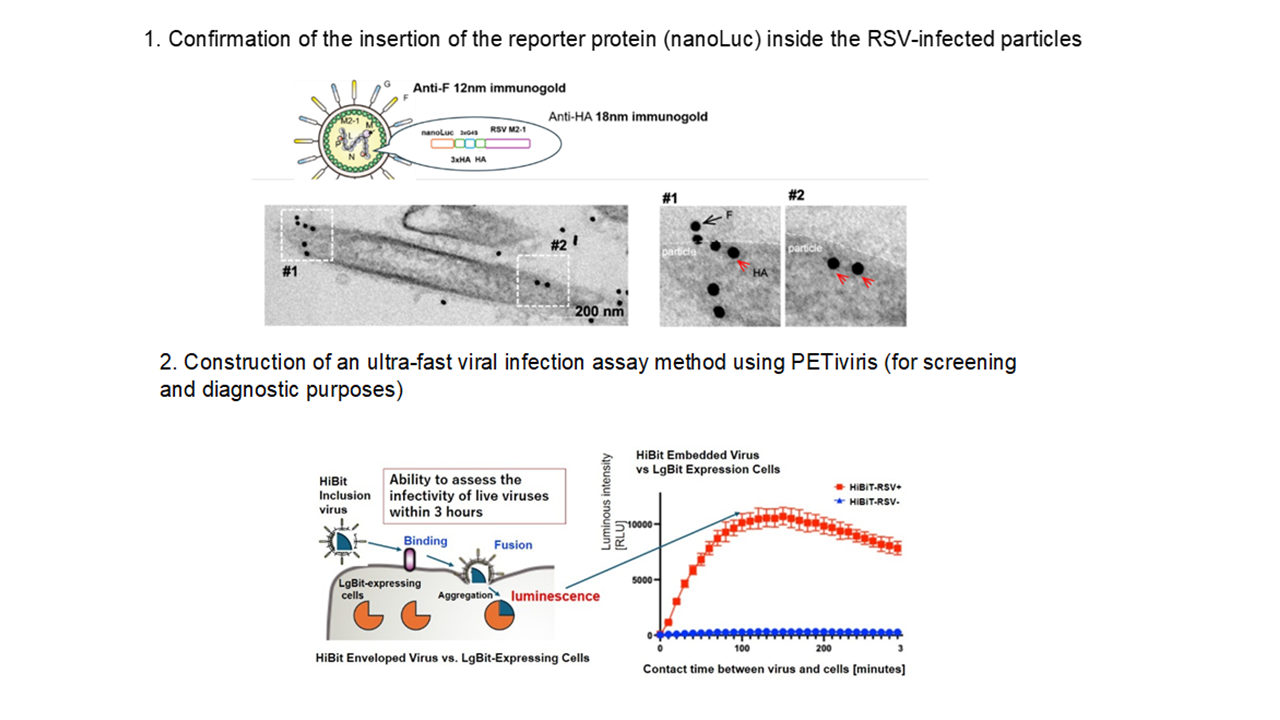
- Virus adsorption and entry can be measured in light emission and fluorescence within a few hours (2 hours of demonstration data acquisition), dramatically shortening the evaluation period.
- Fluorescent and luminescent reporter proteins can be packaged into viruses, enabling quantitative detection at the individual virus particle level.
Background and Technology
Conventionally, the mainstream method for viral titer evaluation and detection involves directly engineering the viral genome to create reporter viruses. However, these methods require sophisticated genetic manipulation and a certain amount of time to detect signals after viral replication. Consequently, there have been challenges regarding the need for more rapid detection, as well as the inability to respond immediately to the latest wild-type strains and variant strains isolated from patients.
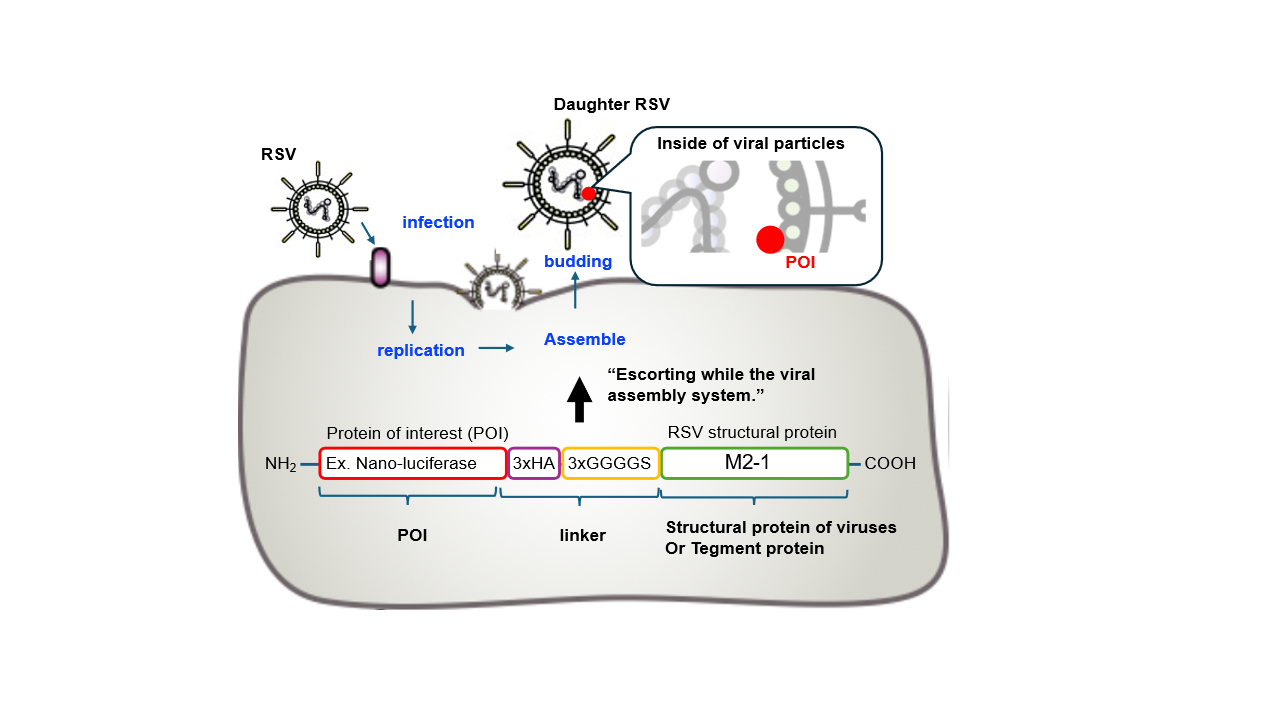
The innovation of this invention lies in its ability to detect viruses down to a single particle without modifying the virus itself, but rather by manipulating only the host cells. Specifically, a "chimeric protein" consisting of the target protein (such as a fluorescent/luminescent reporter or a therapeutic protein formulation) and an internal viral structural protein is pre-expressed in the host cells. When the virus infects these cells, the target protein is spontaneously packed (encapsulated) into the viral particles.
This system enables the construction of infectious viral particles that visualize the infection status while maintaining their inherent infectivity. As a result, this system can be applied as a research platform for the evaluation and screening of therapeutic candidate compounds and the rapid detection of infectious diseases. It also enables the direct tracking of intracellular behavior and inhibitory capacity by packing fluorescent/luminescent proteins along with candidate formulations into particles.
Principles of Technology
Simply preparing the host cell with a 'chimeric protein' expressing functional molecules (such as reporter proteins) and structural proteins, when infected with the virus, the functional molecules are inserted into the virus by the structural proteins.
Data
Partnaring Model
• To Pharmaceutical Companies: This technology can be implemented for high-throughput screening (HTS) and mutant strain monitoring of novel compounds, antibodies, and drug delivery system (DDS) protein formulations. We welcome joint research and development collaborations.
• To Diagnostic Companies: This technology can be utilized as a "next-generation diagnostic kit" to ultra-rapidly detect live viruses in patient specimens as luminescence/fluorescence signals in the supernatant, without waiting for genome extraction or lengthy cultivation. We are seeking collaboration partners for detection evaluation and diagnostic technology development.
• To Research Tool Providers: Potential applications include commercialization as "specialized host cell lines" or "assay kits (reagents)" that allow for the simple preparation of reporter viruses without genetic recombination operations, as well as sales as research tools.
We would highly appreciate the opportunity to first provide detailed explanations and hold discussions with companies interested in any of these areas.
Principal Investigator
• Soh Yamamoto, Lecturer
• Noriko Ogasawara, Associate Professor
Division of Microbiology, Department of Infectious Diseases, Sapporo Medical University
Patents and Publications
• Pending (Unpublished)