
Advantages
・Cell collection is relatively easy and less burdensome for patients
・Seven times higher iPS cell generation efficiency compared to skin fibroblasts
・High proliferative capacity and ease of culture
・Ability to generate high-quality iPS cells with low risk of tumorigenesis and genetic mutations by introducing only three genes (OCT3/4, SOX2, and KLF4), excluding c-MYC
Current Stage and Key Data
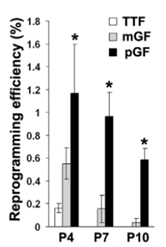
・When comparing reprogramming efficiency of tail-tip fibroblasts (TTFs), mandibular gingival fibroblasts (mGFs), and palatal gingival fibroblasts (pGFs) at the same passage number, GFs showed more than seven-fold higher efficiency. In particular, pGFs maintained high reprogramming efficiency through passage 10 (P10) (see figure on the right).
・The research team is also working on tooth germ regeneration using iPS cell-derived odontogenic epithelial cells created from gingival fibroblasts.
Partnering Model
Osaka University is seeking companies interested in generating iPS cells using this technology. If you are interested, we can arrange an initial meeting with the researcher.
Background and Technology
Disease model cells differentiated from patient-derived iPS cells are increasingly used for drug candidate screening and drug sensitivity evaluation. However, conventional iPS cell sources such as skin fibroblasts and blood cells have drawbacks, including invasive surgical collection procedures that impose physical and psychological burdens on patients, and low generation efficiency.
The researchers focused on gingiva from oral mucosa, which is often removed and discarded during dental treatment, as a new cell source. Gingival fibroblasts not only have high proliferative capacity but also possess unique properties—such as accelerating wound healing in the oral mucosa—that distinguish them from other fibroblasts. Their studies demonstrated that gingiva enables the efficient generation of high-quality iPS cells. In addition, gingival fibroblasts have been shown to be suitable as feeder cells for iPS cell expansion.
Principal Investigator
Prof. Hiroshi EGUSA (Graduate School of Dentistry, Tohoku University)
Patents and Publications
Publications
Egusa H, et al. PLoS ONE, 2010
https://doi.org/10.1371/journal.pone.0012743
Patents
JP5514215B, US8748179B