
Advantages
- Access to complex HMOs: Harnesses the endogenous glycosylation machinery of mammalian cells to target complex and modified HMOs, for which development via microbial fermentation can become increasingly challenging
- Secretory production process: HMOs are secreted into the culture supernatant, enabling the exploration of recovery and purification processes without cell disruption
- Potential for high-value applications: May be applicable to products requiring sophisticated HMO composition design, including human milk fortifiers, preterm infant nutrition, and medical nutrition
Current Stage and Key Data
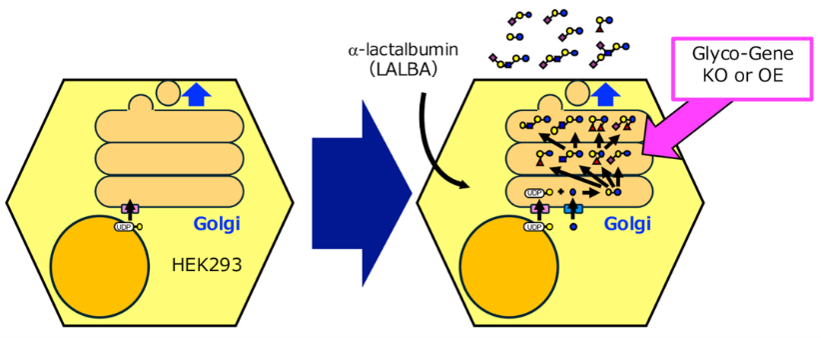
- Secretion of at least eight HMOs into culture supernatant: HEK293 cells expressing LALBA produced and secreted at least eight HMOs into the culture supernatant.
- Production control of the target HMO, DSLNT, through genetic engineering: Co-expression of B3GNT2 and B3GALT5 together with LALBA increased the production of DSLNT by approximately 7.9-fold compared with cells expressing LALBA alone. DSLNT is a complex HMO being investigated in relation to necrotizing enterocolitis in preterm infants.
- Bifidogenic activity of cell-produced HMOs: Culture supernatant containing cell-derived HMOs promoted the growth of Bifidobacterium infantis, a beneficial bacterium commonly found in the infant gut.
Partnaring Model
We are seeking companies interested in collaborative research or patent licensing to support the development and commercialization of HMO-containing products based on this technology.
Potential partners: infant nutrition and food-ingredient companies; HMO and carbohydrate-ingredient manufacturers; cell-culture and biomanufacturing companies; and gut-microbiome companies.)
Background and Technology
HMOs are diverse bioactive glycans found in human milk. They function as prebiotics by serving as selective substrates for beneficial gut bacteria, including bifidobacteria, in infants. Although HMOs are expected to contribute to the development of the gut microbiota and immune system, only a limited subset of the structurally diverse HMOs found in human milk has been industrially produced and incorporated into commercial products. In particular, the production and compositional optimization of complex HMOs and multi-HMO blends become increasingly challenging using microbial fermentation.
This technology introduces LALBA into conventional mammalian cultured cells, thereby repurposing the cells’ endogenous glycan-synthesis and secretory machinery for HMO production. Further engineering of glycosyltransferases enables efforts to control the production level and composition of target HMOs.
Principal Investigator
Professor Morihisa FUJITA (Institute for Glyco-core Research (iGCORE), Gifu University)
Patents and Publications
Information on related literature is included in the materials. Please click the “Iinterested in this technology? [Download Materials]” button below to download and view the materials.