
Advantages
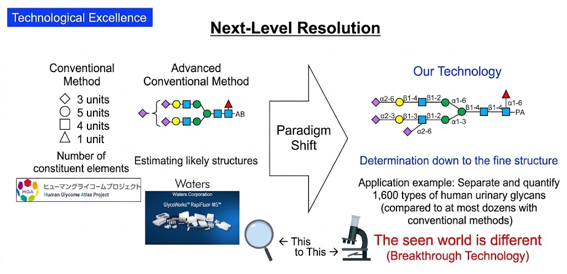
- Supports the differentiation of glycan structural isomers with different linkage positions, branching patterns, and other structural features
- Offers a suite of enabling technologies for sample preparation, glycan standards, analytical software, and glycan structure databases
- Enables analysis using existing LC-MS instruments
Applications
The technology has been applied to the following:
- Structural analysis of glycans in human urine
- Analysis of glycans involved in receptors for avian influenza virus infection
- Structural analysis of polysaccharides produced by lactic acid bacteria
- Structural analysis of biologically active β-glucans.
Partnaring Model
Niigata University is seeking companies interested in glycan analysis using this technology. As an initial step, the researchers will explain the validation status and application examples of each enabling technology, followed by a discussion of its suitability for the company’s analytical challenges and potential opportunities for collaboration.
Examples of potential collaborations are listed below. Proposals beyond these examples are also welcome.
- Manufacturers of LC-MS and other analytical instruments: Joint development to enhance glycan structural analysis capabilities and integrate workflows encompassing sample preparation, measurement, and data analysis
- Analytical service providers: Evaluation of applicability to company samples and exploration of analytical services based on this technology
- Companies in pharmaceuticals, clinical diagnostics, food, and related fields: Joint research on glycan structural comparisons for the assessment of quality attributes of therapeutic antibodies and biosimilars, discovery of novel biomarkers, and structural characterization of functional polysaccharides
Background and Technology
The fine structures of glycans influence the function and stability of glycoproteins. Precise glycan analysis is therefore attracting attention as a technology that can contribute to functional enhancement and quality assessment, not only in pharmaceuticals but also in food proteins, industrial enzymes, and other applications. However, glycans have diverse structural isomers with different linkage positions and branching patterns, making their differentiation and structural determination challenging using conventional methods. For industrial applications, analytical sensitivity, reproducibility, and throughput are important, as is validation linking the resulting structural information to differences in product performance and improvements in manufacturing conditions.
With extensive experience in glycan research, the researchers have developed glycan analysis and matching technologies, an in-house glycan structure database, and technologies for automated glycan structure identification. By combining these technologies with existing LC-MS instruments, they aim to simplify and automate glycan structural analysis.
Principal Investigator
Professor. Shunji NATSUKA (Graduate School of Science and Technology, Niigata University)
Patents and Publications
Information on related literature is included in the materials. Please click the “Iinterested in this technology? [Download Materials]” button below to download and view the materials.