
Advantages
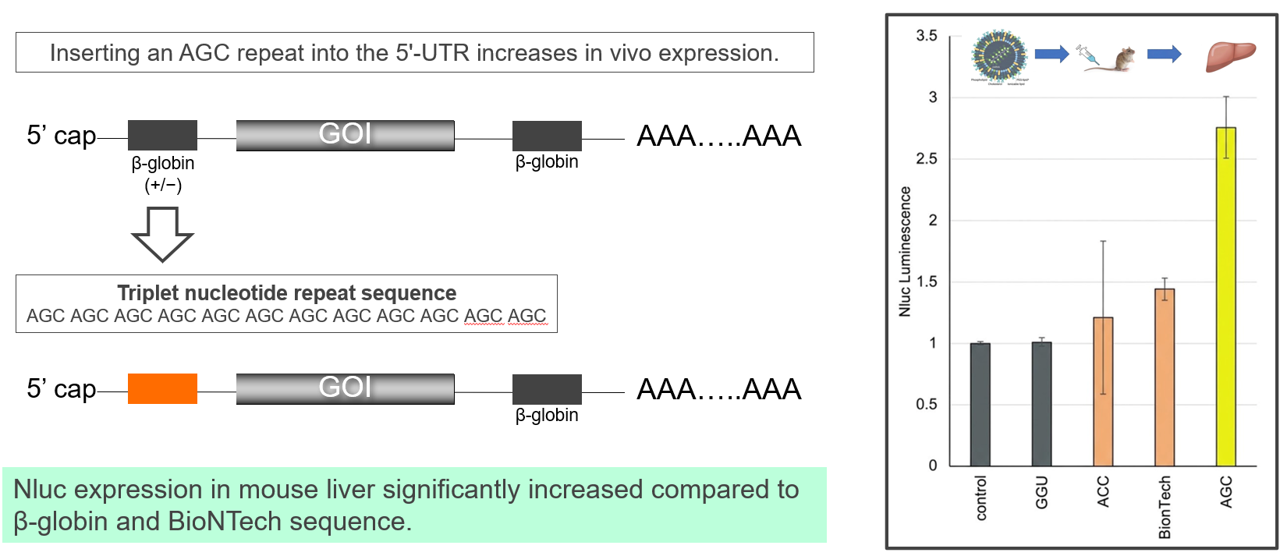
(1) Achieves up to approx. 10-fold higher expression in cell models and approx. 3-fold higher in vivo (mouse liver) compared to controls.
(2) Shows approx. 4 to 6-fold higher protein expression compared to practically used vaccine sequences of Moderna (mRNA-1273) and BioNTech (BNT162b2).
(3) Maintains sustained protein expression for over 50–80 hours in HeLa cells.
Current Stage and Key Data
Proof of Concept (PoC) established in cell and animal models.
Expression enhancement in various cell models: mRNA with a 50-nt AGC repeat showed approx. 10-fold enhancement in HeLa cells, 12-fold in U2OS cells, and 7-fold in HEK293T cells compared to the control.
Sustained expression: AGC and other repeats maintained protein expression for over 50–80 hours in HeLa cells, etc.
In vivo efficacy: Intravenous administration of LNP-encapsulated mRNA via mouse tail vein increased liver expression by approx. 3-fold (up to approx. 7-fold with AGG, etc.) compared to the control.
Partnaring Model
Evaluation MTA: 5’UTR vectors incorporating the target repeat sequences are available under a paid agreement.
Licensing and Co-development: Seeking collaboration in the following areas:
Pharmaceuticals: mRNA drugs and vaccine development.
CDMO: Providing mRNA drug development services incorporating this platform.
DDS Platform Development: Integration with mRNA delivery systems.
Gene Editing: Enhancing CRISPR-Cas9 expression and editing efficiency.
* Cell Therapy: Improved intracellular expression, such as iPS cell generation.
Background and Technology
While mRNA therapeutics are highly established modalities, low intracellular translation efficiency remains a challenge.
Conventional β-globin-derived 5’UTR sequences contribute limitedly to translation.
The inventors developed an expression enhancement platform that replaces the 5'UTR of mRNA with synthetic trinucleotide repeat sequences, such as "AGC".
The introduction of the AGC repeat confirmed an expression increase of up to approx. 10-fold in cell models and up to approx. 3-fold in vivo in mice compared to the control.
Furthermore, it was confirmed to show approx. 4 to 6-fold higher protein expression compared to the vaccine sequences of Moderna (mRNA-1273) and BioNTech (BNT162b2) currently in practical use.
Principal Investigator
Prof. Shinichi Hoshino (Nagoya City University)