
Advantages
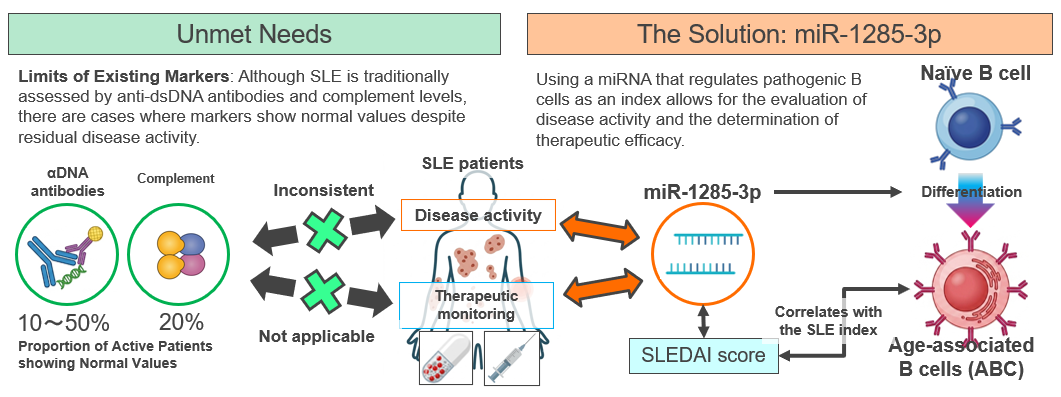
(1) Superiority Over Existing Tests: Accurately assesses disease activity even when conventional markers remain normal (affecting 10–50% of active cases).
(2) Treatment Monitoring: Fluctuates in parallel with disease state (elevates pre-treatment, declines post-treatment) to evaluate drug efficacy.
(3) Pathological Relevance: Directly reflects the underlying disease mechanism by correlating with pathogenic B-cell (ABC) expansion.
Current Stage and Key Data
PoC Established: Successfully validated as a clinical biomarker using human small EVs.
(1) Specific Elevation: Significantly higher in SLE patients (n=31) than healthy controls (n=10).
(2) SLEDAI-2K Correlation: Confirmed in all patients (r=0.3929, p=0.0288, n=31) and even in complement-normal cases (r=0.4623, p=0.1323, n=12).
(3) Treatment Response: Significantly decreased post-treatment in active patients (n=11).
Partnaring Model
Seeking Development Partners: We are looking for diagnostic manufacturers and clinical testing companies to commercialize this technology as an SLE disease activity marker.
Background and Technology
Clinical Challenges: Standard SLE blood markers (anti-dsDNA antibodies, complement levels) often dissociate from actual clinical status, hindering accurate patient evaluation in 10–50% of cases.
Pathological Context: The expansion of pathogenic B cells (Age-associated B cells: ABCs) drives SLE progression and directly correlates with disease activity index (SLEDAI).
Discovery & Mechanism: Identified miR-1285-3p in plasma-derived small EVs. It drives ABC differentiation by suppressing B-cell mitochondrial metabolism (OXPHOS) and downregulating IKZF2.
Biomarker Utility: miR-1285-3p levels correlate with SLEDAI-2K scores and decline after treatment, offering a novel biomarker to complement standard tests and enable treatment monitoring.
Principal Investigator
Dr. Hiromitsu Asashima (University of Tsukuba)
Patents and Publications
Information on related literature is included in the materials. Please click the “Iinterested in this technology? [Download Materials]” button below to download and view the materials.