
Advantages
Unparalleled resistance to variants:
- By mimicking the virus’s entry routes, it retains its neutralizing activity even against the JN.1 and KP.3 strains and does not induce the emergence of resistant strains
Combining convenience and cost-effectiveness:
- Allows for self-administration at home via powder inhalation. Demonstrates dramatic efficacy at doses far lower than those required for intravenous administration
High safety and stability:
- Enzyme inactivation via disulfide (S-S) bonds prevents side effects such as blood pressure fluctuations and enables long-term storage and distribution at room temperature
Background & Technology
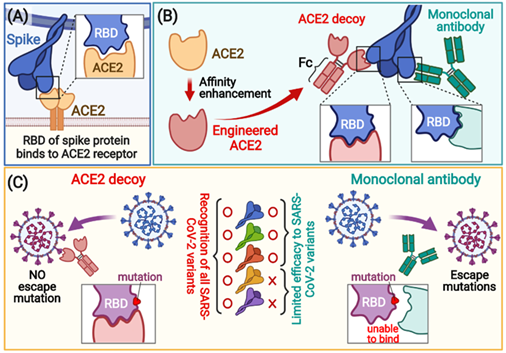
The SARS-CoV-2 virus continues to evolve into new sublineages, evading immunity conferred by existing neutralizing antibodies and vaccines. In response, a strategy has been developed that mimics the ACE2 receptor—the virus’s binding site on host cells—and uses it as a decoy. Using proprietary directed evolution technology, the researchers developed a modified ACE2 that binds to the virus with higher sensitivity than wild-type ACE2 and possesses binding affinity comparable to that of antibodies.
Furthermore, this technology uses a proprietary structural stabilization technique to suppress the enzymatic activity inherent in ACE2, thereby eliminating the systemic effects on blood pressure regulation that were a concern in conventional ACE2 decoy therapies and ensuring high safety as a pharmaceutical agent. In addition to intravenous administration, the researchers have developed a dry powder formulation suitable for inhalation and highly portable, enabling not only administration at medical institutions but also early treatment at home.
Data
Preclinical trials have been completed. Efficacy and safety have been demonstrated in primates (macaques). Optimization of the inhalable dry powder formulation (leucine/trehalose formulation) has also been completed.
Directed evolution (Higuchi et al., 2021):
- A library of randomly mutated ACE2 variants was expressed in 293T cells. Using photoactivated cell sorting, cells with high binding affinity for the spike receptor-binding domain were selected and passaged; variant 3N39 was found to have approximately 100 times the affinity of the wild-type.
Confirmation of Enzyme Inactivation (Higuchi et al., 2021):
- By introducing a disulfide bond into the active site of ACE2, we confirmed that the denaturation temperature of the modified ACE2 was increased by more than 10°C and that enzyme activity was completely blocked.
Resistant mutant induction assay (Higuchi et al., 2021):
- When the virus was passaged for 15 consecutive generations in the presence of an antibody (H4 strain) or the modified ACE2 (3N39v2), a resistant strain emerged after 4 generations with the antibody, whereas with the modified ACE2, neutralization sensitivity was maintained even after 15 generations, demonstrating that escape mutations are less likely to occur.
Mouse/Hamster Treatment Studies (Ikemura et al., 2022):
- When modified ACE2 (3N39v4) was administered intraperitoneally to hamsters infected with the Omicron strain, it was confirmed that viral load in the lungs and the expression of inflammatory factors were significantly suppressed 5 days later. Furthermore, experiments using mice expressing human ACE2 demonstrated that intravenous administration after infection dramatically improved survival rates against lethal infection by the Omicron strain.
Macaque treatment model study (Urano et al., 2023):
- When modified ACE2 (3N39v4-Fc) was administered to macaques infected with the Delta variant (50 mg/kg intravenously, 1 mg/kg via aerosol inhalation), the inhaled dose—even at a low dose of 1/50 that of the intravenous dose—suppressed viral replication in the lungs and improved pneumonia (opacity on CT images).
Neutralizing Activity Assessment (Ito et al., 2025):
- Using pseudotyped lentiviruses to investigate the neutralizing activity of the modified ACE2 (3N39v4-Fc) against BA.2.86 sublineages (JN.1, KP.2, KP.3, etc.), it was confirmed that neutralizing activity was maintained.
Optimization of Additives and Spray Drying, and Aerosol Performance Evaluation (Ito et al., 2025):
- The formulation ratios of additives such as trehalose and leucine were varied, and the mixture was powdered via SFD (spray freeze-drying). The particle size distribution of the powder (3N39v4-Fc) was measured using a cascade impactor. As a result, an optimal formulation (T4/L4 formulation) was determined that minimizes protein aggregation and maintains solubility. It was confirmed that the powder exhibits high yield efficiency (approximately 80%) and is of a size capable of reaching from the trachea to the terminal regions of the lungs (alveoli).
Long-term storage stability study (Ito et al., 2025):
- After storing the powder for 6 months under harsh conditions (40°C, 75% humidity), neutralizing activity and powder dispersibility remained unchanged even after 6 months, demonstrating that distribution without refrigeration (no cold chain required) is feasible.
Mouse powder inhalation study (Ito et al., 2025):
- Intratracheal administration of powdered modified ACE2 (3N39v4-Fc) to mice infected with the MA10 strain demonstrated that a single dose administered 24 hours after infection dramatically suppressed viral replication in the lungs and pneumonia pathology, proving its efficacy against the latest strains such as KP.3.
Safety study in human iPS-derived cardiomyocytes (Ito et al., 2025):
- Since ACE2 plays a critical role in the cardiovascular system, we evaluated the cardiotoxicity of the powdered modified ACE2 (3N39v4-Fc) formulation using human induced pluripotent stem cell-derived cardiomyocytes (hiPS-CM). We confirmed that it does not affect myocardial electrical activity (risk of arrhythmia), contractility, or heart rate.
Principal Investigator
Junichi Takagi (Professor, Institute for Protein Research, The University of Osaka)
Patents & Publications
Patent:
- JP 7756367 (B2)
Publications:
- Higuchi Y. et al., Nat. Commun. (2021) 12, 3802.
[DOI] https://doi.org/10.1038/s41467-021-24013-y
- Ikemura N. et al., Sci. Transl. Med. (2022) 14, eabn7737.
[DOI] https://doi.org/10.1126/scitranslmed.abn7737
- Arimori T. et al., Trends. Pharmacol. Sci. (2022) 43, 838-851.
[DOI] https://doi.org/10.1016/j.tips.2022.06.011
- Urano E. et al., Sci. Transl. Med. (2023) 15, eadi2623.
[DOI] https://doi.org/10.1126/scitranslmed.adi2623
- Ito T. et al., Mol. Ther. Methods Clin. Dev. (2025) 33, 101459.
[DOI] https://doi.org/10.1016/j.omtm.2025.101459
Expectations
TECH MANAGE is now looking for companies to collaborate with the researcher and develop this technology further under the licensing of the related patent described above.
You can also consider joint research using the invention, providing know-how under a confidentiality agreement (CDA), or setting up evaluation or licensing options.
Patents and Publications
Patent:
- JP 7756367 (B2)
Publications:
- Higuchi Y. et al., Nat. Commun. (2021) 12, 3802.[DOI] https://doi.org/10.1038/s41467-021-24013-y
- Ikemura N. et al., Sci. Transl. Med. (2022) 14, eabn7737.[DOI] https://doi.org/10.1126/scitranslmed.abn7737
- Arimori T. et al., Trends. Pharmacol. Sci. (2022) 43, 838-851.[DOI] https://doi.org/10.1016/j.tips.2022.06.011
- Urano E. et al., Sci. Transl. Med. (2023) 15, eadi2623.[DOI] https://doi.org/10.1126/scitranslmed.adi2623
- Ito T. et al., Mol. Ther. Methods Clin. Dev. (2025) 33, 101459.[DOI] https://doi.org/10.1016/j.omtm.2025.101459