
Advantages
- High-precision force mapping measurement is possible for soft samples such as biological samples (e.g. cells).
- Easy to adapt to existing AFM by switching to the new mode without changing the mechanical configuration.
Technology & Background
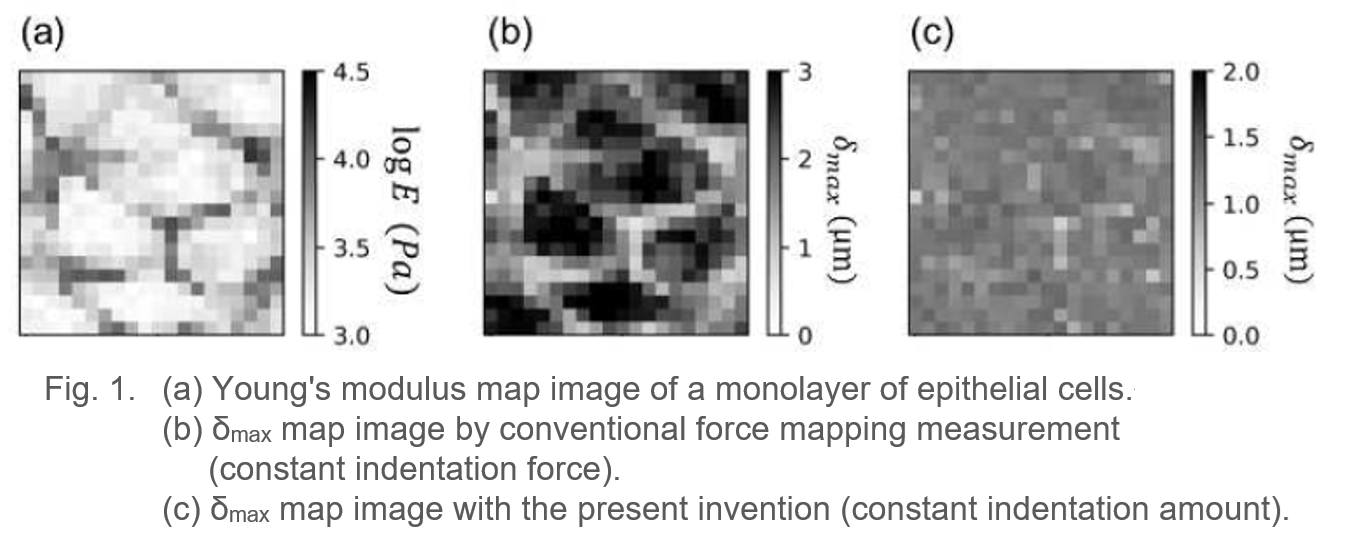
AFM (atomic force microscopy) is widely used to image the surface topography of a sample on a nanoscale and to measure the mechanical properties of the sample surface. In force mapping, the elastic modulus (stiffness) of samples is estimated from force-indentation curves, in which the maximum loading force is controlled to be constant. Therefore, the indentation depth varies depending on the elastic modulus at measurement locations, leading to damage to fragile samples (e.g. cells) with heterogeneous mechanical properties and inaccurate mechanical measurements.
To solve this problem, a mapping method that controls and measures a constant indentation amount rather than indentation force is desired. However, for soft samples such as cells, the contact point cannot be evaluated with high accuracy, resulting in a decrease in the measurement accuracy of the modulus of elasticity. Therefore, it has not yet been possible to control the amount of indentation.
The researchers devised a new method that enables constant control of indentation amount without using contact point information. Specifically, based on information on the indentation force (F1) at an arbitrary point during a force curve measurement, the indentation force at that point (δ1), and the indentation force (δmax) at the point where the maximum indentation force (Fmax) is obtained, the difference value of the indentation force (Δδ) and the ratio value of the indentation force at each position (F1/Fmax) δmax is calculated using only the values that can be measured with the AFM. By programming a feedback mechanism to apply the value of δmax obtained in this way to subsequent force curve measurements, force mapping can be performed while the indentation amount is controlled at a constant value (δmax). This method can be applied without changing the conventional AFM configuration, only changing the measurement mode.
Key Data
- A homemade AFM was prepared and used to validate the invention by combining an upright optical microscope with a cantilever, photodetector, water immersion objective, laser light source, piezo stage, and digital piezo controller.
- Using a monolayer of Madin-Darby Canine Kidney cells (MDCK cells) seeded in a paving stone-like pattern as the measurement sample, AFM force mapping measurements were performed with a constant conventional indentation force and with a constant controlled indentation volume of the present invention, and the results of each were compared, confirming the validity of the present method.
Expectations
TECH MANAGE is now looking for companies to collaborate with the researchers and develop this technology further under the licensing of the related patents described below. It is also possible to consider providing know-how under a CDA, conducting joint research utilizing this invention, or implementing it under an evaluation agreement or granting a license option.
Principal Investigator
Takaharu Okajima, DSc (Professor, Hokkaido University, Japan)
Patents & Publications
Patents:
- A patent applied in Japan and published as JP2025-183175(A1) in Japanese.
Publications:
- Preparing to submit a paper.