
Advantages
Improved Diagnostic Accuracy:
- Distinguishes NPSLE patients with higher accuracy (AUC 0.82) compared to conventional diagnostic methods, reducing diagnostic variability.
Utilization of Existing Equipment and Data:
- Requires no special imaging equipment and can utilize existing head MRI (FLAIR) image data (including older data).
Technology and Background
Neuropsychiatric systemic lupus erythematosus (NPSLE) is a complication of the central nervous system associated with systemic lupus erythematosus (SLE). However, due to its diverse and non-specific symptoms and the lack of useful biomarkers for diagnosis, differentiation from other neuropsychiatric disorders is difficult, often leading to diagnostic delays. Conventional head MRI examinations often do not show specific findings for NPSLE, and diagnosis has had to rely on the experience and comprehensive judgment of physicians, resulting in variability in accuracy.
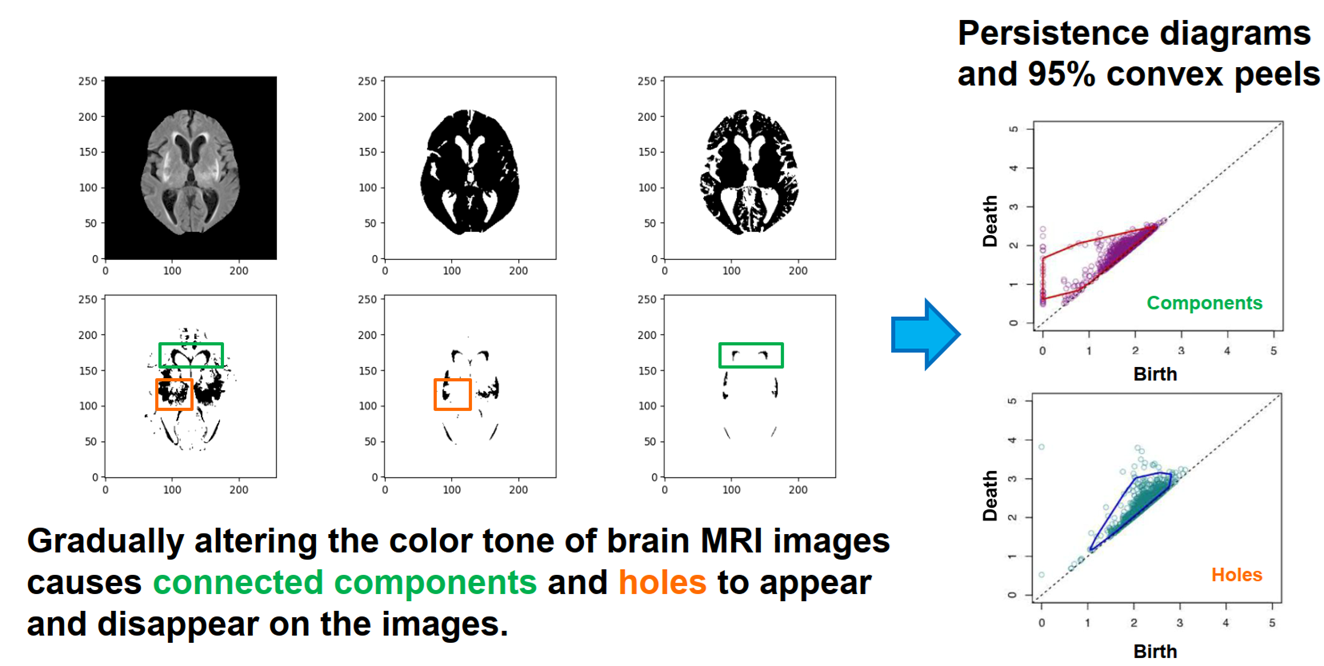
This technology focuses on topological data analysis (TDA), which captures the structural features hidden in MRI images as the shape of the data. By varying image contrast intensity and quantifying the generation and disappearance patterns of topological structures such as "holes" and "connecting components" in lesion areas, it aims to objectively extract image patterns characteristic of NPSLE and dramatically improve diagnostic accuracy.
It became clear that combining the perimeter (arc) and area of the white connected components (holes) with the subject's age, history of cerebrovascular disease, and serum complement levels allows for discrimination with extremely high accuracy, proving highly useful as a model for distinguishing between NPSLE patients and non-NPSLE patients.
Current Stage
- Retrospective analysis using head MRI images from 30 NPSLE patients and 30 SLE patients has confirmed the effectiveness of the diagnostic accuracy (AUC 0.82).
- Confirmation of generalizability through multi-center joint research and prospective validation have been conducted, yielding favorable results.
Partnering Models and Expectations
TECH MANAGE is seeking companies interested in product development and commercialization through licensing of this invention in the following areas:
(1) To Medical Image Analysis Software Development Companies / Brain MRI Equipment Manufacturers:
Software Co-Development:
- Would you be interested in jointly developing software (standalone or integrated into existing systems) that implements the NPSLE diagnostic support algorithm using this technology?
Support for SaMD Regulatory Approval:
- We seek your cooperation in obtaining regulatory approval to introduce the developed software into the market as SaMD (Software as a Medical Device). We look forward to collaborating, leveraging your experience and know-how in regulatory applications.
(2) To Diagnostic Product Manufacturers:
SaMD Development & Regulatory Approval Support:
- We hope to collaborate on product development and obtaining regulatory approval to establish this image analysis technology as a new diagnostic tool (SaMD).
Disclosure of unpublished data, etc., is possible upon conclusion of an NDA with Nagasaki University. Direct meetings and discussions with the researchers can also be arranged.
Please feel free to contact us with any requests.
Principal Investigator
Kayoko Urashima
- Assistant Professor, Graduate School of Biomedical Sciences, Nagasaki University (Japan)
Patents and Publications
Patent:
- PCT/JP2023/005474 (published in Japanese as WO2023/157920)
Publication:
- Urashima K, et al., PLoS One (2025) 20(8): e0329859.
Patents and Publications
Patent:
- PCT/JP2023/005474 (published in Japanese as WO2023/157920)
Publication:
- Urashima K, et al., PLoS One (2025) 20(8): e0329859.