
Advantages
- Realization of direct electrode reactions in media with zero electrical conductivity: Enables approaches for compounds that were previously unsuitable for chemical synthesis or analysis via electrochemical reactions.
- Development of new devices based on electrochemical reactions in supercritical CO2.
- Applicable to fields such as carbon recycling and food analysis.
Background and Technology
Supercritical CO2 (scCO2) is achieved at a critical point of 31.1°C and 7.4 MPa. While its density can reach several hundred times that of its gaseous state, it is highly non-polar and does not conduct electricity; consequently, direct electrochemical reduction has long been considered impossible.
Meanwhile, a bicontinuous microemulsion (BME) is a system formed by carefully balancing the hydrophilic and lipophilic properties of a surfactant, resulting in a structure where both the aqueous and oil phases are continuous. In non-polar liquids (such as oils) where electrochemical reactions are typically hindered by a lack of ionic conductivity, the aqueous phase within a BME acts as an ionic pathway, enabling such reactions to take place.
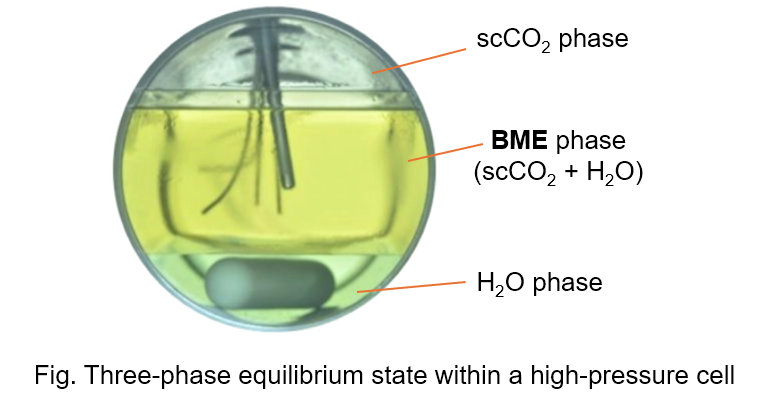
This technology involves precisely tuning the balance between the hydrophilic and CO2-philic properties of a surfactant to create a BME within a high-pressure cell, in which the aqueous phase and the scCO2 phase are three-dimensionally intertwined and mutually continuous. The researchers have successfully demonstrated the concept of driving electrochemical reactions by converting scCO2 into a BME. This approach holds promise for a wide range of future applications — including reaction systems that are challenging for conventional electrochemical devices, the decomposition of CO2 via direct reduction, the synthesis of organic compounds, the development of decarbonization and carbon capture and utilization (CCU) plants, and antioxidant analysis in food products.
Data
In a BME system consisting of an aqueous phase, a CO2 phase (gas phase), and their corresponding microemulsion phases (with isopropanol added as a co-surfactant), ferrocene — which is insoluble in water — was introduced into the system. Electrochemical measurements were then conducted at a sweep rate of 0.05 V/s, using a gold (Au) wire as the working electrode, a stainless-steel reactor as the counter electrode, and a silver (Ag) wire as the reference electrode. The resulting cyclic voltammogram (CV) confirmed that the conductive aqueous microphase functions as an ion-conducting pathway.
Expectations
Kumamoto University is seeking companies interested in collaborating with this research team on the development of new electrochemical reaction devices using this technology, with the goal of commercializing them and applying them to various chemical reactions and analyses. Specifically, manufacturers of electrochemical or supercritical fluid-related equipment, companies providing analytical services, and energy-related chemical companies or infrastructure firms are encouraged to express their interest.
The disclosure of confidential data and meetings with researchers are possible upon signing a confidentiality agreement with Kumamoto University. Please feel free to contact us for more information.
Researchers
- Masashi Kunitake, Professor Emeritus (Kumamoto University, Graduate School of Advanced Science and Engineering / Institute of Industrial Nanomaterials)
- Ken Momose, Professor (Kumamoto University, Semiconductor and Digital Research and Education Organization)
Patents and Publications
Patent:
- PCT application filed (unpublished)
Publication:
- Unpublished