
Advantages
- Comprehensive Screening: Establishing a single-indicator platform based on SLAMF6 to cover multiple disorders within the same clinical field. Aims for early diagnosis of MG, CIDP, AE, and MOGAD.
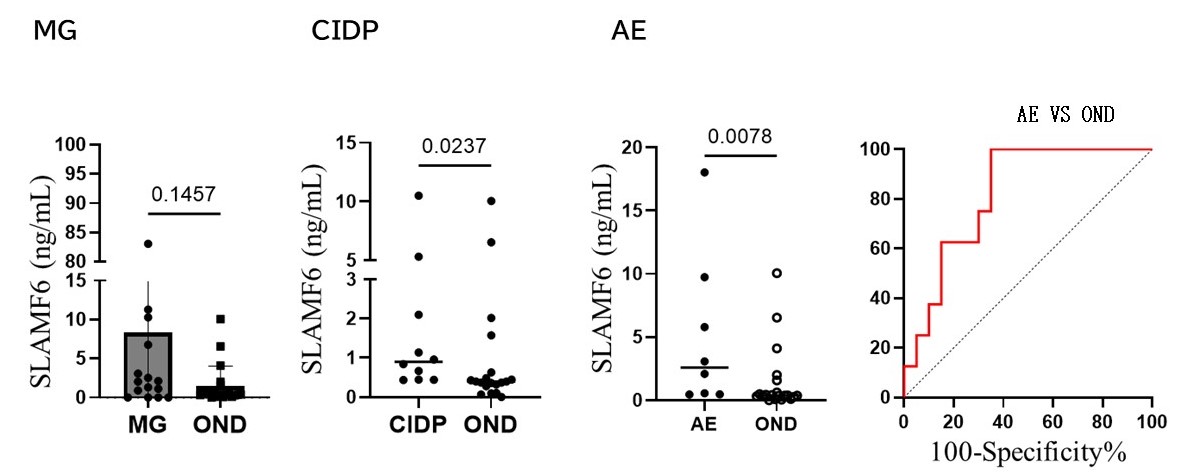
- High Precision: Detects cases in diagnostic "blank zones" (where existing tests fail) with high accuracy, such as AUC 0.82.
- Reduced False Negatives: Provides a next-generation standard to support cases that test negative for traditional antibodies.
- Proven Method: Practicality demonstrated via a simple ELISA method using blood samples.
Current Stage and Key Data
Current status:
POC completed for a highly sensitive detection and differentiation for autoimmune neurological diseases using SLAMF6
●Data
Higher SLAMF6 concentrations were observed in MG, CIDP and AE samples from patient groups compared to non-autoimmune neurological disorder (OND) groups.
Partnaring Model
We are seeking partner companies interested in joint research for steps 1 and 2, and subsequent commercial development. We look forward to starting with a detailed technical briefing and discussion.
1. Establishment of early screening technology through the accumulation of clinical samples.
2. Refining the accuracy and indicators for disease differentiation.
3. Accumulating evidence for monitoring for relapse and treatment decision-making capabilities.
Background and Technology
Autoimmune disorders of the central nervous system cause severe disabilities, such as paralysis and vision loss, across all age groups. Because treatment and prognosis vary significantly by disease, rapid early diagnosis is critical. However, existing biomarkers often struggle to accurately differentiate between conditions like Myasthenia Gravis (MG) and Autoimmune Encephalitis (AE).
SLAMF6 is a novel marker discovered at Sapporo Medical University to bridge this gap. By applying specific SLAMF6 measurement values to determined cut-off points, this method enables the precise identification and differentiation of these disorders via blood tests.
Applicant
Sapporo Medical University
Patent status
Pending (unpublished)