
Advantages
Process Efficiency
Significantly reduces the synthesis process compared to multi-stage chemical synthesis methods.
High diversity
Difficult amino acid residue count of 5-23, with proven cyclization in a wide range of amino acid residues.
High Precision
Avoiding peptide isomerization and dimerization, enabling efficient synthesis
Partnering Model
Current stage: Peptide cyclization across a wide range of substrates and chain lengths has been demonstrated, and mapping is complete.
• To research tool providers:
Offering enzyme families for custom peptide library generation for drug discovery research, developing and commercializing peptide synthesis kits, and sales as research tools.
• For biotech companies:
It is expected that this technology can be used to improve the manufacturing process of peptide pharmaceuticals, or to undertake custom peptide library synthesis and screening contracts.
• For pharmaceutical companies:
Exploration and Screening (HTS) to expand portfolios for peptide drug development, or manufacturing professionals
It can be introduced to improve the efficiency of Seth processes. Joint research and development collaborations are also welcome.
We would appreciate it if we could start with a detailed explanation and discussion with companies interested in each topic.
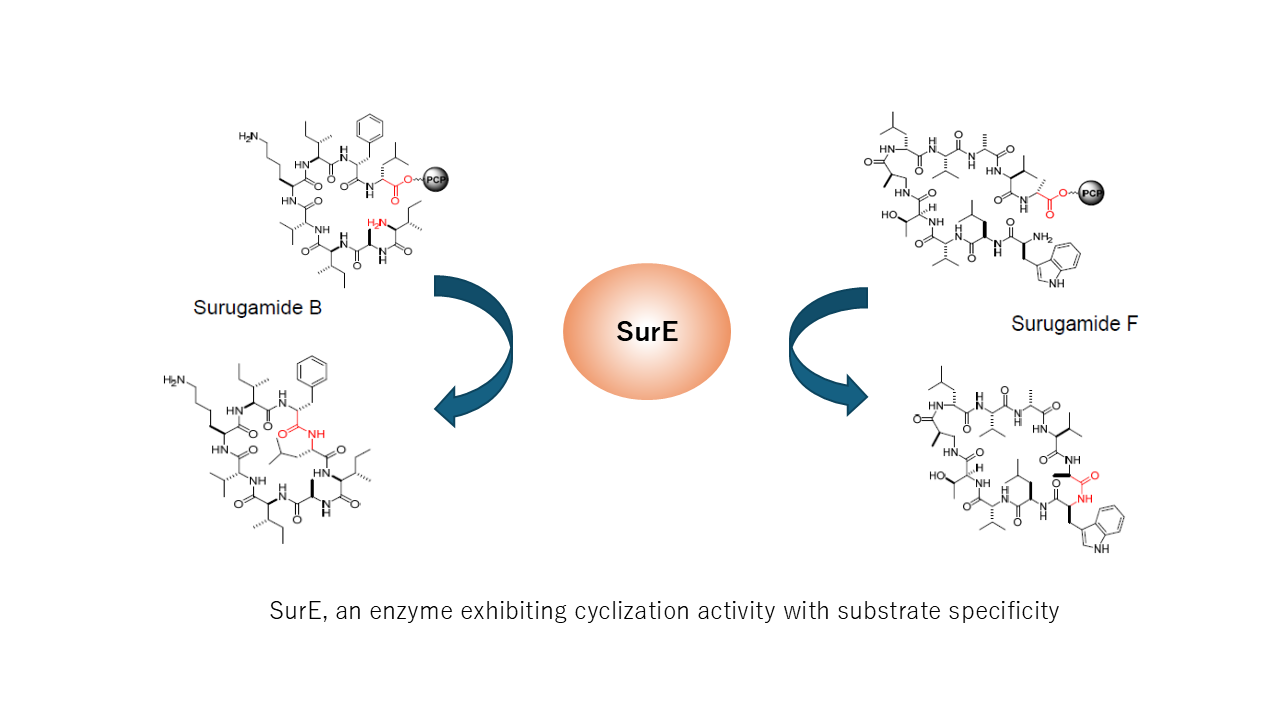
Background and Technology
Macrocyclic peptides are key scaffolds in modern drug discovery due to their strong bioactivity and peptidase resistance. However, conventional chemical macrolactamization is hampered by strict regioselectivity and stereoselectivity, limiting high-throughput library synthesis. To overcome these barriers, the inventors identified SurE, a novel standalone macrocyclizing enzyme (PBP-type TE family). With mapped substrate specificity and chain-length versatility, this highly efficient biosynthetic approach is gaining strong industry traction for practical applications.
Principal Investigator
Professor Toshiyuki Wakimoto , Associate Professor Kenichi Matsuda
Department of Natural Product Chemistry, Graduate School of Pharmaceutical Sciences, Hokkaido University
Patents and Publications
Patent No. JP7874292