
Advantages
- By using glass fiber as the blood cell capture layer, hemolysis is suppressed and more than 99.9% of blood cell components can be removed
- High-purity plasma comparable to that obtained by centrifugation can be collected without electricity or large equipment
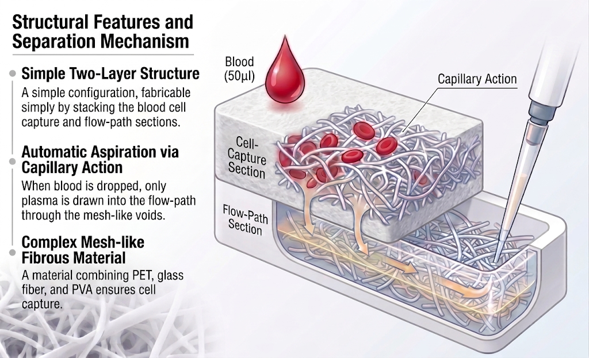
- The device has a simple two-layer structure, consisting of a blood cell capture layer and a flow-channel layer, making it suitable for low-cost mass production
- The separated plasma can be directly collected using a micropipette and readily integrated with existing analytical platforms, including clinical chemistry assays, immunoassays, and nucleic acid amplification tests
Key Data
- Successfully extracted more than 4 µL of plasma from 50 µL of whole blood.
- Confirmed removal of more than 99.9% of blood cell components from the extracted plasma.
- In biochemical assays for glucose and cholesterol, plasma extracted by this technology showed diagnostic accuracy comparable to that of conventional centrifugation-based methods.
Background and Technology
As preventive medicine advances, point-of-care testing (POCT), which enables immediate diagnosis near the patient, is becoming increasingly important. Accurate blood testing requires separation of blood cells and plasma, but conventional centrifugation relies on large instruments and relatively large blood volumes, creating a major barrier for home care and rapid screening applications.
This technology integrates glass-fiber papermaking and coating processes to achieve passive plasma separation using capillary action. By structurally layering the blood-droplet pad and the plasma-holding flow path, and by controlling fiber layering and orientation, it suppresses blood cell rupture and contamination. As a result, it establishes a structure that separates and retains clean plasma without using any power.
Partnaring ModelBackground and Technology
Ehime University is seeking companies interested in commercializing this technology. Collaboration or licensing is envisioned with medical device and diagnostic reagent manufacturers developing compact analytical devices and diagnostic kits.
This technology can serve as a high-precision plasma separation module for existing assay kits such as immunochromatographic tests, and may also be extended to a simultaneous multi-analyte detection platform through flow-channel branching
Principal Investigator
Yoh KATAOKA, Program-Specific Researcher (Paper Industry Innovation Center, Ehime University)
Patents
Applied (Unpublish)