
Advantages
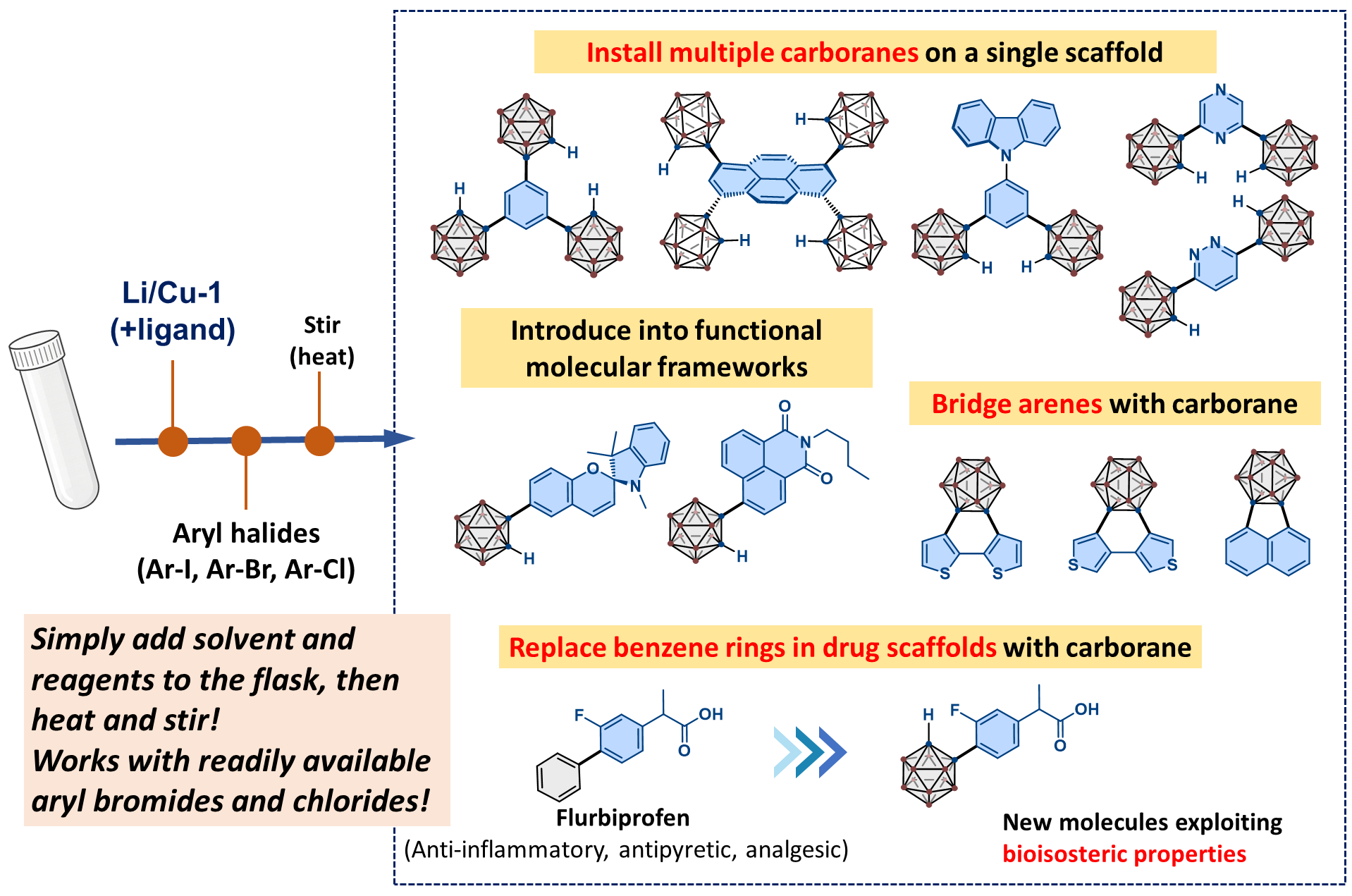
- A simple “Dump-and-Stir” method enables highly efficient incorporation of ortho-carborane into a wide variety of aromatic compounds.
Current Stage and Key Data
- The novel carborane-incorporating reagent, lithium bis(ortho-carboranyl) cuprate (Li/Cu-1), remains stable for more than one month under an inert atmosphere. A decagram-scale synthesis method (approximately 20 g per batch) has been established.
- The synthesis of carborane-incorporated compounds (carboranyl arenes) using Li/Cu-1 has also been demonstrated on a gram scale.
- A diverse range of novel carborane-containing molecules, from anti-inflammatory drug analogues to core scaffolds for functional materials, has been synthesized.
Partnaring Model
The University of Osaka is seeking partner companies interested in utilizing this technology. Examples of potential collaborations are outlined below. Please feel free to contact us to discuss fields and applications not listed here.
- Electronic materials: Adding value to next-generation functional materials
Expected benefits: Higher efficiency and longer lifetime of light-emitting, charge-transporting, and semiconducting devices, as well as precise control of material properties.
Contribution: Development of next-generation electronic materials and breakthroughs in performance.
- Polymer materials: Creation of next-generation functional materials for harsh environments
Expected benefits: Improved heat resistance, oxidation resistance, radiation resistance, and electrical insulation.
Contribution: Development of high-performance polymers that overcome the limitations of conventional materials.
- Pharmaceuticals: Creation of drug discovery leads based on a novel pharmacophore
Expected benefits: Stronger receptor interactions, higher target selectivity, and greater metabolic stability.
Contribution: Creation of drug discovery seed compounds differentiated from existing compounds.
Background and Technology
Carboranes have attracted considerable attention as boron neutron capture therapy (BNCT) agents, as bioisosteres in pharmaceuticals, and as components of electronic materials, high-performance polymers, and aerospace materials. However, conventional methods require complex procedures involving unstable intermediates derived from aryl iodides, which has hindered their industrial application.
This technology employs a novel, isolable reagent, Li/Cu-1, in which two carborane units are bound to a single copper atom. The reaction proceeds simply by mixing and heating Li/Cu-1 with inexpensive aryl bromides or chlorides. Isophthalonitrile, used as an additive, coordinates selectively to the lithium cation, thereby unleashing the full reactivity of the cuprate. This approach efficiently enables the multiple incorporation of carborane units and the construction of fused π-conjugated systems, both of which were previously difficult to achieve.
Principal Investigator
Yoichi HOSHIMOTO Associate Professor (Graduate School of Engineering, The University of Osaka)
Patents and Publications
Information on related literature is included in the materials. Please click the “Iinterested in this technology? [Download Materials]” button below to download and view the materials.