
Advantages
- The vaccine induces high-quality antibodies that recognize the native three-dimensional structure of the virus
- It may also be applicable to species other than red sea bream, including yellowtail, tuna, and greater amberjack
Current Stage and Key Data
- Current Stage
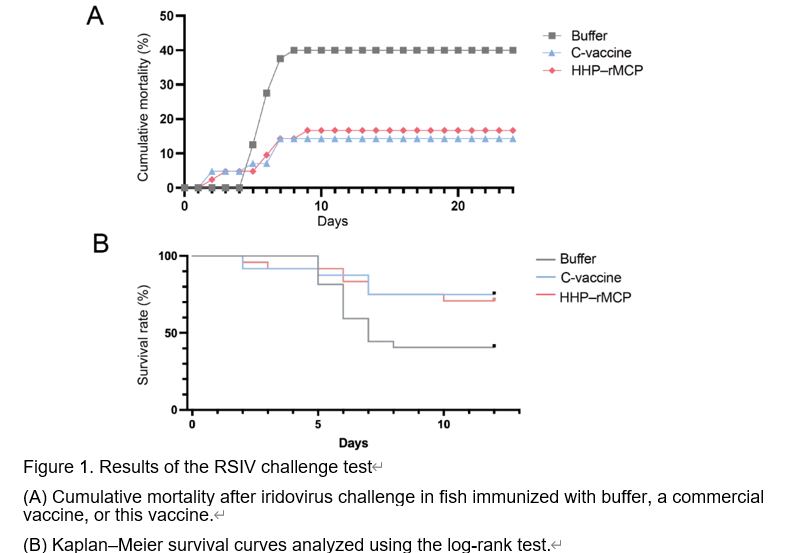
A lab-scale challenge study in red sea bream confirmed protective efficacy equivalent to that of a commercial vaccine.
- Future Plan
We are exploring non-injectable administration routes, such as oral administration.
- Key Data
In a challenge study, red sea bream were intraperitoneally immunized with this vaccine and challenged 20 days later with a virulent strain of red sea bream iridovirus. The mortality rate in the control group (buffer) was 40%, whereas the HHP-rMCP group showed a mortality rate of only 16.7%, demonstrating protective efficacy comparable to that of the commercial formalin-inactivated vaccine (C-vaccine: 14.3%).
Background and Technology
Infectious diseases in aquaculture cause serious economic damage, amounting to approximately 10 billion yen annually in Japan alone (FY2022), creating a major business risk. In particular, countermeasures against red sea bream iridovirus (RSIV), which infects not only red sea bream but also multiple species such as yellowtail, tuna, greater amberjack, seabass, and striped jack, are needed. However, existing inactivated vaccines have reduced antigenicity due to protein denaturation during chemical treatment.
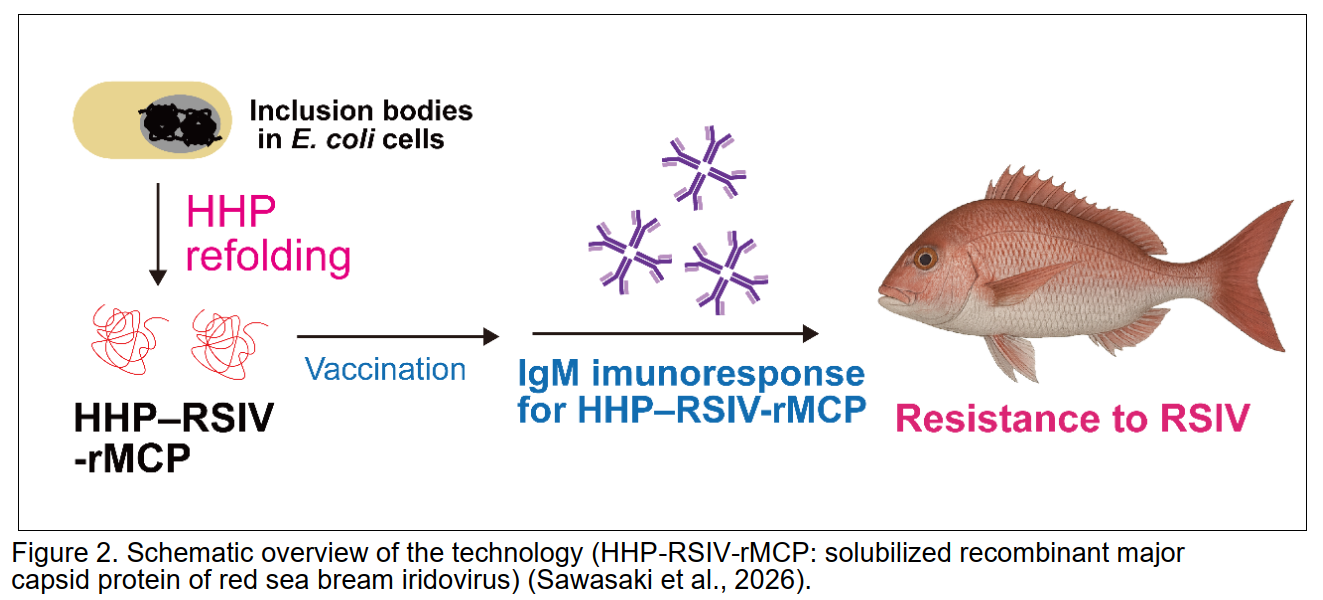
The research group at Ehime University focused on the major capsid protein (MCP), the principal outer capsid component of RSIV, and developed a recombinant vaccine. Native MCP can induce strong immunity, but when produced in E. coli, it tends to form insoluble aggregates (inclusion bodies) and loses activity. This technology applies a “high-hydrostatic-pressure refolding method” to these inclusion bodies, using pressure and decompression at approximately 200 MPa to successfully solubilize the protein while precisely preserving the three-dimensional structure essential for immunogenicity. The vaccine is also being developed for oral administration to improve the work efficiency of operators and is expected to serve as a next-generation vaccine.
Partnering Model
Ehime University is seeking animal and aquaculture vaccine manufacturers interested in the
practical application of this vaccine. If you are interested, we would be pleased to arrange a direct
meeting with the researchers. Please feel free to contact us with any questions.
Principal Investigator
Akira NOZAWA, Associate Professor (Proteo-Science Center, Ehime University)
Yuta SAWASAKI, Specially Appointed Researcher(Proteo-Science Center, Ehime University)
Patents and Publications
Patent: Patent application pending (not yet disclosed)
Publication: Sawasaki Y., et al., Int. J. Mol. Sci.(2026), 27(2), 675;
[DOI] https://doi.org/10.3390/ijms27020675
Patents and Publications
Patent:
- Patent application pending (not yet disclosed)
Publication:
- Sawasaki Y., et al., Int. J. Mol. Sci.(2026), 27(2), 675;[DOI] https://doi.org/10.3390/ijms27020675