Advantage and Core Benefit
- Simple New Surface Treatment: Instead of APTES, L-cysteine is used to modify the gold surface. This allows for a thinner insulator layer and keeps the electric field strong for better SERS signals.
- Higher Sensitivity Than Commercial Products: Can detect very small amounts of molecules (nM level). Shows 3–4 times better sensitivity than top commercial SERS chips.
- Many Possible Uses: Useful for drug discovery, detecting biomarkers and viruses, and testing food safety.
Background and Technology
SERS (surface-enhanced Raman scattering) helps detect very small amounts of substances, and is used in biology, chemistry, and environmental fields. Gold colloidal crystals—gold nanoparticles arranged in regular patterns—are good materials for SERS, especially when they form strong “hotspots” for the electric field.
One way to improve SERS is to use a metal–insulator–metal (MIM) structure. But if the insulator is too thick, the signal becomes weak. The team first used TiO₂ as the insulator, which helped with colloid adsorption but didn’t work well for SERS.
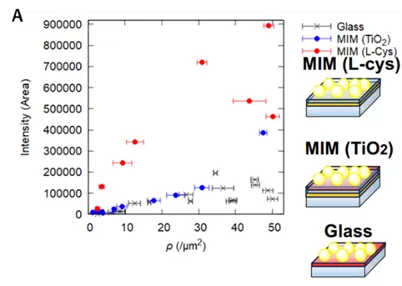
To fix this, they used L-cysteine, which sticks to gold very well. It forms a very thin insulating layer, keeping the electric field strong. With this method, SERS signals became 17 times stronger than from normal glass-based chips. When using gold colloidal crystals instead of randomly placed particles, the signal was even stronger—about 3–4 times better than the best commercial products.
Data
- Random Adsorption on MIM (L-cys) Substrate: SERS signal was 17× stronger than that from a glass substrate.
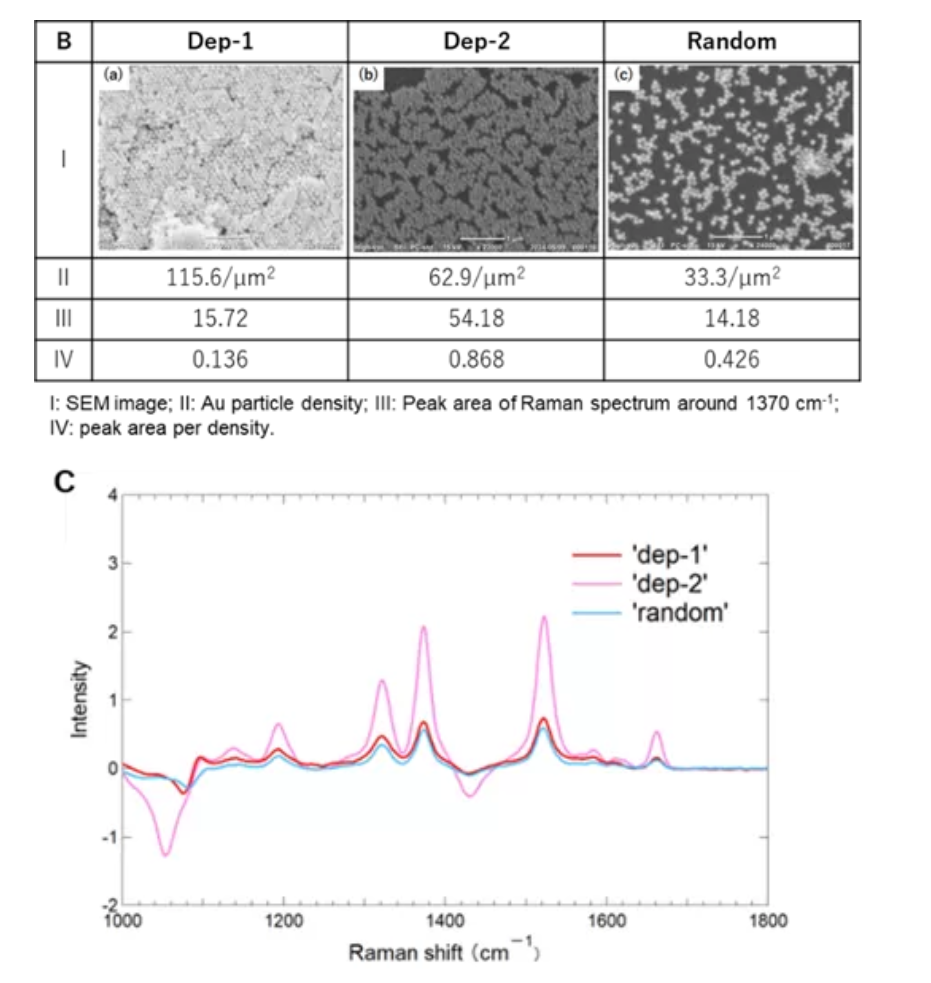
- Crystal Adsorption with Different Densities: When rhodamine was measured on L-cysteine-modified substrates with different densities of gold colloids, the signal was ~4× higher than with random particles, and better than top commercial products.
Patents and Publications
JP7079923B2, Others pending (not yet published)
Principal Investigator
Dr. Junpei Yamanaka and Dr. Akiko Toyotama (Nagoya City University)
Expectations
We are looking for companies interested in testing this SERS substrate and developing it further. Test samples can be provided under a fee-based Material Transfer Agreement (MTA). Please contact us if you are interested.
Project ID: WL-05075