
Advantages
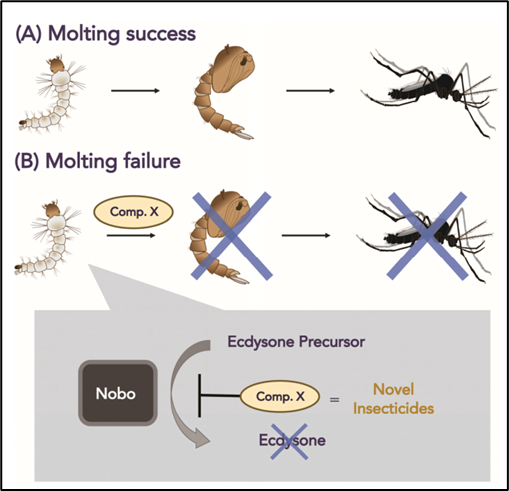
(1) Selective Action on a Novel Target: This agent effectively controls mosquitoes while minimizing impact on non-target insects by targeting the Nobo enzyme, a novel mechanism involved in the ecdysteroid biosynthesis of the Aedes aegypti mosquito.
(2) Addresses Insecticide Resistance: With a chemical structure and mechanism of action distinct from pyrethroid insecticides, it is effective against resistant mosquitoes and is suitable for rotation or combination with existing agents.
(3) Flexible Screening and Development: A high-throughput screening system based on Nobo inhibitory activity has been established, facilitating the efficient discovery of related compounds and lead
Technology Overview & Background
Vector-borne viral diseases such as dengue and Zika fever, transmitted by the Aedes aegypti mosquito, pose a significant public health challenge, causing approximately 700,000 deaths worldwide annually. Mosquito control is critical to managing these diseases, but it is becoming increasingly difficult due to the rise of mosquito populations resistant to existing insecticides, including pyrethroids. Furthermore, the environmental impact of insecticides on non-target insects must be considered during application.
Against this backdrop, a research team at the University of Tsukuba has discovered a novel insecticide, "R22," that acts specifically against Aedes aegypti. The active ingredient of R22 is an isoquinoline compound (2-(5-nitro-2-pyridinyl)-1,2,3,4-tetrahydroisoquinoline) that suppresses the growth and eliminates mosquito larvae by inhibiting the "Noppera-bo (Nobo)" enzyme, which is essential for ecdysteroid biosynthesis. R22 possesses a mechanism of action and chemical structure different from existing pyrethroid insecticides, making it a promising tool to overcome resistance. It also exhibits low toxicity in mammals, indicating a high potential for safe use.
Expectations
The University of Tsukuba is seeking companies in the pesticide and insecticide development sectors that are interested in this technology. We are keen to pursue collaborative development based on this invention, including projects focused on the structural optimization of the lead compound, R22. We have also established an effective high-throughput screening system that can be utilized to discover new compounds. Direct meetings with the researcher can be arranged for further discussions.
Data
(1) Larvicidal Activity against Aedes aegypti: R22 demonstrated high larvicidal efficacy with an LD₅₀ of 0.83 ppm.
(2) Enzyme Inhibitory Activity: R22 showed an IC₅₀ of 0.70 μM against Nobo, an activity approximately 30 times more potent than the existing inhibitor estradiol (IC₅₀ = 2.33 μM).
Principal Investigator
Dr. Ryusuke Niwa(University of Tsukuba)
Patents and Publications
Patent pending