
Advantages
1) Foundational Treatment for HFpEF: Directly targeting cardiac fibrosis, this approach aims for a fundamental improvement in cardiac diastolic function, which is only minimally addressed by existing drugs.
2) Rapid Commercialization Potential: By repositioning the existing drug, tamibarotene (AM80), which has a confirmed safety profile, we can significantly reduce the risks and costs associated with clinical development.
3) Contribution to a Broad Patient Population: This addresses a significant unmet medical need for HFpEF, a condition for which no established treatment exists, and which affects approximately half of all heart failure patients.
Current Stage and Key Data
The preclinical stage (in vivo POC) is complete, and we are preparing for clinical trials in collaboration with Toko Pharmaceutical Industries Co., Ltd., the developer of tamibarotene (AM80).
We are also in consultation with the Japanese regulatory authority (PMDA).
We are seeking partner companies that can provide financial support to accelerate the promotion of clinical trials.
[Data]
Improvement of cardiac diastolic function in HFpEF model mice: Oral administration of tamibarotene (AM80) to HFpEF model mice significantly improved E/e' values, a measure of cardiac diastolic function (Figure on next page: graph comparing E/e' values before and after treatment). values before and after treatment).
Partnaring Model
Collaborative Development/Licensing Agreement: We want to find a partner to conduct regional development and commercialization under a licensing agreement, and advance clinical trials using tamibarotene (AM80).
Background and Technology
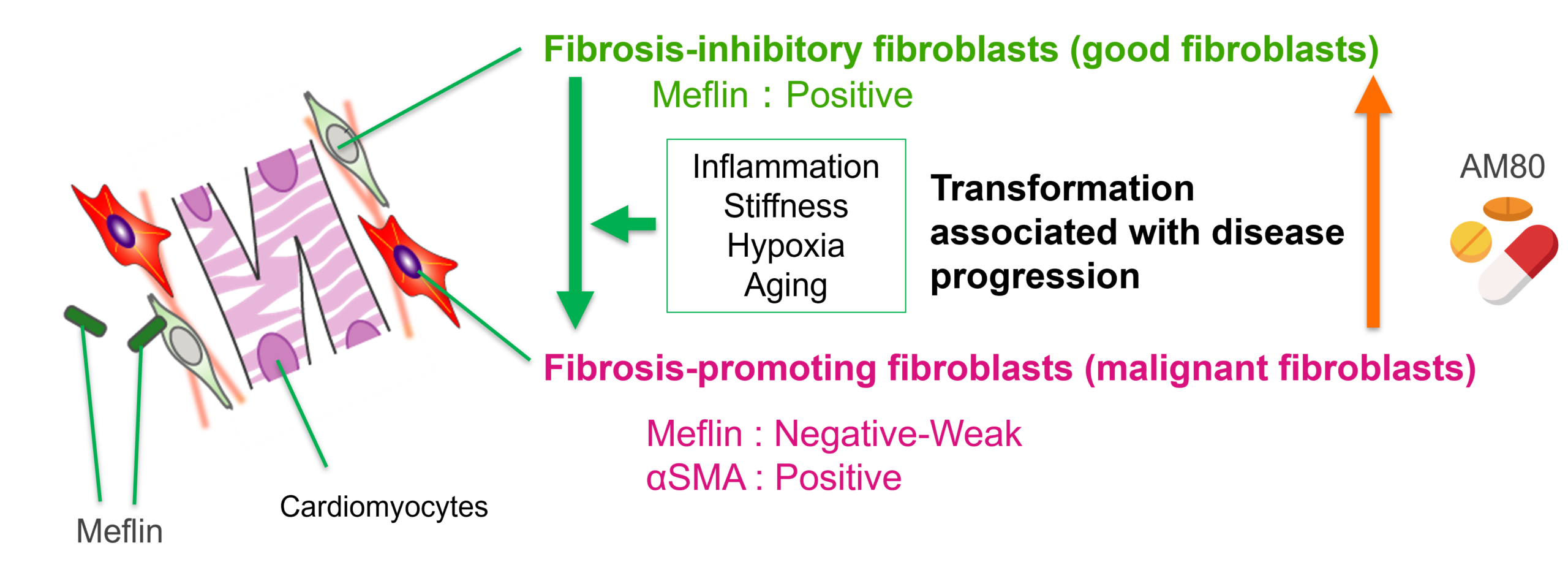
Background: Heart failure with preserved ejection fraction (HFpEF), which accounts for half of all heart failure patients, has a poor prognosis, and drug therapy based on a detailed understanding of the disease pathology has not yet been developed. The proliferation of cardiac fibroblasts and interstitial fibrosis is suggested to be one of the causes of HFpEF onset.
Technology: In our research, we discovered Meflin as a marker specifically expressed in "good" fibroblasts involved in tissue repair. Meflin enhances the action of BMP7 to suppress fibrosis and inhibits the collagen cross-linking enzyme LOX to prevent tissue hardening. When Meflin is deficient, normal fibroblasts differentiate into "malignant" myofibroblasts that promote fibrosis, leading to heart failure that closely resembles HFpEF. After screening for drugs that induce Meflin expression, we found that the existing drug tamibarotene (AM80) was a hit and confirmed that it significantly improved cardiac function in a mouse model of HFpEF. This allows us to propose a completely new therapeutic concept that acts on the root cause of fibrosis.
Principal Investigator
Dr. Katsuhiro Kato and Prof. Atsushi Enomoto (Nagoya University)
Patents and Publications
Patent: PCT/JP2023/016268
Publication: Hara, et al. Circ Res, 2019
Patents and Publications
- Patent: PCT/JP2023/016268
- Publication: Hara, et al. Circ Res, 2019