
Advantages
High diagnostic accuracy: Achieves high accuracy (AUROC 0.87) in distinguishing between HCC and ICC, which is difficult with existing markers.
Completely non-invasive: Enables rapid qualitative diagnosis with only a small blood sample, avoiding liver biopsies that place a heavy burden on patients.
Synergistic effect with existing markers: Further improvement in diagnostic accuracy can be expected by combining this with existing HCC markers.
Current Stage and Key Data
Clinical data obtained through ELISA measurements using human serum (a total of 76 cases, including patients with ICC, HCC, and extrahepatic biliary tract cancer).
Significant increase in serum CXCL2 concentration: The ICC patient group (median 247.2 pg/mL) showed significantly higher values compared to other groups, including HCC.
High ability to distinguish from HCC: In the distinction between ICC and HCC, the AUROC was 0.87. When the optimal cut-off value was used, a diagnostic accuracy of 92.86% sensitivity and 84.62% specificity was confirmed.
Partnaring Model
Seeking partner companies: We are looking for collaborative partners, such as diagnostic drug manufacturers, for the practical application of the HCC/ICC diagnostic marker based on this technology.
Expected collaboration: We welcome joint research and development with companies that have a track record in developing existing liver cancer markers or those interested in creating multi-item panel diagnostic kits.
Meetings with the inventor: We also accept direct meetings with the inventor regarding technical details and future development roadmaps.
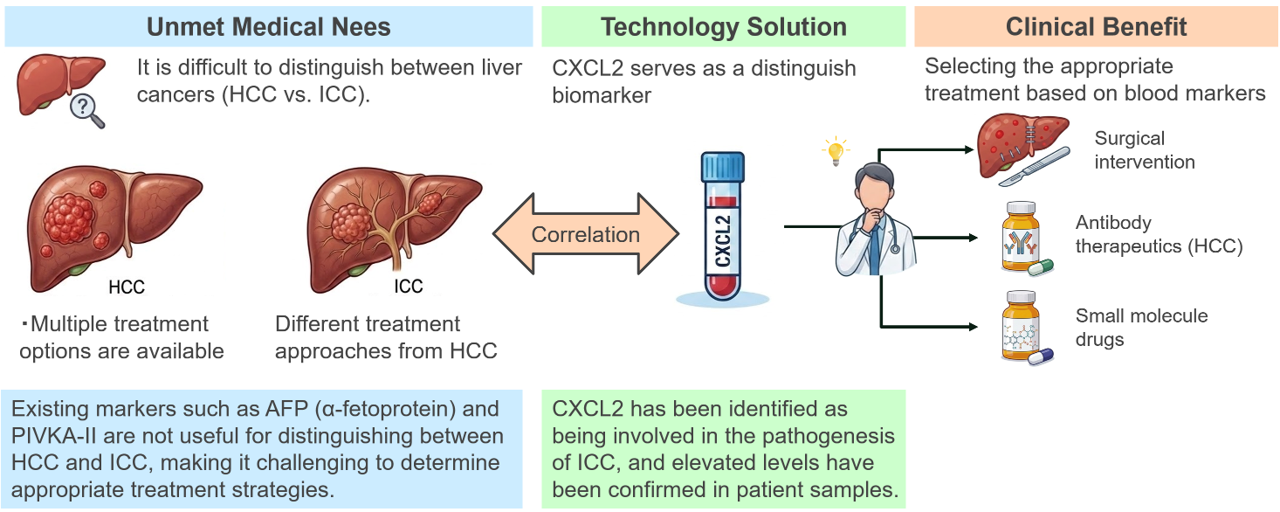
Background and Technology
Need for accurate distinction in liver cancer: It is important to distinguish between hepatocellular carcinoma (HCC) and intrahepatic cholangiocarcinoma (ICC), which has a poor prognosis, because their treatments are fundamentally different.
Challenges of existing diagnosis: Existing tumor markers and imaging diagnosis often have difficulty distinguishing ICC, making it necessary to rely on liver biopsies for a definitive diagnosis.
Discovery of a novel marker: A research group at Osaka University discovered that "CXCL2" in the serum serves as a specific biomarker for ICC.
Mechanism and proof: It was revealed that CXCL2 is involved in the transdifferentiation from hepatocytes to ICC. Furthermore, it was proven that CXCL2 levels are significantly higher in the serum of actual ICC patients.
Strengths of this technology: It is a breakthrough diagnostic method that can easily and accurately distinguish between HCC and ICC using only a blood test.
Principal Investigator
Takahiro Kodama, Professor (Department of Gastroenterology and Hepatology, Graduate School of Medicine, Osaka University)
Patents and Publications
Patent filed (Unpublished)