
Advantages
(1) Maximizing the effectiveness of regenerative medicine: By actively incorporating transplanted cells into neural circuits, accelerated functional expression and therapeutic effects are expected.
(2) Scientific basis: Based on the discovery that "sleep is crucial for the integration of immature neurons," evidence has been obtained in mouse experiments showing that "synchronized stimulation to a specific phase of theta waves during REM sleep" significantly promotes memory consolidation.
(3) High versatility and scalability: Compatible with both optical and electrical stimulation. It can be developed not only for cell transplantation therapy but also as an "effect-enhancing add-on technology" for existing DBS/RNS (Deep Brain Stimulation/Responsive Neurostimulation) devices.
Current Stage and Key Data
Using mouse models, the mechanism that the rhythm (phase) of brain waves during sleep is important for memory consolidation has been elucidated.
It has been demonstrated that by synchronizing with that rhythm, the integration of iPS cell-derived immature neural cells into the hippocampus can be induced, enhancing memory.
[Key Data]
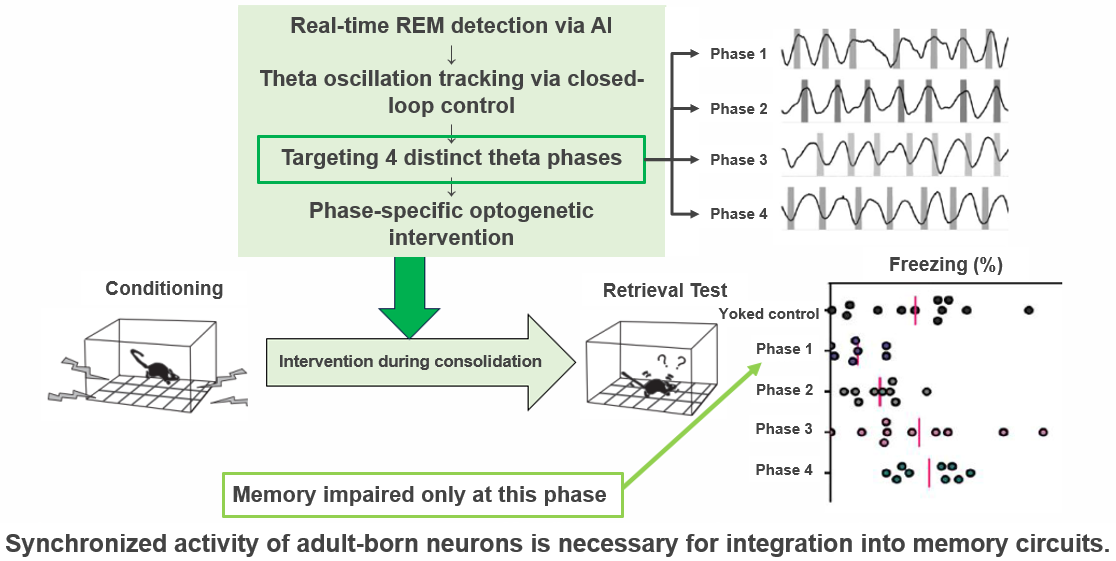
After training mice with invasive stimuli, optogenetic intervention was performed during "REM sleep". One theta wave cycle was divided into four phases, with stimulation synchronized to each. Consequently, freezing time (indicating impaired consolidation) was reduced only during a specific phase.
When light stimulation was synchronized with a specific theta phase during post-learning REM sleep, memory consolidation was significantly promoted compared to the control.
Partnaring Model
We propose collaborative research with companies developing cell medicines for neurological diseases.
Envisioned collaboration: The company provides therapeutic cells, and the University of Tsukuba conducts tests synchronizing brain waves with transplantation to verify improvements in engraftment and functionality.
As a next step, we propose a discussion with the inventor under an NDA, including undisclosed information.
Background and Technology
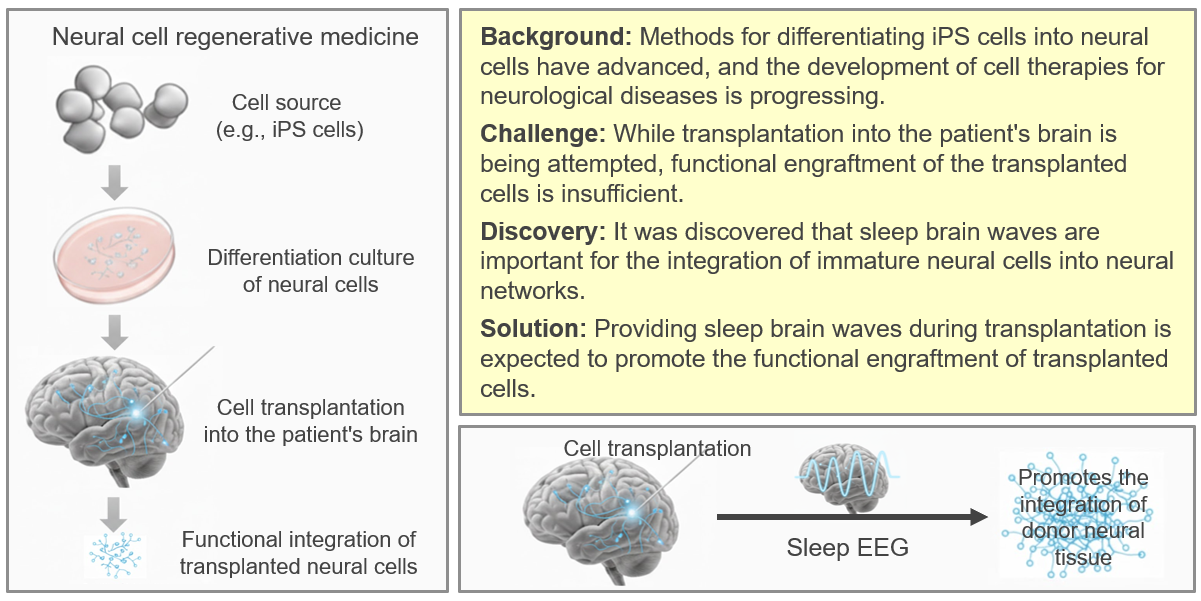
Challenge: Incompatibility of transplanted cells. In neural regenerative medicine using iPS cells, "integration failure"—where transplanted cells fail to connect with existing circuits and perform functions—remains a major challenge.
Scientific Discovery: Importance of REM sleep and theta waves. The reseachers discovered that synchronized activity with theta oscillations during REM sleep is essential for integrating immature neurons into memory circuits.
Solution: "Cell Integration Promotion System“. This system uses AI to detect REM sleep in real-time and stimulates transplanted cells during specific theta wave phases when neural plasticity is highest.
Result 1: Memory impairment via phase-specific intervention. In mouse experiments, stimulating a specific theta phase during post-learning REM sleep inhibited memory consolidation, proving the critical importance of "timing".
Result 2: Active memory promotion via synchronized stimulation. Conversely, light stimulation synchronized with the specific theta phase significantly promoted memory consolidation, suggesting transplanted cells can be "actively" incorporated into networks.
Principal Investigator
Prof. Masanori Sakaguchi M.D., Ph.D. (Kobe University / University of Tsukuba)
Patents and Publications
Patent pending (Undisclosed)
Press Release: https://www.tsukuba.ac.jp/journal/medicine-health/20250819143000.html
Srinivasan, S. et al. Nat Commun 16, 7210 (2025). https://doi.org/10.1038/s41467-025-62554-8
Koyanagi, I. et al. Neurosci Res Jan:186:51-58. (2023). https://doi.org/10.1016/j.neures.2022.10.001
Tezuka, T. et al. Sci Rep 11, 11151 (2021). https://doi.org/10.1038/s41598-021-90332-1
Patents and Publications
- Patent pending (Undisclosed)
- Press Release: https://www.tsukuba.ac.jp/journal/medicine-health/20250819143000.html
- Srinivasan, S. et al. Nat Commun 16, 7210 (2025). https://doi.org/10.1038/s41467-025-62554-8
- Koyanagi, I. et al. Neurosci Res Jan:186:51-58. (2023). https://doi.org/10.1016/j.neures.2022.10.001
- Tezuka, T. et al. Sci Rep 11, 11151 (2021). https://doi.org/10.1038/s41598-021-90332-1