
Advantages
Effective against Resistant IRR: Overcomes limitations of standard premedication (e.g., antihistamines).
Rapid Clinical Development: Enables drug repositioning of clinically-tested PAF inhibitors.
Broad Market Potential: Applicable to diverse high-ADCC antibodies (e.g., Rituximab, Avelumab, next-gen bispecifics).
Current Stage and Key Data
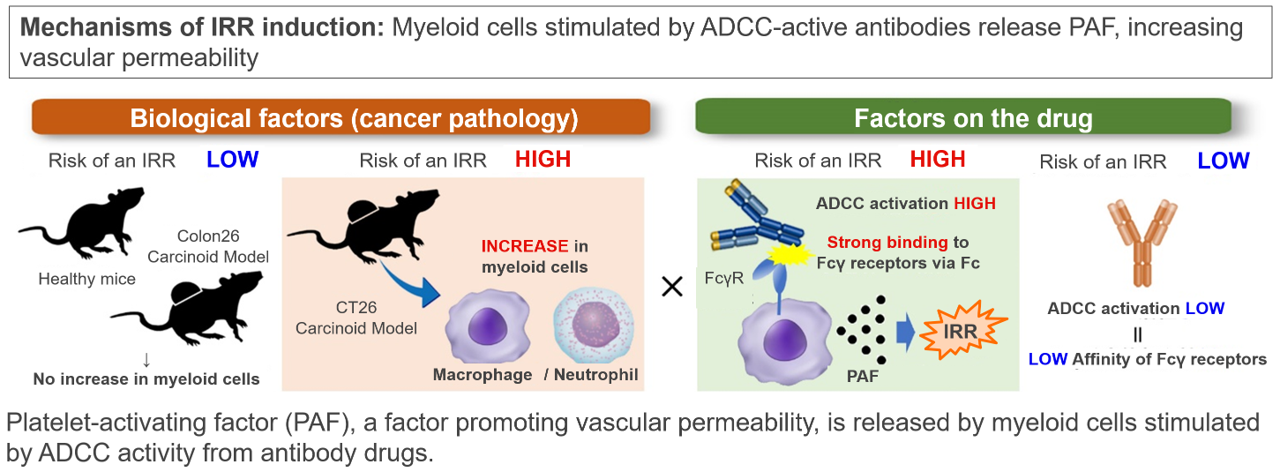
Validation in a tumor-bearing model: Using tumor-bearing mice with increased bone marrow cells as an IRR model, we have confirmed that multiple PAF receptor inhibitors suppress the onset of IRR.
Validity of the target: We have demonstrated that the removal of hematopoietic cells using clodronic acid liposomes suppresses the onset of IRR.
Inhibition of Hypothermia by PAF Blockade: While antihistamines (diphenhydramine) were ineffective against IRR, PAF receptor antagonists (CV-6209, Apafant, etc.) demonstrated a significant inhibitory effect.
Quantification of Serum PAF: LC-MS/MS analysis confirmed an increase in serum PAF concentrations upon the onset of IRR.
Partnaring Model
Companies developing PAF inhibitors or holding compound libraries: Joint development with companies holding PAF receptor inhibitor assets, aimed at clinical translation for the prevention and treatment of IRR.
Companies with antibody drug discovery platform technologies: Joint development of systems to predict and evaluate IRR risk using human Fcγ receptor models or sharing expertise to design next-generation antibodies with reduced IRR risk.
Licensing: Patent licensing is available for agents intended for the prevention and improvement of infusion-related reactions, as well as for their screening methods.
Background and Technology
Background: Challenges in Standard Treatment
Frequent Side Effect: High IRR incidence during initial antibody administration.
Limitations of Premedication: Standard drugs (e.g., antihistamines) are often insufficient (e.g., Rituximab ~77%, Avelumab ~99%).
Our Technology: Mechanism Elucidation & New Target
Risk Factor: High ADCC activity strongly increases IRR risk (FAERS analysis).
PAF Involvement: Antibody drugs stimulate myeloid cells to release PAF, increasing vascular permeability.
Target Validation: PAF inhibitors significantly suppress antihistamine-resistant IRR in our proprietary mouse model.
Principal Investigator
Dr. Hiroto Hatakeyama, Dr. Yuta Tameimoto (Chiba University, Graduate School of Pharmaceutical Sciences)
Patents and Publications
Patent pending(unpublished)