
Advantages
Targeting the Tumor Microenvironment (TME): A novel mechanism that minimizes the impact on the systemic immune system and selectively inhibits only macrophage-derived PF4 within the tumor.
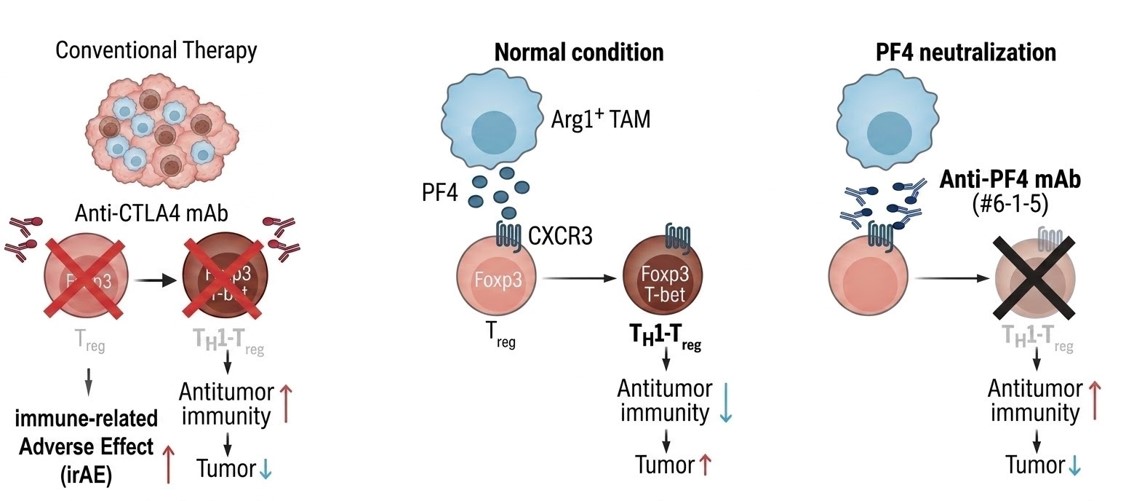
Avoidance of immune-related adverse events (irAEs): Preserves normal Tregs and suppresses only "tumor-associated Th1-Tregs," thereby avoiding autoimmune side effects caused by conventional immunotherapies.
Potent efficacy comparable to existing drugs: Demonstrates tumor shrinkage effects comparable to anti-CTLA-4 antibodies while maintaining a high safety profile without inducing autoimmunity.
Current Stage and Key Data
[Current Stage]
In vivo (Mice): Pre-clinical Stage. Proof of Concept (POC) for the antitumor effect and autoimmune avoidance of the established anti-PF4 neutralizing antibody has been obtained in two cancer models (MC38, B16F10).
Human Clinical Data: TCGA analysis confirmed that high expression of PF4 and a macrophage marker (CD11b) correlates with poor prognosis.
[Key Data]
Arg1+ TAMs: Depletion of Arg1+ TAMs decreases Th1-Tregs, activates antitumor immunity, and suppresses tumor growth.
PF4: PF4 induces Th1-Treg differentiation.
Anti-PF4 mAb: Shows an antitumor effect comparable to anti-CTLA-4 mAb, without inducing autoimmunity.
Partnaring Model
Co-development: Seeking partners to generate and optimize a novel humanized anti-PF4 mAb.
Antibody Provision: Anti-PF4 mAb (#6-1-5) is available for in-house evaluation under a paid Material Transfer Agreement (MTA).
Background and Technology
[Background and Challenges] While existing immune checkpoint inhibitors (such as anti-PD-1/CTLA-4 antibodies) are widely used, their action on the systemic immune system poses a challenge by inducing immune-related adverse events (irAEs), including autoimmune diseases.
[Discovery of the mechanism inducing tumor-associated Tregs] Th1-Tregs, which suppress cancer immunity, accumulate in the tumor microenvironment. The inventors discovered that the chemokine "PF4 (CXCL4)", secreted by tumor-associated macrophages (Arg1+ TAMs), induces the differentiation of these Tregs.
[Solution and Effects] It was revealed that an anti-PF4 neutralizing antibody selectively inhibits Th1-Treg differentiation locally in the tumor. Because it does not affect systemic normal Tregs, it avoids autoimmune diseases while exhibiting tumor growth inhibitory effects equivalent to anti-CTLA-4 antibodies, raising expectations for it to become a highly safe therapeutic approach.
Principal Investigator
Prof. Masahiro Yamamoto (University of Osaka)
Patents and Publications
Patent pending (Unpublished)
DOI: 10.1126/science.adn8608
Patents and Publications
- Patent pending (Unpublished)
- DOI: 10.1126/science.adn8608 https://doi.org/10.1126/science.adn8608