
Advantages
- Improved Vibration Suppression: Limits absorber operation to frequencies near the resonance frequency of the target object. Prevents the new resonances that conventional dynamic vibration absorbers cannot avoid and enhances damping performance.
- No Power Supply or Sensors Required: The absorber activates automatically only when the vibration of the target object is near its resonance frequency. Uses no power supply, motors, or sensors to detect the frequency or to start and stop the absorber.
- Lower Operating and Maintenance Costs: The simple mechanism reduces maintenance effort and cost compared with large-scale systems such as hydraulic ones.
- Wide Range of Applications: Can be incorporated into buildings, bridges, industrial machinery, ships, helicopters, drones, and more, regardless of scale or field.
Background and Technology
Suppressing vibration has been a long-standing challenge for buildings and industrial products, from the shaking of buildings and bridges during earthquakes to the rolling of ships in waves and the blade vibration of helicopters. Many vibration absorption technologies, including dynamic vibration absorbers (such as pendulum-type absorbers and mass dampers) and fin stabilizers, have been researched and developed, and they have achieved a certain degree of success. However, one phenomenon remains difficult to solve even today: resonance. When an object is subjected to vibration at its natural frequency (resonance frequency), it shakes violently. Left unaddressed, resonance causes severe damage and leads directly to safety problems.
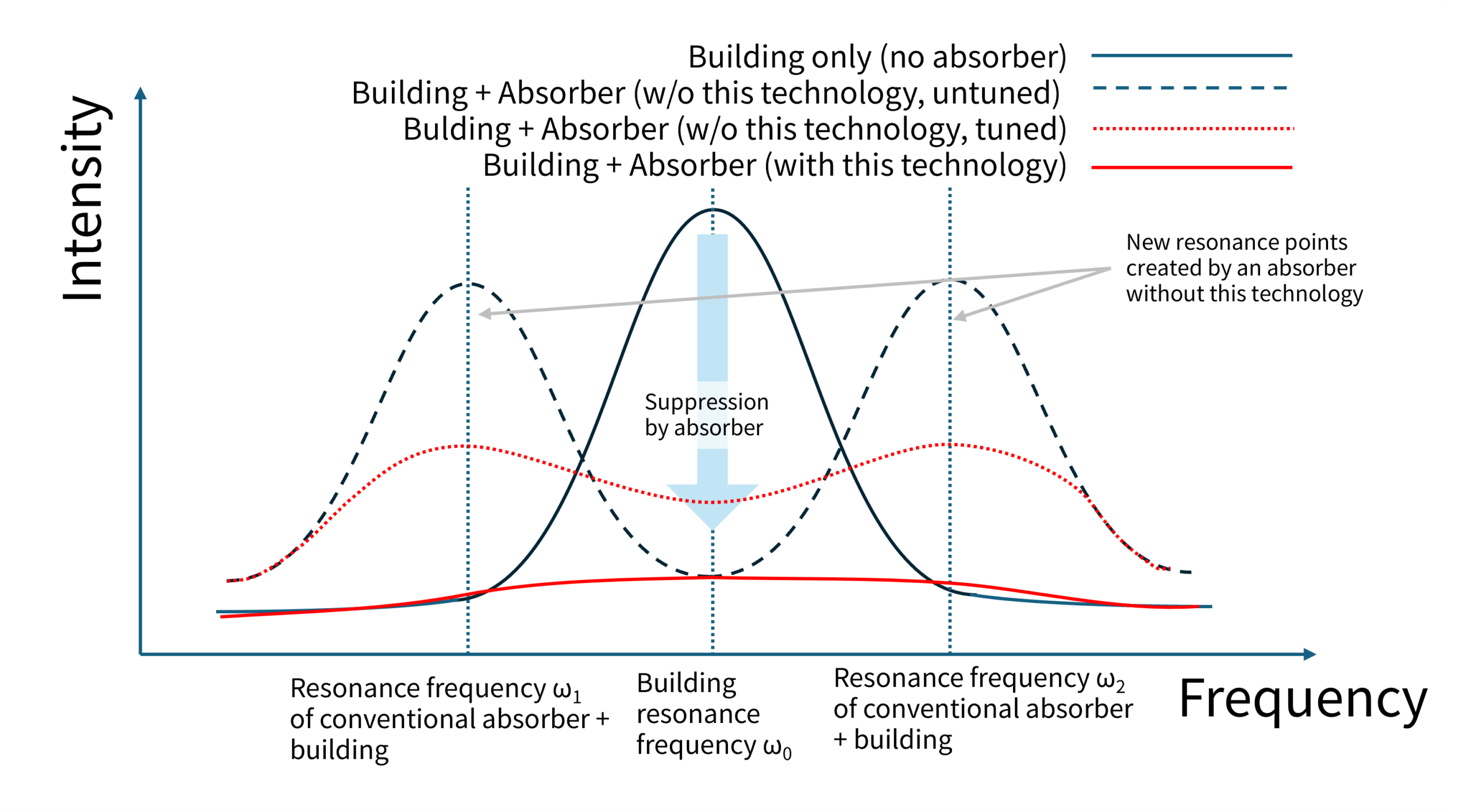
Resonance is difficult to solve because of a side effect caused by the vibration absorption technology itself. For example, when a dynamic vibration absorber is installed in a building, vibration near the building's resonance frequency ω0 is suppressed (arrow in the figure). However, the combined system of the building and the absorber has two resonance points, ω1 and ω2, and vibration at these points increases as a side effect (dashed line in the figure). If the operating band of the absorber is widened to suppress this side effect, the damping effect at ω0 itself weakens (dotted red line in the figure). Narrowing the band in which the absorber is effective makes the resonances at ω1 and ω2 grow, while leaving it wide dulls the effect at ω0. This has been the long-standing dilemma of resonance countermeasures.
The answer lies in narrowing the timing at which the absorber operates. In other words, if the absorber is driven only at the building's resonance point ω0, the side effect does not occur. This technology achieves this with a passive “latch mechanism.” The mass of the absorber (the damper part) built into the target object (a building or equipment) is held in place indirectly via magnets. When the vibration of the target object approaches the resonance frequency ω0, the magnets act as a nonlinear spring, automatically releasing the mass and allowing the absorber to move. When the vibration moves away from ω0, the magnets hold the mass in place again.
As a result, the absorber operates only near ω0, and the resonances at ω1 and ω2 that arise with conventional technology do not occur. Because the absorber works only at resonance, when the effect of vibration is greatest, the resonance of the target object can be suppressed effectively (solid red line in the figure).
The latch mechanism uses a spring made with magnets (a magnetic spring). By properly tuning the characteristics of this spring, the latch is designed to release at the building's resonance point ω0. In other words, the latch mechanism passively “detects” the vibration frequency and controls the operation of the absorber without any special sensor. In addition, because a magnetic spring is used to hold and release the absorber mass, no drive system such as a motor, and no power supply for one, is required.
Key Data
The concept of this technology has been confirmed by numerical simulation. In a simulation of a building in resonance, the magnetic spring of the latch exhibited nonlinear behavior and automatically released and held the absorber mass, and the absorber, operating only near the resonance point, strongly suppressed the vibration.
Expectation
This technology can be applied to a wide range of fields where vibration and resonance are a problem, including vibration control and seismic retrofitting of buildings, bridges, shipbuilding and marine transport, offshore wind power generation, industrial machinery such as machine tools, and aircraft such as helicopters and drones. Its passive operation is expected to be especially effective for applications where power supply installation work, frequent maintenance, or complex control should be avoided. The University of Tsukuba is seeking companies interested in this technology. The technology can be put to use immediately under a license for the patent and know-how. For companies wishing to examine its applicability to their products or to discuss detailed design for specific products, joint research is also available.
Principal Investigator
Prof. Hiroshi Yabuno (University of Tsukuba)
Patents and Publications
- Patent pending (unpublished)
- Reference: A recent research report by Prof. Yabuno (not a description of this technology)
C. Zhang and H. Yabuno, SICE Festival with Annual Conference (SICE FES), 27 August 2024. Engineering, Physics, 2024
Bibcode: sice.conf...77Z