
Advantages
- Analyzes the “phase resetting” phenomenon that arises spontaneously in unconscious brain activity—an objective, non-invasive biomarker of depression that does not rely on the patient’s subjective report and cannot be intentionally manipulated.
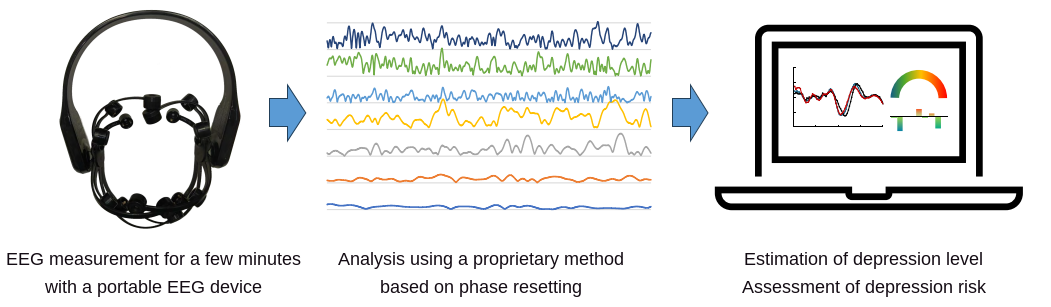
- No large-scale equipment is required; measurement is completed in a few minutes using an inexpensive, simple EEG device, minimizing the burden on the user.
Background and Technology
Depression is a serious social problem that markedly reduces productivity and quality of life.
Depression is currently diagnosed largely through interviews by specialists and subjective self-reporting, and no objective indicator of depression has yet been clearly established. Early-stage depression with mild symptoms is also difficult to notice.
Through many years of research on the brain’s neural networks and on Artificial Intelligence, Professor Masahiko Morita of the University of Tsukuba discovered that “EEG phase resetting” can serve as a biomarker of depression. The phase resetting is a phenomenon in which the timing (phase) of brain waves abruptly aligns when their amplitude decreases; it occurs unconsciously in healthy individuals on a daily basis. By monitoring the frequency of this EEG phase-resetting phenomenon and its successive occurrences, Professor Morita and colleagues developed an algorithm that can assess an individual’s “intensity of depressed mood” and “severity of depressive symptoms.”
Measuring EEG phase resetting does not require a large medical-grade EEG system; a simple EEG device is sufficient. Everyday EEG measurement combined with this technology should therefore make it possible to monitor depressed mood. Beyond clinical benefits such as the early detection of depression and the recording of depressive symptoms, this is expected to find application in healthcare services such as mental-health checks in the workplace and at home.
Furthermore, beyond depressive symptoms, the EEG phase-resetting phenomenon is increasingly suggested to be linked to sleep-state assessment and to other psychiatric and neurological conditions such as dementia and ADHD. In the future, this technology is expected to be applicable to the early detection and diagnosis of these conditions as well.
Key Data
- Analysis of EEG data from participants (untreated adults) confirmed that features related to phase resetting correlate strongly with Self-rating Depression Scale (SDS) scores.
- The predictive model we developed distinguished individuals with moderate-to-severe symptoms from those with mild symptoms with over 80% accuracy.
Expectation
The University of Tsukuba is seeking partnerships with EEG-device manufacturers, medical-device manufacturers, and healthcare-related companies that are interested in this technology. Depending on your company's capabilities and business area, we propose collaborations such as the following:
- For EEG-device or medical-device manufacturers: Consider adopting this algorithm as a new analytical function in the EEG devices you develop.
- For healthcare-related companies: Leverage EEG devices and medical equipment incorporating this technology to create new businesses such as stress monitoring and mental-health management services.
- Seeking ideas for new application areas: Beyond depression, phase resetting is also suggested to be associated with mental and neurological states such as sleep assessment, dementia, and ADHD. We would be glad to discuss a joint research framework.
Once a non-disclosure agreement is concluded with the University, we can share detailed technical information. If you would like the University’s support for technical validation and development toward commercialization at your company, we can discuss joint patent applications and patent licensing. We also welcome ideas for new businesses and joint research that focus on application areas beyond depression.
Principal Investigator
Prof. Masahiko Morita (Institute of Systems and Information Engineering, University of Tsukuba)
Patents and Publications
**Patents**
- WO2024/162387 (PCT/JP2024/003046)
- WO2025/023155 (PCT/JP2024/025846)
Other patent applications pending (unpublished).
**Publications**
- Morita M, et al.,Scientific Reports (2023) 13:14036. DOI: 10.1038/s41598-023-40582-y https://doi.org/10.1038/s41598-023-40582-y
Other manuscripts under review.
- University of Tsukuba press release (in Japanese):
https://www.tsukuba.ac.jp/journal/medicine-health/20230904180000.html