
Advantages
●Integrates complex processes such as solvent extraction and vacuum drying—which previously required approximately 15 hours—into a single paper-based platform, dramatically reducing pretreatment time to under 50 minutes.
●Requires no large equipment like centrifuges or specialized expertise, enabling stable pretreatment for anyone via on-paper washing and derivatization while effectively preventing sample loss.
●Allows selective adsorption and concentration of target substances from ultra-trace samples of 10 μL or less, making it ideal for dental diagnostics, pediatrics, and home-based healthcare where reducing sampling burden is critical.
Background and Technology
Pretreatment for GC-MS analysis has long been the primary bottleneck in rapid diagnostics due to its reliance on cumbersome steps, including solvent extraction, prolonged vacuum drying, and derivatization.
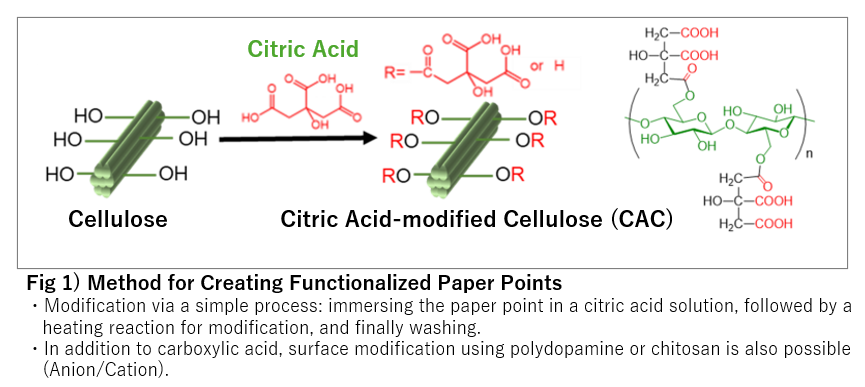
This technology introduces a novel functional device featuring cellulose fibers highly modified with functional groups such as citric acid and chitosan. The device selectively adsorbs target metabolites the moment the sample is aspirated, allowing washing and derivatization to be completed directly on the paper. This breakthrough realizes an ultra-simple analytical workflow that completely bypasses conventional extraction and drying stages.
Data
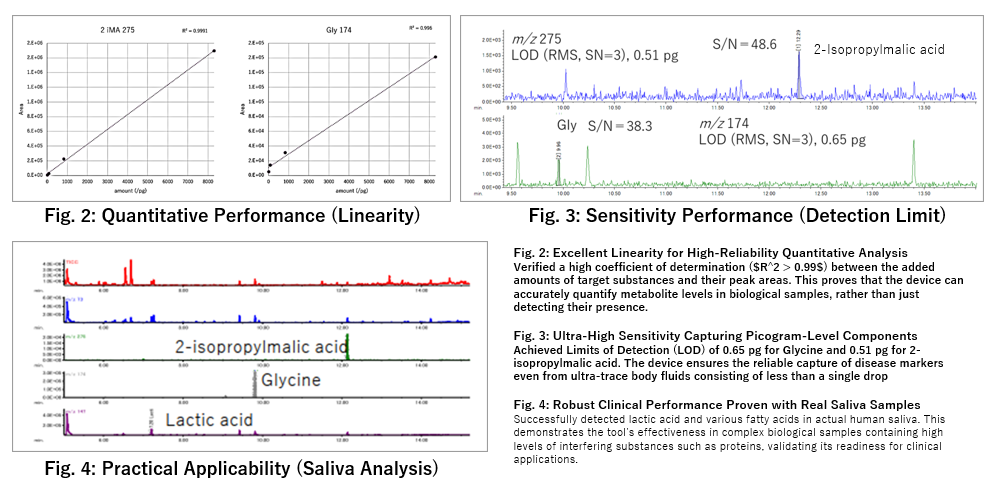
●Excellent Linearity for Reliable Quantitative Analysis (Fig. 2):
Confirmed a high coefficient of determination (R² > 0.99) between added amounts of target substances and their peak areas. This enables precise quantification of metabolites in biological samples, moving beyond mere detection.
●Ultra-High Sensitivity at the Picogram Level (Fig. 3): Achieved Limits of Detection (LOD) of 0.65 pg for Glycine and 0.51 pg for 2-isopropylmalic acid. The system reliably captures disease markers even from ultra-trace body fluids of less than one drop (< several μL).
●Clinical Applicability to Real Samples (Fig. 4):
Successfully detected organic acids, including lactic acid and various fatty acids, in actual saliva samples. This proves the tool’s effectiveness even in complex biological samples containing high levels of interfering substances like proteins.
Expectations
We are seeking partners to co-create next-generation analytical solutions by resolving long-standing pretreatment bottlenecks to drive business competitiveness
▼Diagnostic & Analytical Device Manufacturers
Goal: Instant Diagnostics & New Markets
We aim to integrate "under 30-minute" results as a core value in dental, POC, and mobile diagnostics to create new market value.
▼Clinical Labs & CROs
Goal: Throughput & Profitability
We seek to modernize workflows by reducing overnight processes to under 50 minutes, significantly cutting labor and reagent costs.
▼ Materials & Environmental Companies
Goal: Application-Specific Devices
We offer customization of functional groups for specific markers or pollutants to co-develop high-performance, needs-based sampling devices.
Principal Investigator
Junichi Osuna (Specially Appointed Researcher, Graduate School of Science, Osaka University)
Patents and Publications
Japanese Patent Application No. 2024-088075