
Advantage and Core Benefit
●Dramatic Leap in Practical CO2 Capture Capacity under Low Partial Pressure
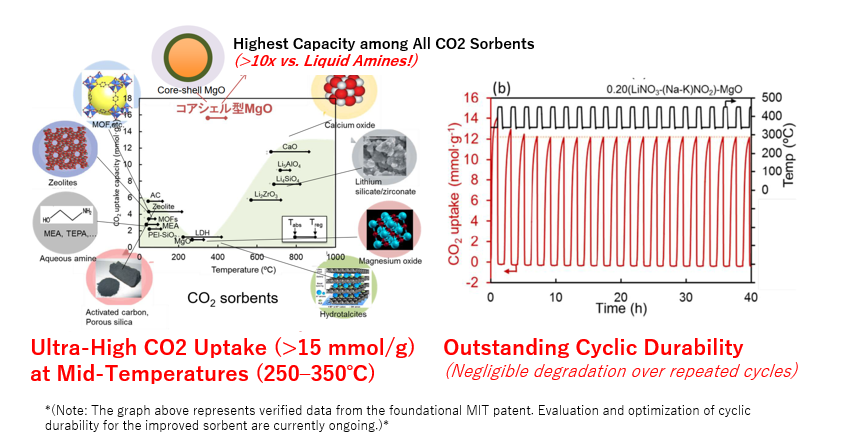
By applying our institute's proprietary improvements to the base material developed at MIT (which holds a maximum potential of 15 mmol/g), the capture capacity under low partial pressure (0.15 bar)—equivalent to actual industrial flue gas—has been boosted by over 1.6 times (from 1.5 to 2.5 mmol/g). This breakthrough enables a dramatic downsizing and a minimal footprint for capture facilities.
●Exceptional Adsorption/Desorption Cyclic Stability
Our proprietary molten salt coating suppresses thermal degradation and enables low-temperature desorption. Proven high durability with negligible performance decay even under continuous cyclic operations.
●100% Dry Process with Zero Cooling and Minimal Thermal Loss
Directly processes mid-temperature flue gas (250–350°C) without any pre-cooling. Eliminates the need for massive cooling infrastructure required by amine systems, fundamentally resolving the immense energy loss associated with heating aqueous solutions.
Background and Technology
Conventional wet amine scrubbing operates at low temperatures (40–60°C), making massive cooling equipment, immense energy consumption, and equipment corrosion severe bottlenecks when treating mid-temperature flue gas.
Building upon the foundational technology (molten salt-coated MgO) developed by the inventor during his tenure at MIT, this state-of-the-art technology integrates a proprietary improvement—the "precise dispersion of carbonates"—developed at Institute of Science Tokyo.
This advancement enables high-capacity, high-speed CO2 adsorption and desorption even under low partial pressure (0.15 bar) environments typical of industrial flue gases.
Key Data and Current Stage
This material demonstrates overwhelming superiority in the mid-temperature range (250–350°C), a critical gap that existing porous materials (Zeolites, etc.) or high-temperature sorbents (CaO, etc.) cannot effectively cover. It maintains its initial performance over multiple continuous cycles, successfully validating excellent regenerability and cyclic stability at the laboratory level. (Note: The graph below represents data from the foundational MIT patent.)
Expectations
By integrating this unparalleled capture capacity with the inventor’s process concept for "pre-treatment-free, multi-gas multi-stage separation," we aim to deploy a highly efficient, next-generation integrated CCUS system.
To overcome engineering barriers and co-create a new market for mid-temperature carbon capture, we are actively seeking partnership with forward-thinking companies in the following sectors:
• 【Materials & Forming】 Chemical, material, or catalyst manufacturers capable of granulating powder into practical pellets/honeycombs and establishing mass-production processes.
• 【Equipment & Engineering】 EPC companies, environmental plant developers, or boiler manufacturers ready to design next-generation reactors and systems that maximize this material's potential.
• 【Deployment & End-Users】 Heavy industry, steel manufacturing, or large-scale mobility corporations (marine shipping, etc.) that can provide mid-temperature flue gas environments for field testing.
Principal Investigator
Assoc. Prof. Takuya Harada (Institute of Science Tokyo, School of Materials and Chemical Technology)
Patents and Publications
Patents:
・[Core Technology (Patent under Application)]
Japanese Patent Application No. 2024-138932 (WO2026042784A1)
・[Foundational Patent (Reference)]
US 10,322,399 B2 / Assignee: Massachusetts Institute of Technology (MIT)
Information on related literature is included in the materials. Please click the “Iinterested in this technology? [Download Materials]” button below to download and view the materials.