
Advantages
High Safety:
- The anaerobic threshold (exercise limit) can be predicted using only low-intensity warm-up exercises.
Reflects Daily Physical Condition:
- It detects in real time fluctuations in daily exercise tolerance caused by lack of sleep or poor health.
Simplified Testing:
- It achieves highly accurate monitoring using only a continuous blood pressure monitor and AI, without the need for expensive, bulky breath gas analyzers.
Background and Technology
In cardiac rehabilitation and the prevention of lifestyle-related diseases, the most effective intensity is considered to be the anaerobic threshold (AT), the point at which the body transitions from aerobic to anaerobic metabolism. However, accurately measuring the AT requires the use of specialized equipment to apply a load that exceeds the AT, which poses physical risks for patients with heart disease and the elderly. Furthermore, since the optimal exercise intensity varies daily depending on factors such as sleep and fatigue levels, the values obtained during testing are not always accurate. The Karvonen method is a well-known approach for determining optimal intensity without exercise stress; however, as it is calculated using only resting heart rate and age, it often deviates significantly from the actual optimal exercise intensity, which likewise fluctuates from day to day.
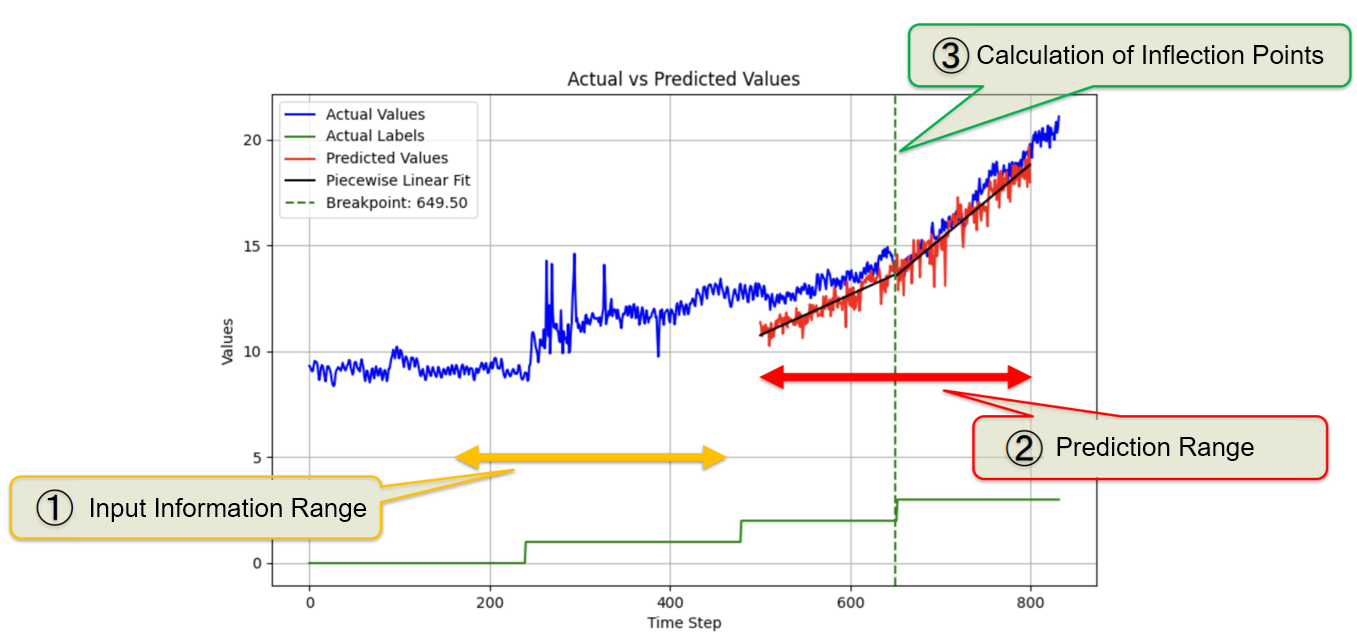
To resolve these issues, the researchers have developed a system that predicts the point at which the subsequent exercise load will reach its limit (inflection point: DPBP) based on slight changes in blood pressure and heart rate during the warm-up phase. By focusing on the double product (DP = 'systolic blood pressure' x 'heart rate'), which correlates with myocardial oxygen consumption, the system uses AI to analyze and predict subtle DP responses during the warm-up phase. This allows the system to predict and calculate the DPBP (the inflection point where the slope of DP rises sharply; see figure)—which would normally appear when the exercise load is increased in the future—before the actual load is applied. Rather than relying on a one-size-fits-all formula like the Karvonen method, this approach derives the optimal intensity based on the body’s current condition. Consequently, it enables the creation of personalized exercise prescriptions tailored to each patient on a daily basis before starting their routine, and is expected to serve as a groundbreaking solution that supports safe rehabilitation for patients with heart disease.
Data
Researchers examined 58 patients with cardiovascular disease and 26 healthy individuals to verify the correlation between measured AT obtained through breath gas analysis and the inflection point (DPBP) predicted and calculated using a continuous blood pressure monitor.
The results showed a significant correlation (p < 0.0001) between measured AT and DPBP predicted from continuous blood pressure.
Expectations
Fukuoka University is seeking companies interested in this invention to collaborate on its development.
The researcher has already prototyped a program for wearable devices using this technology and plans to use this program to collect additional data and continue development to verify its effectiveness and improve its accuracy. The research team is seeking joint development partnerships with companies that develop rehabilitation equipment, wearable blood pressure monitoring devices, and healthcare technology companies. We also invite companies currently developing apps for wearable devices to consider incorporating this technology into their products.
Upon signing a confidentiality agreement with Fukuoka University, we can disclose unpublished data and arrange meetings with the researchers. Please feel free to contact us for more information.
Principal Investigator
Yasunori Suematsu, MD, PhD
Associate Professor, Department of Cardiology, Fukuoka University Hospital
Patents and Publications
A patent applied in Japan and unpublished.