
Advantages
- LAT1‑mediated tumor selectivity: LAT1 is highly expressed in many malignant tumors, and α‑methyl‑tyrosine derivatives are taken up into tumor cells with high selectivity via LAT1‑mediated transport.
- Versatility as a LAT1‑targeted platform: The boronic acid pinacol ester derivative Bpin‑AMT functions as a LAT1‑targeted building block that not only enables radiotheranostic labeling, but is also expected to be extendable to BNCT boron carrier precursors and LAT1‑mediated DDS carriers through conjugation of small‑molecule anticancer drugs or PDT photosensitizers.
Current Stage and Key Data
Current Stage
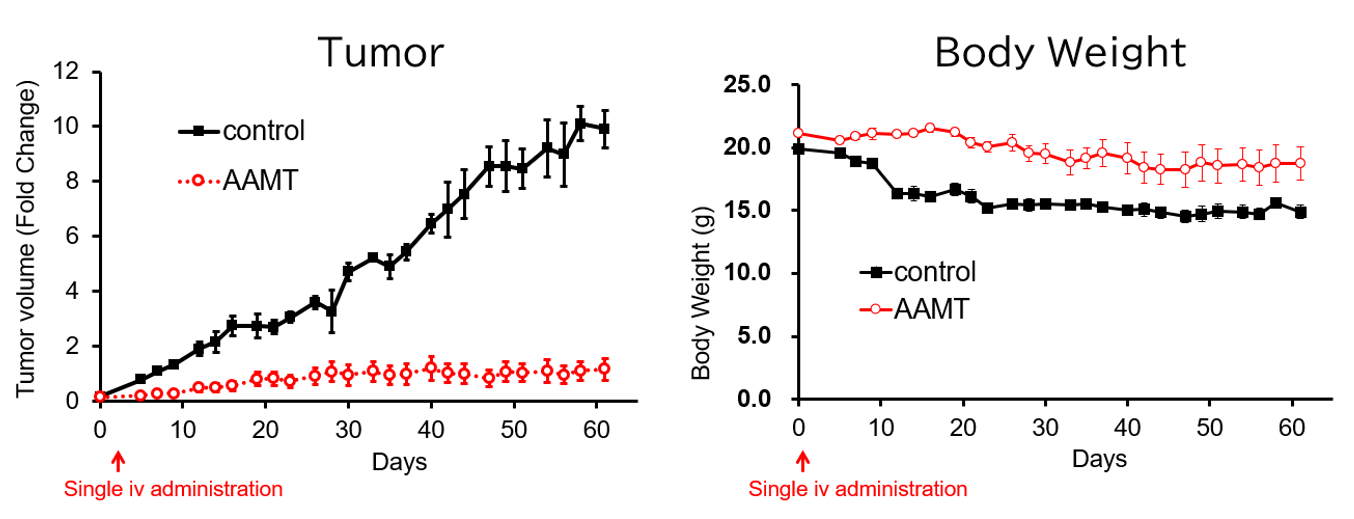
Proof of concept (PoC) of therapeutic efficacy of 211At‑AAMT has been obtained in mouse models (including PANC‑1 pancreatic cancer).
Efficient labeling of 211At and 131I under mild aqueous conditions has been achieved using Bpin‑AMT.
Key Data
In PANC‑1 tumor‑bearing mice, a single intravenous dose of 211At‑AAMT (1 MBq) resulted in tumor growth suppression for approximately 2 months without significant body‑weight loss, indicating favorable safety signals in this model.
Whole‑body biodistribution data of 211At‑AAMT in mice have also been obtained.
Partnaring Model
The University of Osaka is seeking partners interested in collaborative research and/or in‑licensing to utilize this building block for the creation of novel LAT1‑targeted agents.
In particular, collaborations with pharmaceutical and biotech companies, which have focus on the following areas:
- Radiation and nuclear medicine (TAT, RI diagnostics, RI therapeutics)
- Small‑molecule anticancer drugs and molecular targeted therapies
- Photodynamic therapy (PDT) and photosensitizer development
We would be happy to arrange technical discussions with the principal investigator for interested companies.
Background and Technology
L‑type amino acid transporter 1 (LAT1) is a transporter for neutral amino acids. Because cancer cells require large amounts of amino acids for growth, LAT1 is frequently overexpressed in many solid tumors, including lung cancer, pancreatic cancer and malignant melanoma, and high LAT1 expression has been associated with aggressive disease and poor prognosis. In contrast, LAT1 expression in normal tissues is generally low, making LAT1 an attractive molecular target for cancer therapy and drug delivery.
α‑Methyl‑tyrosine (AMT) is a tyrosine derivative known to have high affinity for LAT1, which is upregulated in cancer cells. In particular, α‑methyl‑tyrosine analogs such as FAMT are transported selectively via LAT1 and are hardly transported by other amino acid transporters such as LAT2, thereby providing high selectivity for tumor uptake in PET imaging. However, conventional radiolabeling of AMT has relied on mercury‑based halogen exchange reactions, which pose issues in terms of manufacturing safety, variability in radiochemical yield, and product stability.
To address these challenges, researcher have developed a novel AMT derivative bearing a boronic acid pinacol ester (Bpin) group on the aromatic ring (Bpin‑AMT). Utilizing the Bpin moiety, 211At as well as therapeutic and diagnostic iodine radionuclides can be labeled safely and efficiently under mild aqueous conditions. Furthermore, the Bpin group can be converted to the corresponding boronic acid (B(OH)2) as a precursor for BNCT boron carriers, and it can also serve as a building block for conjugation of small‑molecule anticancer drugs or PDT photosensitizers to the AMT scaffold. Thus, this technology is expected to provide a versatile platform for the development of a broad range of LAT1‑targeted radiopharmaceuticals and drug delivery systems.
Principal Investigator
Invited Associate Professor. Yoshifumi SHIRAKAMI (Institute for Radiation Sciences, The University of Osaka)
Patents and Publications
Patent: PCT/JP2022/013808 (entered national phase in JP, US, EP, CN)
Publication: Kaneda‑Nakashima K, et al. Cancer Sci. 2021;112(4):1512‑1522.
doi:10.1111/cas.14761..
Patents and Publications
Patent:
- PCT/JP2022/013808 (entered national phase in JP, US, EP, CN)
Publication:
- Kaneda‑Nakashima K, et al. Cancer Sci. 2021;112(4):1512‑1522. doi:10.1111/cas.14761