
Advantages
High Unmet Medical Need: Provides a new therapeutic option for childhood end-stage renal failure (nephronophthisis), for which no specific treatment currently exists.
Potential for Expanded Indications: The identified "aberrant activation of the IL-6/JAK/STAT3 pathway" may be shared by other ciliopathies with renal cysts, such as autosomal dominant polycystic kidney disease (ADPKD), suggesting potential for broader applications.
Drug Repurposing: Existing JAK inhibitors (e.g., ruxolitinib) that are already approved and used for other diseases can be repurposed.
Current Stage and Key Data
Current Stage: Proof of Concept (PoC) has been confirmed using Xenopus embryos, which share a similar basic kidney structure with humans.
Next Steps: Efficacy evaluation and detailed mechanism validation using mammalian models or disease models derived from patient iPS cells (e.g., iPS cell-derived kidney organoids).
Key Data:
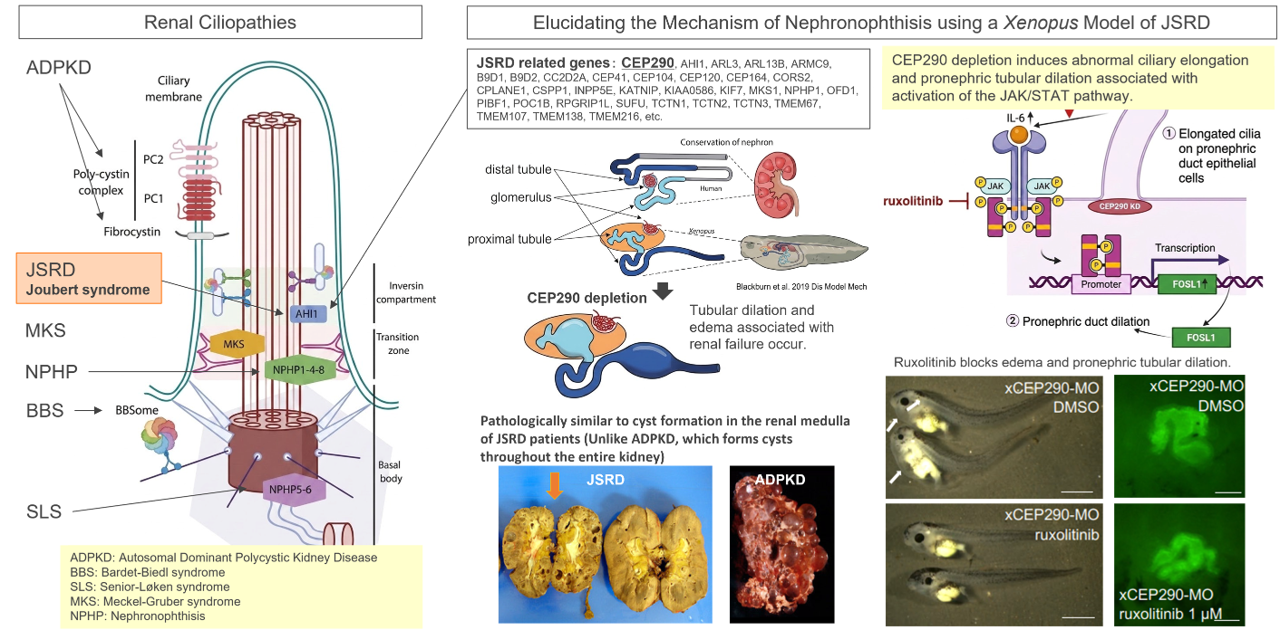
(1) In the kidneys of CEP290-depleted Xenopus models (morphants), RNA-seq and RT-qPCR analyses showed that the expression of genes associated with the IL-6/JAK/STAT3 pathway and its downstream target FOSL1 was significantly up-regulated.
(2) Treatment with a JAK inhibitor (ruxolitinib) suppressed STAT3 phosphorylation and significantly improved pronephric tubular dilation and edema.
(3) Overexpression of FOSL1 in normal embryos induced pronephric tubular dilation. Conversely, inhibiting FOSL1 function in the disease model rescued the dilation. This confirms that FOSL1 is a direct cause of the pathology.
Partnaring Model
We are seeking partner companies to license this technology and/or collaborate on its development and commercialization.
Companies developing drugs targeting the JAK-STAT signaling pathway, or those interested in drug repurposing and rare diseases.
Background and Technology
Joubert syndrome-related disorders (JSRD) are genetic diseases caused by ciliary abnormalities, frequently complicated by severe kidney disorders like nephronophthisis (NPH).
NPH is a leading cause of childhood end-stage renal failure, but how mutations in JSRD-causative genes (such as CEP290) lead to renal damage has remained unclear, and no specific treatment is available.
Using a Xenopus disease model, the inventors revealed the underlying mechanism of NPH.
We found that CEP290 depletion causes aberrant activation of the IL-6/JAK/STAT3 signaling pathway, which induces pronephric tubular dilation via overexpression of the transcription factor FOSL1.
Furthermore, they demonstrated that administration of a JAK inhibitor (e.g., ruxolitinib) to target this pathway significantly improved the renal defects in the model.
Principal Investigator
Prof. Yoichi Kato (Nagoya City University)
Patents and Publications
Patent: Patent pending (unpublished)
Publication: Udval Uuganbayar et al., J Biol Chem. 2025 Aug;301(8):110413. (doi: 10.1016/j.jbc.2025.110413)