
Advantages
- Some anti-CKAP4 monoclonal antibodies (mAbs) obtained
- Tumor-suppressing effects were demonstrated in mouse xenograft models by using the newly developed humanized anti-CKAP4 mAbs
Technology and Background
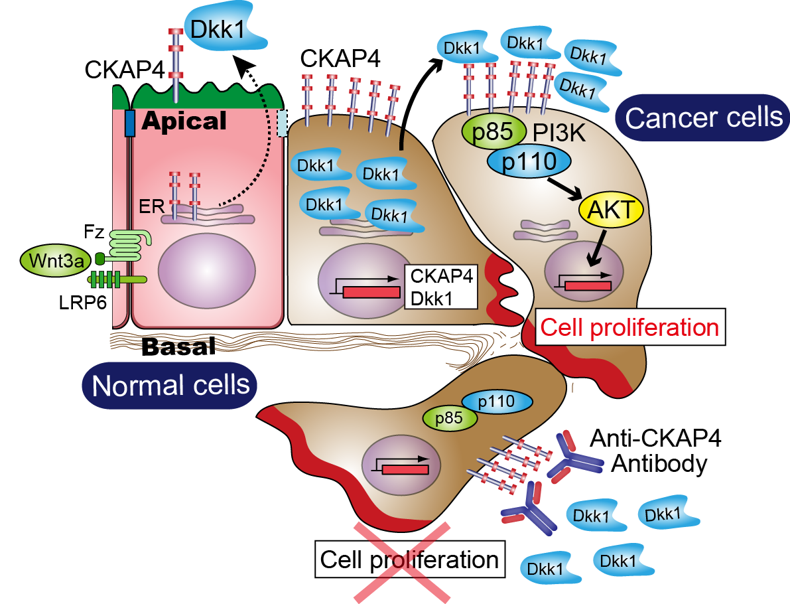
Dickkopf1 (DKK1) is a secretory protein that antagonizes oncogenic Wnt signaling by binding to the Wnt coreceptor low density lipoprotein receptor–related protein 6 (LRP6). It has been shown to suppress tumorigenesis in some cancer cells; however, it is also up-regulated in many types of cancer and associated with poor prognosis. Wnt-independent mechanisms by which DKK1 promotes cancer cell proliferation are not well understood.
In this study, researchers identified that cytoskeleton-associated protein 4 (CKAP4) is a novel DKK1-binding protein by using mass spectrometry analyses and immune sedimentation, then found that it becomes a new therapeutic target. CKAP4 was detected in tumor lesions of 66–74% of pancreatic and lung cancer cases. The researchers also demonstrated that DKK1 interacts with CKAP4 to promote activation of AKT, and CKAP4 specifically regulates tumor cell proliferation by DKK1. They also showed that suppressing of CKAP4 gene expression or antibodies inhibit proliferation of tumor cells.
Current Stage and Key Data
Current Stages:
- The project has reached the stage where humanized antibodies have been developed based on mouse antibodies, and their efficacy has been confirmed in vivo in combination with existing drugs.
Key Data:
- Researchers specified DKK1 binding region on CKAP4, designed and obtained some anti-CKAP4 mAbs against on the C-terminal region epitopes of CKAP4 which are highly homologous between mice and human.
- The role of CKAP4 expression in tumorigenesis in vivo was investigated by s.c. implantation of pancreatic or lung cancer cells into the flanks of immunodeficient mice. Anti-CKAP4 antibodies inhibited proliferation of these cancer cells, and the volumes and weights of the xenograft tumors decreased.
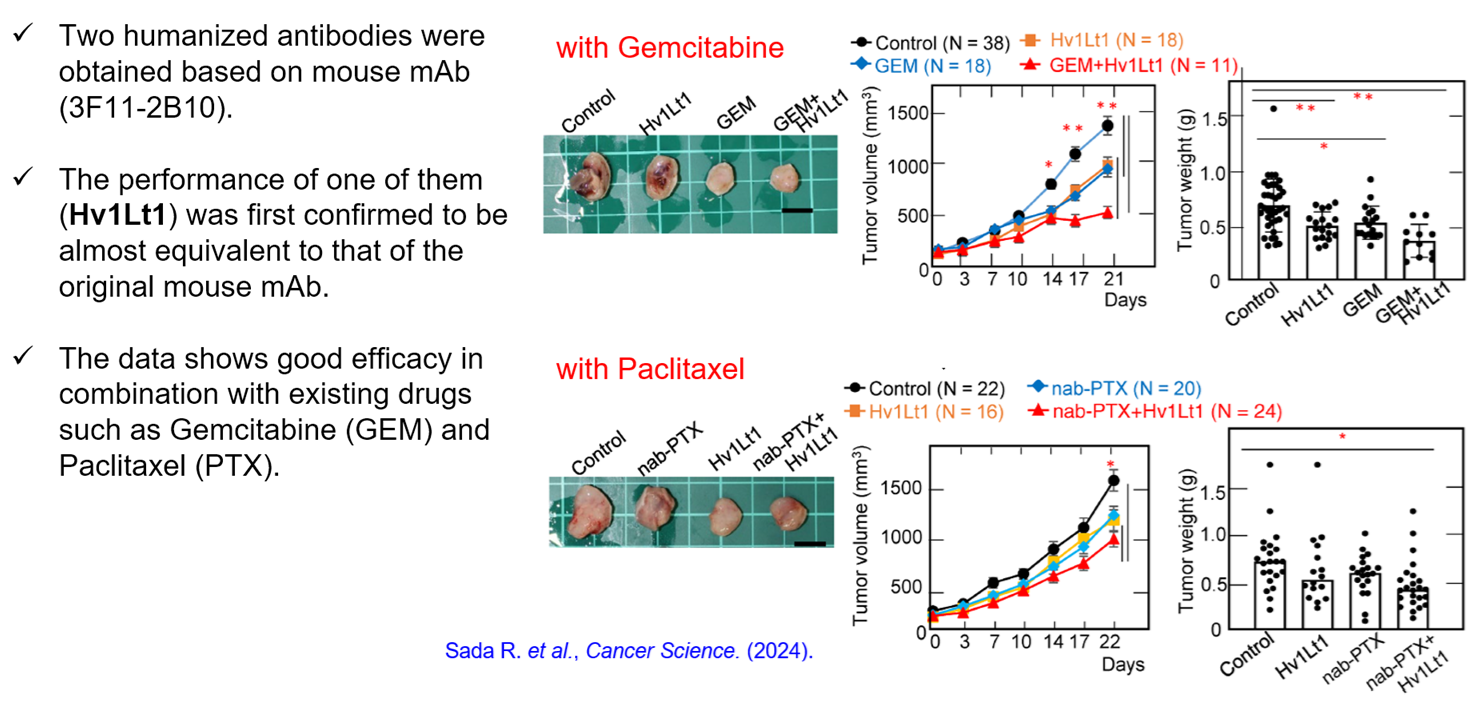
- Two humanized antibodies were obtained based on mouse mAb (3F11-2B10), and the humanized mAb (Hv1Lt1) possessed superior binding affinity and demonstrated to be almost equivalent to the original mouse mAb in suppressing pancreatic cancer and modulating immune responses.
- Combining Hv1Lt1 with existing chemotherapies such as gemcitabine and paclitaxel revealed that the combination exerts good efficacy.
Partnering Models
TECH MANAGE is looking for a pharmaceutical company entering collaboration with the researchers to develop and commercialize this technology further by the related patents licensing. We also appreciate any consideration of collaborative/supportive research or exclusive evaluation (set up for it with licensing options).
Principal Investigator
Akira KIKUCHI, MD, PhD
Specially Appointed Professor, CiDER, The University of Osaka (Japan)
Patents and Publications
Patents:
(1) PCT/JP2016/052485 [anti-CKAP4 antibodies]
- JP: 6,316,498 (Issued)
- US: 10,618,954 (Issued)
- EP: 3287143 (Issued in DE, FR, GB)
(2) PCT/JP2024/020940 [anti-CKAP4 humanized mAbs]
- JP: (Pending)
- US: (Pending)
- EP: (Pending)
Publications:
- Kimura H, et al., J. Clin. Invest. (2016) 126, 2689–2705.
- Shinno N, et al., Oncogene (2018) 37, 3471–3484.
- Kajiwara C, et al., Cancer Res. (2018) 78, 6107–6120.
- Kimura H, et al., Clin. Cancer Res. (2019) 25, 1936–1947.
- Nagoya A, et al., Transl. Lung Cancer Res. (2023)12, 408–426.
- Sada R, et al., Cancer Sci. (2024) 115, 3358–3369.