
Advantages
- Novel mechanism of action: A unique concept of "supplementing a protective factor," distinct from conventional "inhibitors."
- Avoidance of severe infection risks: Because it does not suppress cytokine production, it is less likely to compromise the host's pathogen-elimination capabilities through immunosuppression, a common drawback of traditional inhibitors.
Background and Technology
Sepsis is one of the leading causes of death worldwide. In 2017, an estimated 48.9 million incident cases of sepsis were recorded globally, with 11 million sepsis-related deaths. In Japan, the in-hospital mortality rate for septic shock remains over 30%, presenting a major clinical challenge. Currently, sepsis treatment mainly consists of supportive care, such as antimicrobial administration and mechanical ventilation, with no established drugs that directly target the host's immune response. Although numerous attempts have been made to develop drugs that suppress excessive immune responses, none have reached approval, leaving a massive unmet medical need.
When immune cells undergo pyroptosis, Damage-Associated Molecular Patterns (DAMPs) are released extracellularly. The subsequent excessive infiltration of neutrophils into organs is recognized as a crucial process in organ damage. Consequently, research on pro-inflammatory DAMPs has been actively pursued.
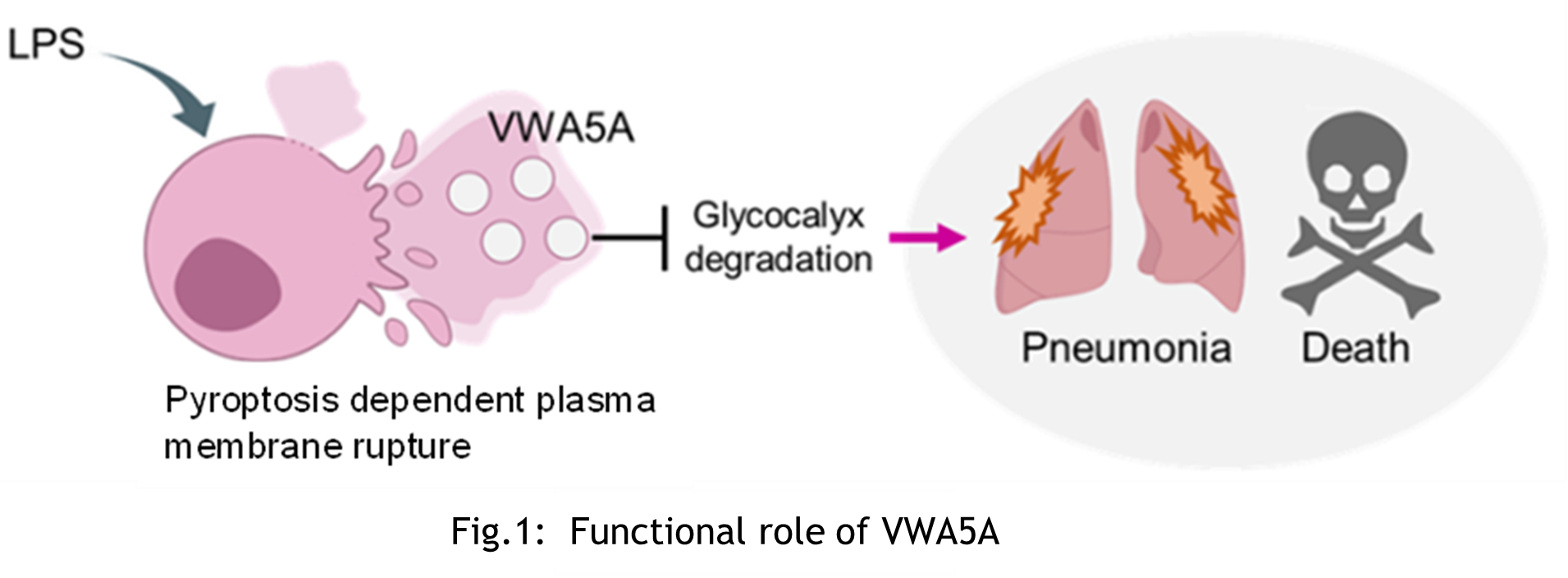
The active ingredient of this technology, VWA5A, is a newly identified DAMP released during pyroptosis. However, it is uniquely characterized by its function to suppress rather than induce inflammation. VWA5A protects the glycocalyx layer on the surface of vascular endothelial cells, thereby inhibiting neutrophil infiltration into infected organs without affecting cytokine production. This offers a novel therapeutic concept that can overcome the vulnerability of conventional anti-inflammatory drugs, which typically impair the body's ability to eliminate pathogens.
Key Data
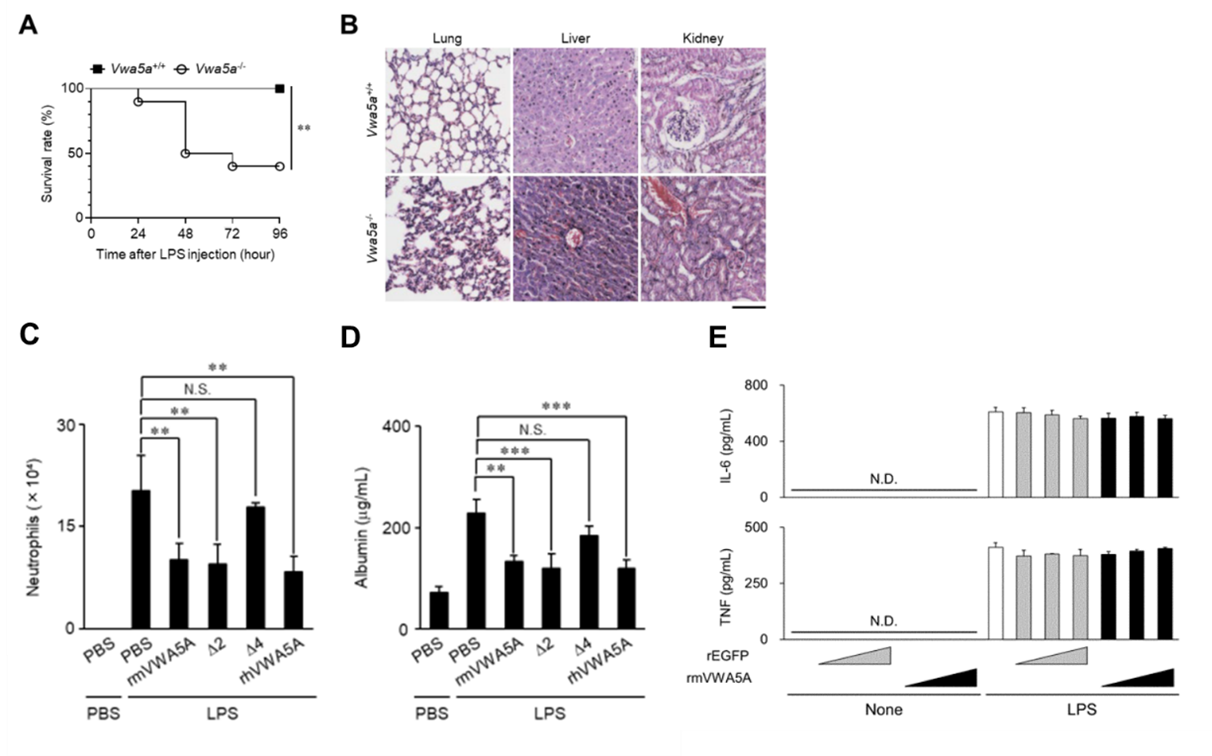
・ VWA5A-deficient mice exhibit a significantly reduced survival rate during endotoxin shock induced by intraperitoneal administration of LPS, and suffer from excessive neutrophil infiltration and severe tissue damage in major organs, including the lungs (Fig. 2A, B).
・ In an LPS-induced pneumonia model using wild-type mice, intravenous administration of both mouse and human recombinant VWA5A significantly suppressed neutrophil infiltration into the lungs and albumin leakage (hyperpermeability) (Fig. 2C, D). Note: rm and rh denote mouse and human recombinants, respectively. Δ2 is a VWF_A domain deletion mutant, and Δ4 is a C-terminal region deletion mutant.
・ In vitro analysis confirmed that VWA5A does not suppress the production of inflammatory cytokines (such as TNF and IL-6) by macrophages, but instead inhibits the adhesion of neutrophils to vascular endothelial cells (Fig. 2E).
Expectations
Osaka University is seeking pharmaceutical/biotech companies to partner with us in advancing the development of VWA5A therapeutics. We also welcome collaborative research focused on molecular downsizing and optimization (e.g., identification of the minimum active sequence, formulation optimization) based on insights into the active region.
VWA5A-deficient mice and VWA5A antibodies can be provided as screening and R&D tools for sepsis drug discovery.
Principal Investigator
Prof. Tatsuya Saitoh (Department of Host Defense, Graduate School of Pharmaceutical Sciences, Osaka University)
Patents and Publications
Patent pending (Unpublished)