
Advantages
- Proof-of-concept efficacy has been demonstrated in clinically relevant models, in which murine stromal components and desmoplastic reaction are formed in vivo, rather than using FAP-overexpressing engineered cell lines.
Current Stage and Key Data
- Current Stage:Antitumor efficacy (PoC) has been obtained in mouse xenograft models.
- Future Plan:Expansion to radionuclides other than astatine-211 is under investigation, and optimization of FAPα familiar compounds is ongoing.
- Key Data
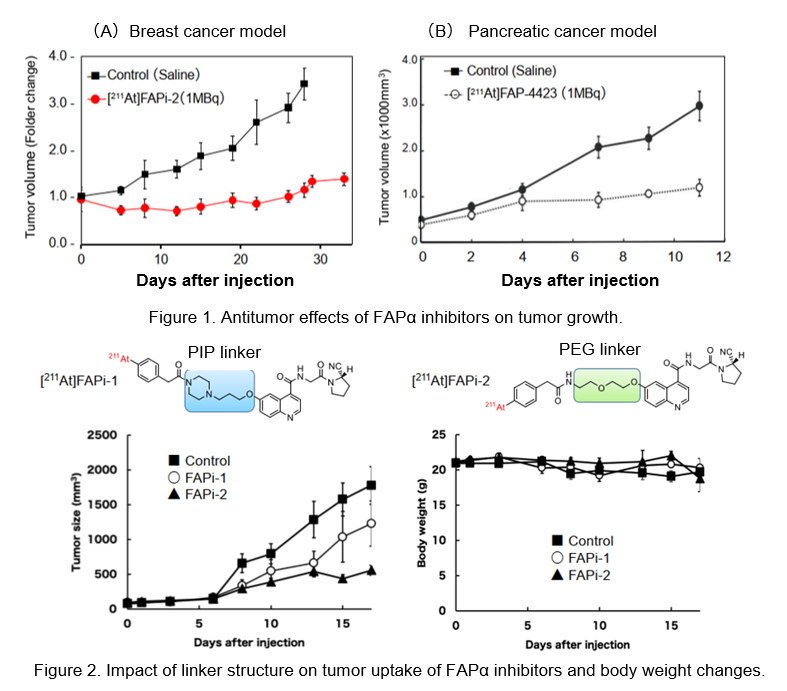
・ In breast cancer and pancreatic cancer xenograft models, administration of astatine labeled FAPα inhibitors ([211At]FAPi-2 and [211At]FAP-4423) resulted in significant suppression of tumor growth (Figure 1).
・ In pancreatic cancer xenograft models, administration of FAPα inhibitors with different linker structures [211At]FAPi-1 and [211At]FAPi-2) showed that the PEG linked [211At]FAPi-2 achieved greater tumor growth inhibition, with no apparent impact on body weight (Figure 2).
Partnaring Model
Osaka University is seeking pharmaceutical and biotech partners in the radiopharmaceutical and oncology fields who are interested in this technology. If you are interested, we would be pleased to arrange a technical discussion meeting with the principal investigator.
Background and Technology
Refractory solid tumors such as pancreatic cancer and triple-negative breast cancer often exhibit a dense desmoplastic stroma that functions as a physical barrier to therapeutic penetration, leading to treatment resistance and poor prognosis.
Fibroblast activation protein α (FAPα) is highly expressed on cancer-associated fibroblasts within the tumor stroma but is virtually absent in most normal adult tissues, making it an attractive pan-tumor target for imaging and therapy.
This technology utilizes medium-sized molecule FAP inhibitors (FAPI) with high affinity for FAPα, conjugated to therapeutic or diagnostic radionuclides. Proof-of-concept has been obtained in mouse models that recapitulate naturally formed stromal components, enhancing the translational relevance to human disease. This technology enables both diagnostic imaging and targeted radionuclide therapy using the same ligand scaffold, supporting a FAP-targeted theranostic approach.
Principal Investigator
Invited Associate Professor. Yoshifumi SHIRAKAMI (Institute for Radiation Sciences, The University of Osaka)
Patents and Publications
PCT/JP2023/006110