
Advantages
- KG2032, a novel HLA allele-selective antibody identified by researchers
- A potential new treatment option for relapsed AML following allo-HCT
- A therapeutic design intended to minimize damage to donor-derived normal hematopoietic cells
- Potential expansion to AML patients without allo-HCT
Current Stage and Key Data
- Preclinical stage. An investigator-initiated clinical trial is planned with support from the Japan Agency for Medical Research and Development (AMED).
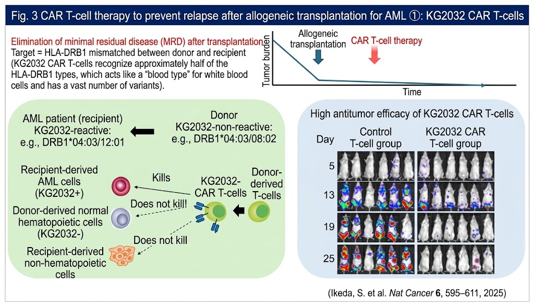
- KG2032-derived CAR-T and CAR-NK cells significantly suppressed leukemia progression and prolonged survival in AML model mice.
Partnaring Model
The University of Osaka is seeking licensing and collaborative research opportunities with pharmaceutical and biotechnology companies interested in developing therapeutics based on KG2032. In addition to CAR-T and CAR-NK therapies, potential applications in other modalities, including bispecific antibodies, are open for discussion.
Flexible partnering arrangements are available depending on your interests, including technical discussions with the principal investigator, technology evaluation, collaborative research, and licensing.
Background and Technology
Acute myeloid leukemia (AML) relapse after allo-HCT remains a major therapeutic challenge. Therapies targeting antigens shared by AML cells and normal hematopoietic cells face the challenge of damage to normal hematopoietic cells.
This technology uses KG2032, a novel antibody identified by researchers at The University of Osaka that selectively recognizes a subset of HLA-DRB1 alleles, to exploit HLA differences between patient-derived AML cells and donor-derived normal hematopoietic cells. It is intended for patient–donor combinations in which the patient's AML cells express KG2032-reactive HLA-DRB1, while the donor-derived normal hematopoietic cells are nonreactive.
By leveraging this selectivity, the technology aims to enable the development of CAR-T, CAR-NK, and other therapies that target AML cells while sparing donor-derived normal hematopoietic cells.
Principal Investigator
Professor. Naoki HOSEN (Department of Hematology and Oncology, The University of Osaka Graduate School of Medicine)
Patents and Publications
Information on related literature is included in the materials. Please click the “Iinterested in this technology? [Download Materials]” button below to download and view the materials.