
Advantages
Non-invasive approach: Unlike existing treatments requiring surgical procedures or device implantation, this system utilizes transcranial electrical stimulation (tES) applied over the scalp, reducing the physical burden on patients.
Individual optimization: By automatically adjusting the electrical stimulation based on the heel-contact timing, the intervention adapts to each patient's unique gait characteristics.
Current Stage and Key Data
Expected medical device class: Preparing for PMDA regulatory consultations and clinical trials for Class III medical device commercialization.
Current development phase: Conducting a double-blind comparative trial using a prototype, while optimizing stimulation parameters and reducing hardware weight.
Future roadmap: Targeting SaMD launch in 3 years and hardware launch in 5 years, actively seeking joint development partners.
Improvement of gait parameters: Ten sessions of gait rehabilitation with optimal phase-adjusted transcranial electrical stimulation in 24 patients significantly improved gait speed, stride length, and stance phase time.
Improvement of comprehensive motor function: Significant improvements were also observed in the UPDRS Part III score for overall disease severity and the M-PAS score for motor ability.
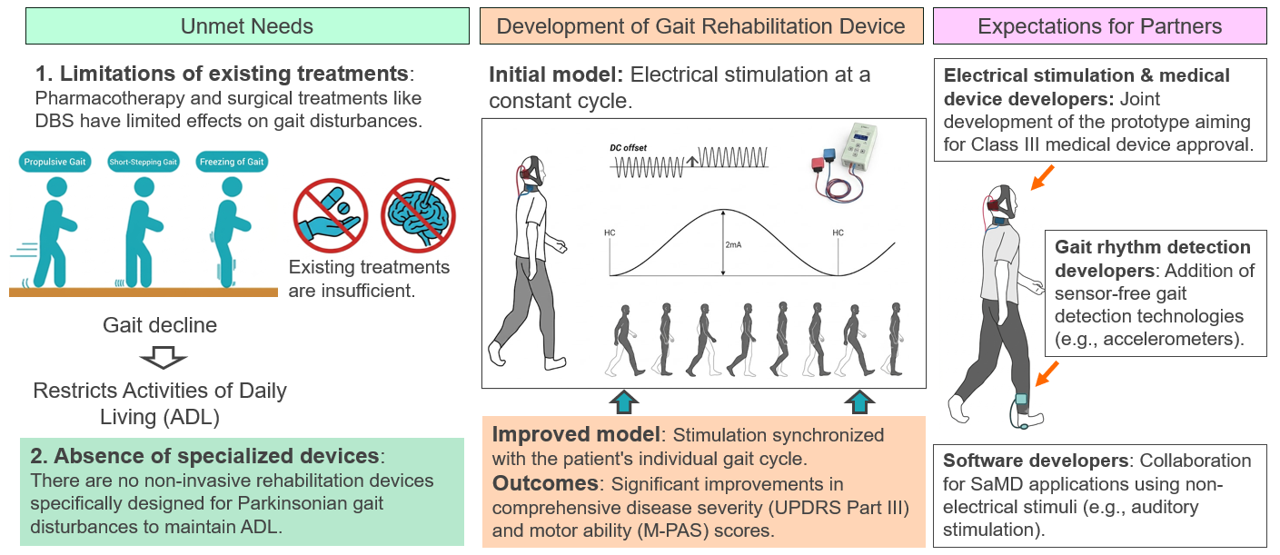
Partnaring Model
Class III Medical Device: Seeking joint development with companies possessing expertise in electrical stimulation and medical devices.
SaMD Expansion: Envisioning joint research with companies skilled in sensor-based gait detection and app development.
Available Resources: Hardware and app prototypes are completed, with unpublished data disclosure possible under an NDA.
Expected Specifications
Miniaturization & Wireless Design: Upgrading the PC-driven wired prototype to a lightweight, wireless head-worn device for easier clinical and home use.
Sensor-Free Gait Detection: Eliminating foot-attached sensors by integrating accelerometers or other technologies to automatically detect gait frequency.
Simplified Electrode Positioning: Developing an intuitive mechanism for patients or caregivers to accurately place electrodes over target areas (cerebellum and opposite shoulder) without expert help.
Background and Technology
Background and challenges: Existing therapies cannot prevent progressive motor decline in Parkinson's disease, necessitating specialized rehabilitation devices to maintain Activities of Daily Living (ADL).
Technology overview: We developed a gait rehabilitation device using non-invasive transcranial electrical stimulation (tES) synchronized with the patient's gait frequency.
Phase optimization: To improve comprehensive disease severity (UPDRS), the device automatically adjusts stimulation timing to the most frequent optimal phase based on heel contact.
Utility and prospects: Optimal phase-adjusted stimulation significantly improved gait speed, stride length, and UPDRS scores, indicating potential for broad application in neurodegenerative gait disturbances.
Principal Investigators
Dr. Yoshino Ueki, Dr. Mitsuya Horiba (Nagoya City University), Dr. Tatsuya Mima (Ritsumeikan University), Dr. Yumie Ono (Meiji University)
Patents and Publications
PCT/JP2026/014463
DOI:10.1136/jnnp-2022-329966