
Advantages
New mechanism promoting a breakdown of DNase I-resistant NETs
Low infection risk with no adaptive immune suppression; strong synergy with existing immunosuppressants
Repositioning of approved drugs (such as dalteparin) significantly shortens development costs and timelines
Current Stage and Key Data
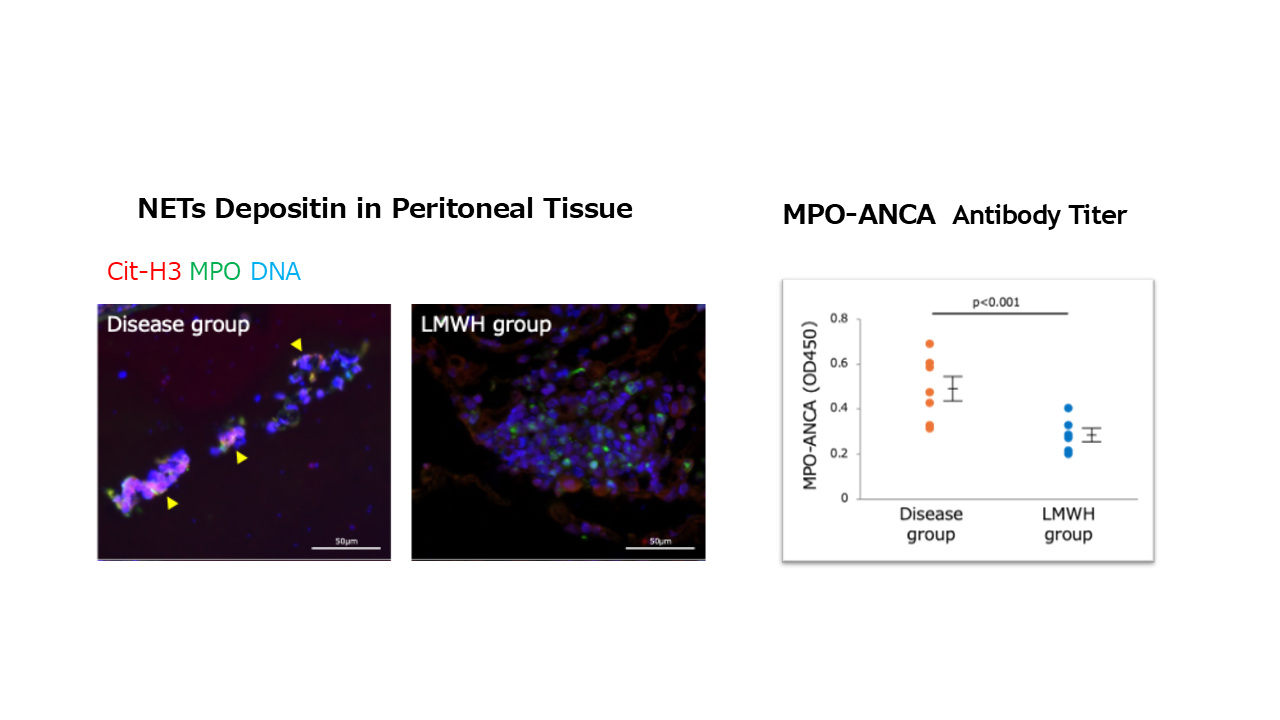
In the LMWH treatment group, NETs deposition in peritoneal tissue was lower than in the disease group, and MPO-ANCA antibody titers were significantly lower.
Partnaring Model
[Current Development Stage] Demonstrated lesion reduction effect and safety in in vitro (human neutrophils) and in vivo (AAV model mice), with non-clinical PoC (proof of concept) acquired.
[Future Development and Joint Research Projects]
1. Optimization of combination therapy: Evaluation of synergy effects and dose setting with existing standard treatments (such as glucocorticoids, rituximab, cyclophosphamide, etc.)
2. Promotion of Clinical Development and Trials: Protocol development and execution of rapid Phase I/II clinical trials utilizing clinical and safety data for approved drugs (such as dalteparin)
3. Formulation and administration route study: Establishing optimal dosing schedules and formulation designs tailored to the pathology and living environment of vasculitis
4. Exploring Indication Expansion: Expansion into other autoimmune and chronic inflammatory diseases involving excessive accumulation of degradation-resistant NETs
We would be happy to start with a discussion with companies interested in the above development collaborations.
Background and Technology
ANCA-associated vasculitis (AAV) is a systemic small-vessel vasculitis designated as a rare disease, and existing immunosuppressive therapies and complement receptor antagonists (such as Abacopan and others) pose serious challenges due to severe infections, organ damage, and high relapse rates. The pathogenesis of AAV is deeply involved in the excessive accumulation of neutrophil extracellular traps (NETs), and under pathological conditions, pathogenic NETs that acquire resistance to the degradation of DNase I in the body form, leading to ongoing vascular damage and chronic inflammation. However, none of the existing treatments directly affect the breakdown of these NETs.
In this study, we discovered a new mechanism by which low-molecular-weight heparin (LMWH), an acidic polysaccharide, interferes with the condensed DNA-histone complex to dissociate histones from DNA, enabling DNase I access to DNA and thereby strongly promoting the breakdown of DNase I-resistant NETs. Furthermore, supporting this, we confirmed in vitro the breakdown of degradation-resistant NETs by LMWH, and in vivo trials using AAV model mice, demonstrated a significant reduction in plasma MPO-ANCA antibody titers and marked reduction of glomerular lesions (crescent, necrosis, extracapillary proliferative lesions) with high therapeutic effects.
Principal Investigator
Akihiro Ishizu, Professor, Faculty of Health Sciences, Hokkaido University
Patents and Publications
Pending (domestic phase)